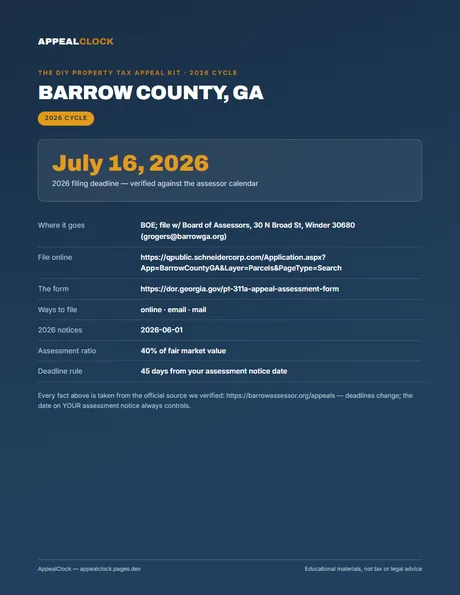
How the 45-day window works in Barrow County
The Barrow County Board of Assessors mails assessment notices once a year, and the 45-day appeal clock starts on the date stamped on your notice — not the day the envelope lands on your doorstep. Because notices can go out in batches over several days, the date printed on your specific notice is the one that legally controls. Before you rely on any countywide deadline figure, check the header of your own notice first.
Miss the window and Georgia law offers no administrative remedy for the current tax year. Your right to appeal resets only when next year's notice arrives — which means twelve months of overpaying with no recourse. That hard reset is exactly why the countdown on this page exists. The deadline shown above reflects the current cycle; your printed notice date is always the authority.
The 40% math that decides whether appealing is worth it
Georgia assesses residential property at 40% of fair market value under O.C.G.A. § 48-5-7. Your tax bill is that assessed figure multiplied by the local millage rate. To see whether an appeal pencils out, run the numbers before you file: subtract the value you can support from what the county claims, multiply the difference by 0.40, then multiply by your millage rate expressed as a decimal. A $30,000 reduction in appraised value removes $12,000 from your assessed base — and at a combined millage of 30 mills, that's roughly $360 off the annual bill, every year the lower value holds.
Compounding the benefit further: when a Barrow County appeal resolves in your favor, the Georgia 299(c) freeze typically holds your negotiated value in place for two additional years, turning one afternoon of paperwork into savings across three tax cycles. The statewide rules that govern every Georgia assessment — including how the ratio and freeze operate — are laid out in the Georgia property tax appeal guide if you want the full statutory picture before you file.
What actually wins at the Barrow County Board of Equalization
Barrow County residential appeals move to the Board of Equalization — a panel of trained citizen volunteers, separate from the assessors who set the original value. They respond to organized evidence, not to frustration. Three categories carry the most weight:
- Comparable sales. Identify three to five homes in your area — similar in size, age, and condition — that sold for less than your appraised value in the year leading up to your assessment date. Bring addresses, sale dates, prices, and square footage so the comparison is side-by-side, not impressionistic. This is the foundation of nearly every successful residential appeal.
- Record-card errors. Pull your property record through the county portal and verify the basics: square footage, bedroom and bathroom count, finished versus unfinished space, lot size, and outbuilding descriptions. A data-entry error inflating your recorded square footage is among the fastest wins available — it requires no market argument, only a correction of fact.
- Condition evidence. Dated photographs and contractor estimates for anything a mass-appraisal model cannot see — foundation issues, deferred maintenance, storm damage, or an outbuilding that is no longer functional. The county's model values your street; you can show what is wrong with your specific parcel.
Organizing everything on a single clear page before the hearing signals preparation and makes the board's decision easier. The letter template and comp worksheet in the resource kit on this page are built around exactly this structure.
Filing: portal, email, mail, and what happens after
Barrow County offers three ways to file. The online portal via the county's qPublic system timestamps your submission instantly and generates a confirmation you can save — it is the safest path when the deadline is close. Email works equally well if you include your completed PT-311A and any supporting documents: send to grogers@barrowga.org and keep the delivery confirmation. For mail or hand delivery, bring or send your PT-311A to the Board of Assessors at 30 N Broad St, Winder, GA 30680; if you mail it, a USPS postmark on or before the deadline satisfies the filing requirement — request one at the counter so you have proof.
After you file, the Board of Assessors reviews the appeal first and may respond with a revised value. Accept it and the case closes. Decline and your appeal moves to a Board of Equalization hearing — typically a brief session where you walk through your evidence. You may also elect free arbitration or a hearing officer at the time of filing, but for most residential owners the BOE path is the practical choice: it costs nothing, a partial win still triggers the 299(c) value freeze, and the process is designed for homeowners without legal representation. The PT-311A form is available directly from the Georgia Department of Revenue at the link in the filing table on this page.
Barrow County details worth knowing before you file
A few local wrinkles catch homeowners every cycle. First, the assessment notice is not a tax bill — it proposes the value the county intends to use, and the window to dispute it is tied to that notice, not to when the bill arrives. By the time the bill comes, the appeal period is already closed.
Second, confirming your homestead exemption status is a separate task from filing an appeal. Exemptions have their own spring deadline and cannot be applied retroactively through the appeal process — so while you have the notice in hand, verify your exemption is already recorded at the assessor's office.
Third, one common point of confusion: Barrow County and Bartow County are neighboring but entirely separate jurisdictions with different assessors, millage rates, and filing procedures. If your property is in Bartow, the Bartow County appeal page has the applicable rules. Similarly, property owners elsewhere in Georgia — including those looking at Bibb County — will find that procedures vary even when the underlying state law is the same. The county's official appeals information is maintained at barrowassessor.org/appeals and is the primary source for anything that may have changed since this page was last updated.