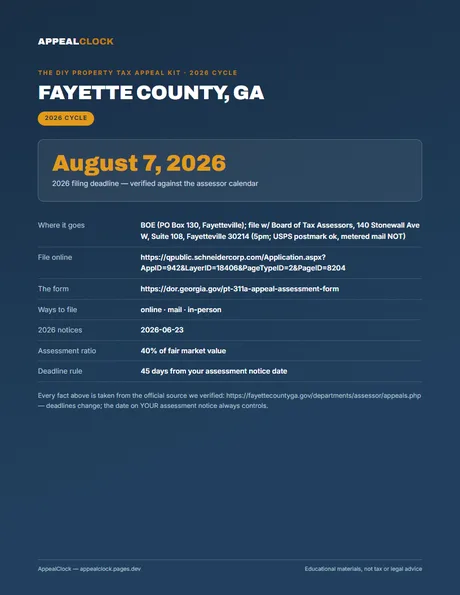
How the 45-day window works in Fayette County
The Fayette County Board of Tax Assessors mails annual assessment notices, and your 45-day appeal clock starts on the date printed on yours — not the day it arrives in your mailbox. Notices can go out in batches across the county, so the date on your neighbor's notice may differ from yours. The date that legally controls is the one in the header of your specific notice, not the countywide date shown in the band above. Check yours before assuming the two match.
Miss the window and the right to appeal this cycle is gone. Georgia resets the opportunity with next year's notice, and there is no administrative path back once the deadline has passed. That is the reason this page keeps a live countdown rather than printing a static date.
The 40% math that determines whether appealing makes sense
Georgia law (O.C.G.A. § 48-5-7) requires every county to assess property at 40% of fair market value. Your bill is that assessed figure multiplied by the combined local millage rate. Fayette is a higher-value suburban market, which means the dollars at stake on a successful appeal are correspondingly larger. A concrete example: if the county appraises your home at $420,000 and comparable sales support a value of $380,000, you have removed $40,000 from the appraised value — that is $16,000 off the taxable base. At any reasonable combined millage rate, that is a meaningful annual reduction.
What amplifies the number is Georgia's 299(c) freeze: a successful appeal typically holds the resolved value for the following two years. One organized afternoon of research can translate to three years of lower bills on a Fayette property. The Georgia property tax appeal guide explains the statewide framework — including how the freeze applies — in detail.
What actually wins at the Board of Equalization
Fayette County appeals route to the Board of Equalization — a panel of trained property owners, not assessor staff — and they respond to organized evidence, not frustration. Three categories carry the most weight in a residential hearing:
- Comparable sales. Three to five homes near yours, similar in size, age, and condition, that sold for less than your appraised value in the year prior to the assessment date. Comps are the spine of nearly every winning residential appeal.
- Record-card errors. Pull your property record through the county portal and check square footage, bedroom and bathroom count, finished basement area, and lot dimensions. Discrepancies are not unusual, and a documented error is the fastest path to a reduction.
- Condition evidence. Photos and repair estimates for problems the county's mass-appraisal model cannot see — foundation issues, water damage, deferred maintenance, an outbuilding in disrepair. The board acts only on what you bring.
Boards in Georgia reward homeowners who make the comparison easy to follow — one clear page of comps outperforms a folder of unordered screenshots. Neighboring counties like Barrow and Bartow route appeals the same way, so this evidence framework transfers if you own property in multiple counties.
Filing: portal, mail, in-person, and what happens next
Fayette County offers three filing paths. The online portal (linked in the filing table below) is fastest — it timestamps your submission immediately and generates a confirmation to save. If you prefer paper, download form PT-311A and either deliver it in person or mail it. In-person filing goes to the Board of Tax Assessors at 140 Stonewall Ave W, Suite 108, Fayetteville 30214; the office closes at 5:00 p.m. on the deadline date. If you mail the form, Fayette requires a genuine U.S. Postal Service postmark — metered postage is explicitly not accepted as proof of timely filing. That is a local rule that differs from what many property owners assume, and it is covered further in the section below. When it is close, file online or hand-deliver.
After you file, the Board of Tax Assessors reviews your appeal first and may offer a revised value. Accept it and the process ends. Decline and your case moves to the Board of Equalization for a hearing — typically a brief appointment where you walk through your comps and any condition evidence. Arbitration and a hearing officer are also available at filing time, but for most standard residential appeals the BOE path is free and well-matched to the typical homeowner's situation. If the BOE result still feels wrong, Superior Court is the next escalation, though for most owners a partial win plus the 299(c) freeze is the practical endpoint.
Fayette-specific details that catch people off guard
Metered mail is rejected. Fayette County requires a genuine USPS postmark — a stamp canceled at a post office window. A postage-meter imprint does not qualify as proof of timely filing. If you are within a few days of the deadline and want to mail your PT-311A, go to the post office counter and ask the clerk to hand-cancel it. Better still, file online and skip the postmark question entirely.
The notice is not a bill. Your assessment notice shows the value the county intends to use; the tax bill arrives later, when the appeal window is already closed. When the notice lands, treat it as the trigger — not something to set aside until billing season.
Homestead exemptions are separate. An appeal adjusts your property's appraised value — it does not apply or change your exemptions. Exemptions carry their own spring deadline and their own form. If you are unsure whether your homestead exemption is on file, the assessor's office at 140 Stonewall Ave W can confirm it; do not assume an appeal handles both.
Mass appraisal does not mean accurate. If your neighborhood was revalued countywide, the model used area averages that cannot account for your specific lot position, your street's traffic, or your home's individual condition. The BOE hears appeals on individual merits regardless of how a countywide reassessment was generated.