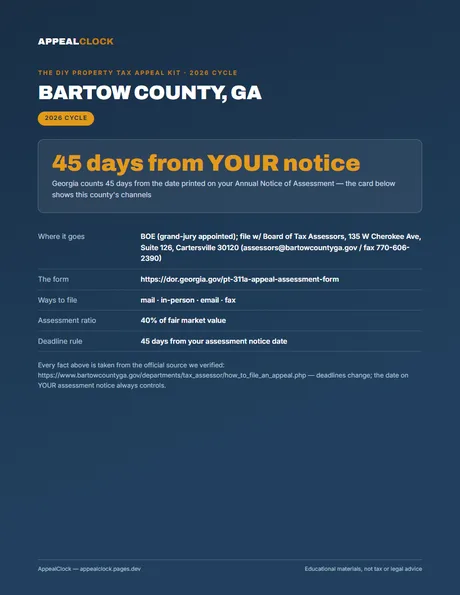
How the 45-day window actually works in Bartow County
The Board of Tax Assessors mails assessment notices once a year, and the 45-day clock starts on the date printed on yours — not the postmark, not the day it lands in your mailbox. Bartow sends notices in batches across the county, so the countywide window shown above is a practical guide, but your notice date is the one that controls legally. Check the top of the notice first; if your date differs from the countywide date, yours is what the clock runs from.
There is no grace period and no informal extension. Miss the 45-day window and your appeal right resets with next year's notice — the same assessment you wanted to challenge sits on your bill until the following cycle. That's the entire reason this page carries a live countdown.
The 40% math that decides whether an appeal is worth the effort
Georgia law (O.C.G.A. § 48-5-7) requires every county to assess property at 40% of fair market value. Your tax bill is that 40% figure — the assessed value — multiplied by your local millage rate. A concrete example: if Bartow's mass-appraisal model puts your home at $300,000 and comparable sales support $270,000 instead, you've removed $30,000 of appraised value, which is $12,000 off your taxable base. At your local millage rate, that difference compounds into real savings on every bill while the lower value holds.
A successful appeal also triggers the Georgia 299(c) freeze in most cases — the resolved value is protected for two additional years, meaning one afternoon of paperwork can ripple across multiple tax cycles. That's the math that makes organizing your comparable sales worth the time, even for modest reductions. For a broader look at how Georgia's framework operates statewide, the Georgia property tax appeal guide covers the statutory structure in full.
What actually wins at the Bartow County Board of Equalization
Bartow's BOE is appointed by the grand jury — a panel of trained citizens, not assessor staff — and they decide cases on evidence. Nationally, organized residential appeals succeed 40–60% of the time when the homeowner brings documentation. Three types of evidence carry the most weight:
- Comparable sales. Three to five homes near yours, similar in size, age, and condition, that sold for less than your assessed market value in the period before the assessment date. This is the backbone of nearly every winning residential case.
- Record-card errors. Pull your property record from the assessor's office and check square footage, bedroom and bathroom count, basement finish status, and lot size. Data-entry errors in county records are more common than most homeowners expect, and correcting one is often the fastest path to a reduction.
- Condition evidence. Photographs and repair estimates for anything the county's mass-appraisal model can't see — foundation problems, a deteriorating roof, structural damage, or drainage issues that depress market appeal. Condition-based grounds are legitimate and the BOE is equipped to weigh them.
Bring everything organized on one or two pages. BOE hearings typically run 15 to 20 minutes, and a board that can follow your argument without digging through a folder is more likely to move in your direction.
Filing in Bartow County: four ways to submit, no online portal
Bartow County does not offer an online appeal portal — your completed PT-311A must be submitted through one of four offline channels. All routes land at the same place: Board of Tax Assessors, 135 W Cherokee Ave, Suite 126, Cartersville, GA 30120.
- Mail. USPS postmark is your proof of timely filing. Send certified mail and keep the receipt — a missing appeal is rare, but a dated postmark ends any dispute instantly.
- In person. Drop off your PT-311A at the office above during business hours. Ask for a date-stamped copy; that receipt is your record.
- Email. Send to assessors@bartowcountyga.gov and keep the sent message in your archive. The timestamp in your sent folder is your proof.
- Fax. Send to 770-606-2390 and save the transmission confirmation page before you close it.
After you file, the Board of Assessors reviews first and may send a revised value. Accept it and the case closes. Reject it and your appeal moves to a BOE hearing — a short conversation where you walk through your evidence. You can also choose arbitration or a hearing officer at filing time, but for a standard residential appeal the BOE path is free and the right starting point. If the BOE outcome still feels off, escalation to Superior Court remains available, though a partial win paired with the 299(c) freeze is the practical stopping point for most homeowners.
Bartow County traps that catch filers every cycle
Four local patterns create problems worth knowing before you file. First, the assessment notice is not a tax bill — the mailing that shows the new appraised value is the one you can fight; by the time the actual bill arrives, the window has closed. Second, when an appeal is pending, Bartow issues an interim bill calculated at 85% of the contested value; budget for the reconciliation payment either direction the case resolves. Third, the homestead exemption is a separate application with its own spring deadline — an appeal doesn't apply it retroactively, and the savings compound when both are in place, so check your exemption status while you're organizing your appeal documents.
Finally, if your neighborhood was reassessed en masse after a revaluation cycle, don't assume the increase is beyond challenge. Mass-appraisal models smooth across entire subdivisions and miss individual condition problems, lot irregularities, and street-level market differences. The BOE exists precisely because those models aren't perfect. If you want to see how neighboring counties handle the same process under Georgia's framework, the Barrow County appeal guide and the Bibb County appeal guide walk through comparable procedures.