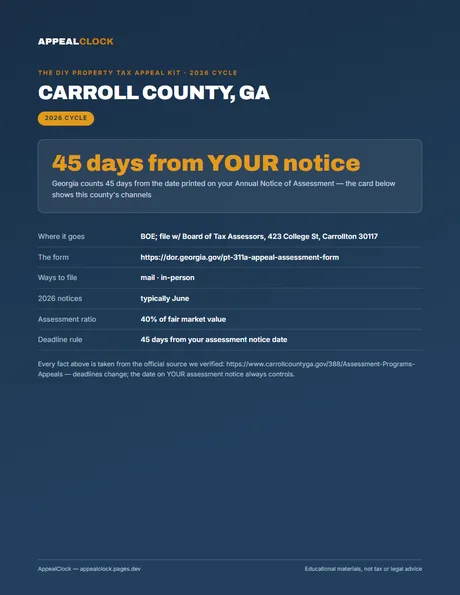
How the 45-day window works in Carroll County
Carroll County mails assessment notices once a year, and Georgia law starts the clock on the date printed on your notice — not the day it arrives in your mailbox, not the day you open it. The 45-day window is the same rule that applies across every Georgia county, from Barrow to Bartow, but the date that legally controls is the one on your notice specifically. Notices can go out in batches, so verify the date in the upper corner of your own mailing before relying on any countywide figure.
Miss the window and Georgia offers no administrative remedy until next year's notice arrives. There is no extension, no petition, and no late-filing exception for the current cycle. That is the only reason this page has a live countdown at the top.
The 40% math: is an appeal worth the afternoon?
Georgia assesses residential property at 40% of fair market value — the ratio fixed by O.C.G.A. § 48-5-7, the same statute that governs every county in the state. Your bill is that 40% assessed value multiplied by Carroll County's combined millage rate. A concrete example: if the county appraises your home at $280,000 and comparable sales support $250,000, you've documented $30,000 of excess appraised value. That removes $12,000 from your taxable base; at a combined millage in the 30-mill range, that's roughly $360 per year — and the savings repeat as long as the lower value holds.
A successful appeal also triggers the Georgia 299(c) freeze, which locks your assessed value for the two years following resolution. One afternoon of organized paperwork can therefore represent three years of savings — which is why homeowners who take a careful look at their property record almost never regret filing.
Evidence that wins at the Carroll County Board of Equalization
Carroll County BOE hearings are decided by a panel of trained community members — not the assessors whose value you're disputing — and they respond to evidence, not frustration. Three categories carry the room:
- Comparable sales. Three to five homes near yours, similar in size, age, and condition, that sold for less than your appraised value before the assessment date. This is the single strongest argument in a residential appeal.
- Record-card errors. Pull your property record from the Carroll County Tax Assessor and check square footage, bedroom and bathroom count, basement finish status, and lot size. Data-entry mistakes are not rare, and catching one is often the fastest reduction available.
- Condition evidence. Photographs and written repair estimates for anything the county's mass appraisal model can't observe — structural problems, deferred maintenance, storm damage, or an accessory structure that's no longer functional.
The appeal letter template and comp worksheet in the kit organize all three into a single page — boards reward homeowners who make the decision easy.
Filing in Carroll County: mail and in-person only
Carroll County does not offer an online filing portal — appeals go by mail or in person to the Board of Tax Assessors at 423 College St, Carrollton, GA 30117. Both routes are legally equivalent; pick whichever gives you cleaner proof of filing. If you mail your PT-311A, use certified mail or request a postmark at the counter — the USPS postmark date is your legal record, and that's what matters if there's ever a dispute about timeliness. If you deliver in person, ask for a date-stamped copy before you leave. The PT-311A form is available from the Georgia Department of Revenue (linked in the filing table above).
After you file, the Board of Assessors reviews your appeal first and may offer a revised value. Accept it and the case closes. Decline and your appeal moves to a BOE hearing — typically a brief session where you walk the panel through your comparable sales and condition evidence. Escalation paths from there include arbitration, a hearing officer, or Superior Court, but most residential appeals reach their final outcome at the BOE level.
Carroll County traps that catch homeowners every cycle
Four patterns trip up otherwise prepared filers. First, the assessment notice is not a tax bill — it shows the appraised value you're entitled to fight. The actual bill arrives later in the year, when the appeal window is long closed. Second, Georgia requires interim taxes to be paid at 85% of the contested value while an appeal is pending; budget for a reconciliation payment either way once the case resolves. Third, homestead exemptions are a completely separate filing with a spring deadline — appealing your assessment does not retroactively apply an exemption you haven't already claimed, and the savings from exemptions often rival those from a successful appeal. Review your options on the Georgia property tax appeal page while the assessment is still fresh. Fourth, if your neighborhood was reassessed as a group, don't assume the increase is untouchable — mass appraisal models miss street-level problems and deferred maintenance, which is exactly the evidence the BOE is equipped to weigh.