How the two-stage appeal window works in Bremen Township
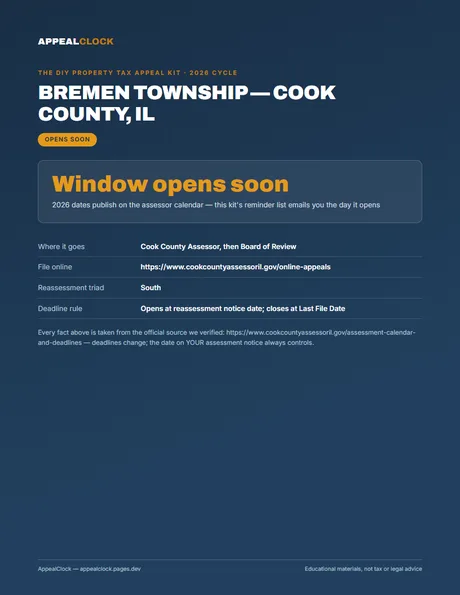
Cook County's process gives you two separate opportunities to challenge your assessment. The first opens when the Cook County Assessor mails reassessment notices for Bremen Township — that mailing date triggers the Assessor appeal window, which closes at the Last File Date shown in the band above. File during that window, and the Assessor's own staff reviews your evidence and may issue a revised value. If that outcome doesn't satisfy you, a second stage opens at the Board of Review, a three-member elected panel that operates on its own calendar and makes an independent determination. The BOR's 2025 group session dates for Bremen are in the filing panel above.
The two stages aren't redundant — they're additive. You can introduce evidence at the BOR that the Assessor didn't weigh, and the Board isn't bound by the Assessor's conclusion. Missing the Assessor window doesn't close the BOR door entirely, but starting at both levels gives you the best odds and the most time to build your case. That's why the countdown on this page tracks the Assessor window: it opens first and it closes first.
The 10% math that determines whether an appeal moves the needle
Illinois law sets Cook County residential assessments at 10% of estimated market value (35 ILCS 200/9-155). That 10% figure is your assessed value — but it isn't the number your tax rate is applied to directly. The Illinois Department of Revenue publishes an annual state equalizer (sometimes called the multiplier) that is applied to assessed value to produce your Equalized Assessed Value (EAV). Cook County's equalizer has historically run well above 2.0, meaning a reduction at the assessment level is amplified before it reaches your bill. Then the combined local rate — school district, municipality, park district, and others — is applied to the EAV. The chain means a reduction of $20,000 in estimated market value becomes $2,000 less in assessed value, then multiplied by the equalizer and the local tax rate. In the higher-rate districts across Bremen Township's service area, that arithmetic makes even a modest market-value correction worth real money every year the lower value holds. For a full picture of how Cook County's assessment math interacts with exemptions and equalizers, see the Cook County property tax appeal overview.
What actually wins at the Cook County Board of Review
The Board of Review is an evidence panel, not a grievance window. For a residential appeal in Bremen Township, three categories carry the most weight:
- Comparable sales. Three to five homes near yours — similar in size, age, and condition — that sold for less than your assessed market value in the Assessor's valuation window. This is the backbone of the vast majority of winning residential appeals, and the valuation date on your notice tells you which sales period to pull.
- Property record errors. Request your property record card through the Assessor's portal and verify square footage, bedroom and bathroom count, garage, basement finish, and lot size. Transcription errors are common in mass reassessment years, and a confirmed factual error is the fastest path to a reduction.
- Condition evidence. Photos and contractor estimates for anything a mass-appraisal model can't observe — foundation problems, flood damage, an unusable outbuilding, deferred maintenance that depresses the property's real market value below the county's estimate.
Organize your evidence on one summary page before your hearing. BOR sessions move quickly, and boards reward homeowners who make the decision straightforward. Palos Township homeowners filing against the same Board of Review use the same three-category approach — the evidence standards are countywide.
Filing with the Assessor — portal, paper, and what comes next
The Cook County Assessor's online portal is the fastest filing route: it timestamps your submission instantly and returns a confirmation you can save as proof. Paper appeals are also accepted at the Assessor's office; if you mail a paper filing, the USPS postmark is your evidence of timely submission, so request one at the counter. Either way, keep a copy of everything you submit — the Assessor's determination letter is the document you'll need when you carry the case to the Board of Review.
After the Assessor reviews your evidence, you'll receive a written determination. If the reduction offered is acceptable, the process ends. If the Assessor declines to reduce or offers less than you believe is warranted, your case is eligible for the Board of Review during their scheduled session (shown in the filing panel above). A BOR appearance is typically 10–15 minutes: you walk through your comparables, answer questions, and the panel issues a decision. Written submission without an in-person appearance is also available. If the BOR result is still unsatisfactory, the Property Tax Appeal Board (PTAB) and circuit court are further escalation options — but for most homeowners, the BOR outcome is the practical endpoint.
Bremen Township and the South triad — what to know before you file
Bremen is one of the larger townships in Cook's South triad, covering a wide swath of the south suburbs. Because the South triad reassesses on a triennial cycle, the values you're contesting reflect market conditions the Assessor observed during the reassessment year — not necessarily what comparable homes are selling for right now. That lag can work in your favor or against it: whichever direction prices have moved, your comparable sales need to come from the Assessor's look-back window, not the current market. The valuation date is printed on your notice; match your comps to that window or the Board of Review will discount them.
Two local patterns catch South triad filers every cycle. First, homestead exemptions — General Homestead, Senior Freeze, Longtime Occupant, and others — are entirely separate filings with their own spring deadlines. A successful appeal doesn't apply them retroactively, and many homeowners discover a missing exemption only while pulling their record card for an appeal. Check your exemption status at the same time. Second, if your block was swept up in a mass reassessment increase, the uniform percentage doesn't mean your individual property value is correct — block-level models miss street-level problems, and that's exactly the kind of case the Board of Review is designed to hear. For how other Cook County townships navigate the same two-stage process, the Cicero Township appeal guide covers the same Assessor-then-BOR structure.