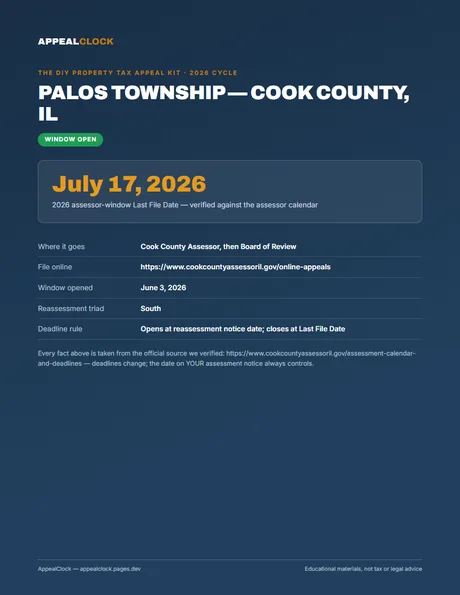
How Palos Township's reassessment window actually works
Palos Township sits in Cook County's South triad, which means the Assessor reassesses every parcel here on a triennial cycle — once every three years. When reassessment notices go out, the appeal window opens; it closes at the Last File Date shown above. The date on your notice controls your personal deadline, so check it directly rather than assuming a single countywide cutoff applies to everyone.
Miss the Assessor's window and your next formal opportunity is the Board of Review's Group 2a session, which opens after the Assessor's deadline closes and offers a second shot at the same assessment year. That BOR window is shorter and the process is slightly different, but it is real — and the countdown above tracks it. After both windows close, the right resets with the next triennial reassessment. That's the whole reason this page runs a live clock.
Cook County's assessment math and why appealing compounds
Cook County assesses Class 2 residential property at 10% of fair market value under its property classification ordinance. The Illinois Department of Revenue then applies a state equalization factor — the annual multiplier — to bring Cook's assessments in line with the statutory one-third standard. Your taxable base, the equalized assessed value (EAV), is the product of those two steps. Trim the appraised value and every number downstream shrinks proportionally.
Concrete example without invented figures: if the Assessor pegs your home $60,000 above what comparable sales support, that $60,000 becomes $6,000 of assessed value before the state multiplier is applied and local rates are calculated. The savings compound because a successful appeal anchors your value through the next full triennial reassessment cycle. One afternoon of paperwork, three years of benefit — that's the arithmetic that makes the effort worth it.
What actually wins at the Cook County Board of Review
The Board of Review is an independent three-commissioner body, not the Assessor's staff, and it responds to organized evidence rather than expressed frustration. Three categories carry the room in residential appeals:
- Comparable sales. Three to five arm's-length sales of similar nearby homes, closed before the assessment date, at prices below your appraised value. This is the spine of nearly every winning residential case.
- Record-card errors. Pull your property record from the Assessor's site and verify square footage, bedroom and bathroom count, garage type, and lot size. A data entry mistake is the fastest win available — the Assessor often corrects it without a hearing.
- Condition evidence. Photos and licensed contractor estimates for anything the mass-appraisal model cannot see from the street — foundation problems, flood damage, an addition that was never completed.
Neighboring townships like Cicero and Stickney go through the same BOR process on the same countywide calendar — the evidence standards are identical across Cook County. The Cook County appeal overview lays out the full procedural roadmap if you want the broader picture before building your evidence file.
Filing your appeal: portal, paper, and what happens after
The fastest path is the Cook County Assessor's online portal (linked in the filing panel above) — it records a timestamp instantly and issues a confirmation you can save as proof of timely filing. Paper filers can submit at the Assessor's office; if you mail it, the USPS postmark is your legal proof, so request one at the counter rather than dropping it in a collection box.
After you file, the Assessor reviews the evidence and may issue a revised value. Accept it and the appeal closes. Reject it — or if the Assessor makes no change — your case moves to the Board of Review for a hearing during the Group 2a session. A BOR hearing is typically short, often under twenty minutes, and consists of walking commissioners through your comparable sales. If the BOR result is still unsatisfactory, Illinois allows further escalation to the Property Tax Appeal Board (PTAB) or Circuit Court, though for most Palos Township homeowners a partial win at the BOR is the sensible stopping point.
Palos Township traps that catch homeowners every reassessment cycle
Four Cook County wrinkles are worth knowing before you file. First, the South triad's triennial cycle means this year's assessment anchors your value for years — a missed appeal now costs more than one in a lighter market. Second, your assessment notice is not a tax bill; the actual bill arrives later, at which point both appeal windows have closed. The notice is the document you act on immediately.
Third, homestead exemptions — General Homestead, Senior, and others — are administered on a separate track with their own filing deadlines. An appeal does not apply exemptions retroactively, so confirm yours are active while you have the Assessor's portal open. Fourth, if your neighborhood was reassessed en masse, do not assume the number is untouchable. Mass-appraisal models price speed over street-level nuance; a cracked retaining wall, a drainage problem, or a layout that hurts resale value simply does not appear in the model — and that gap is exactly what a well-documented BOR appeal is designed to close.