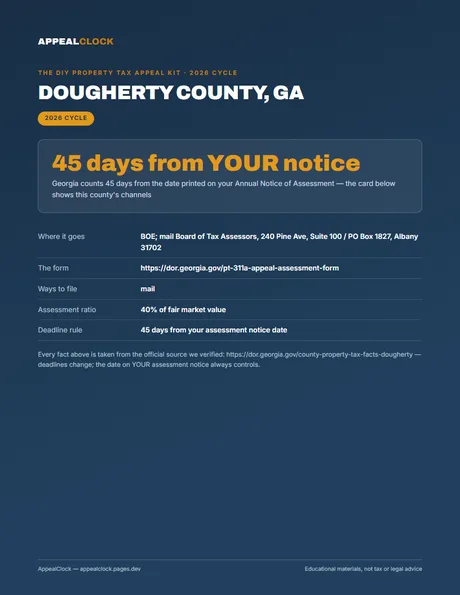
How the 45-day window works in Dougherty County
Dougherty County mails assessment notices once a year, and the appeal clock starts on the date printed on yours — not the day it arrives in your mailbox, and not any countywide date you may see elsewhere. The deadline shown on this page is reported from county records and listed as a reference; the date on your notice is the one that legally controls. If the two differ, yours wins — verify it on the top of your notice before you do anything else.
Miss the window and Georgia's appeal right is gone until next year's notice. There is no hardship extension, no late-filing path, and no administrative workaround once the 45 days expire. That is why the countdown at the top of this page exists — the fee to file is zero, but the fee to miss is an unchallenged bill for another full year.
The 40% math that decides whether appealing is worth your time
Georgia law (O.C.G.A. § 48-5-7) sets the assessment ratio at 40% of fair market value. Your tax bill is that 40% figure multiplied by the local millage rate — not the full appraised number. In practical terms: if the Dougherty County Board of Tax Assessors values your home at $180,000 and you can document comparable sales supporting $155,000, you have removed $25,000 of appraised value, which is $10,000 off the assessed base. Albany carries one of the higher combined millage stacks in southwest Georgia, so that reduction translates to a meaningful annual difference on the bill.
The math compounds further if you win. A resolved appeal typically triggers the Georgia 299(c) freeze, protecting your assessed value for the following two years. One afternoon of evidence-gathering can lock in savings across three billing cycles — which is why even a modest reduction is worth the effort on a mid-range residential parcel.
What actually wins at the Board of Equalization
Dougherty County appeals route to the Board of Equalization — a panel of trained citizens, not the assessors' staff — and they respond to organized evidence, not expressions of frustration. Three categories of evidence carry the room:
- Comparable sales. Three to five properties near yours — similar size, age, and condition — that sold for less than your assessed value in the period before the assessment date. This is the backbone of nearly every successful residential appeal.
- Record-card errors. Pull your property record and check square footage, bedroom and bathroom count, basement finish status, and lot size against what you know to be true. Mass-appraisal databases carry factual errors with surprising frequency, and a documented correction is the cleanest win available — no negotiation required.
- Condition evidence. Photographs and contractor estimates for anything the county's model couldn't observe: a damaged roof, foundation problems, deferred maintenance, or an outbuilding no longer serviceable. Physical condition the assessor never inspected is legitimate and persuasive at the board level.
Bring your evidence organized on a single page. Boards reward homeowners who make the decision easy; a folder of unorganized screenshots works against you. For a broader look at how Georgia's appeal process works at the state level, the Georgia property tax appeal guide walks through the statutory framework in detail.
Filing by mail: what to send and what happens after
Dougherty County does not offer an online portal for assessment appeals — paper mail is the only filing path. Download form PT-311A from the Georgia Department of Revenue website and mail your completed appeal to the Board of Tax Assessors at 240 Pine Ave, Suite 100, Albany, GA 31702 (mailing address: PO Box 1827, Albany, GA 31702). Do not drop it in a collection box. Take it to a postal counter and get a dated USPS postmark — that postmark is your legal proof of timely filing, and you will want it if there is ever a dispute about when your appeal arrived.
After you file, the Board of Assessors reviews your appeal first and may respond with a revised value. If you accept, the matter closes there. If not, your case advances to the Board of Equalization for a hearing — typically a short, structured conversation where you walk through your comparable sales and any record-card corrections. You may also elect arbitration or a hearing officer at the time of filing, but for a standard residential appeal the BOE hearing is free and effective for most homeowners. If the BOE outcome still feels wrong, Superior Court is the next step, though the 299(c) freeze that typically accompanies a resolved appeal makes escalation unnecessary in most cases.
Dougherty County traps that catch homeowners every cycle
Four local wrinkles cost Dougherty County homeowners their appeal rights or their savings every year.
The notice is not the bill. The notice you receive shows the assessed value you have the right to challenge. The tax bill arrives later — after the appeal window has already closed. Act when the notice arrives, not when the bill does.
Interim billing during a pending appeal. Filing an appeal does not suspend your payment obligation. While the appeal is open, your bill is calculated at 85% of the disputed value; when the appeal resolves, a reconciliation payment or credit is issued. Budget for that adjustment either way.
Homestead exemptions are separate. An appeal reduces your assessed value but does not apply any exemption you haven't already claimed. Exemptions have their own spring deadline and must be filed independently. If you haven't reviewed what you qualify for, the Georgia property tax appeal guide covers the full exemption landscape while you're already doing this work.
Mass reassessment is still appealable. If your neighborhood received across-the-board value increases, don't assume the number is settled. Mass-appraisal models don't account for street-level condition problems, and the Board of Equalization exists specifically to hear those individual cases. Neighboring counties follow the same 45-day Georgia framework — if you own property elsewhere in the region, Barrow County and Bartow County use the same evidence-gathering process.