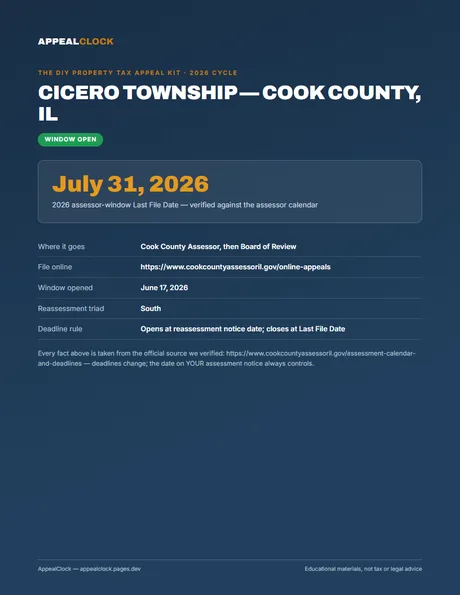
How the Cicero Township appeal window actually works
Cook County uses a triennial reassessment system, rotating through three geographic triads — and 2025 is a South Triad reassessment year, meaning Cicero Township parcels have been revalued. The window to appeal opens when the Assessor mails reassessment notices and closes at the Last File Date shown above; that date is absolute, and there is no grace period. Miss it and your next standard opportunity is three years out, at the following South Triad reassessment cycle.
Cook County also gives homeowners two sequential chances to challenge a value. The first is the Assessor-level review, which is where you are now. If the Assessor's revised figure still overstates your property, you can escalate to the Board of Review during its own window — shown in the filing panel — for an independent second hearing. Preserving that second-level right generally requires filing at the Assessor level first, which is the practical reason to act before the deadline shown above rather than waiting to see the bill.
The Cook County math that makes appealing worth it
Cook County classifies most residential property (Class 2) at 10% of fair market value — well below the Illinois statewide assessment level of 33.33%. To bridge that gap, the Illinois Department of Revenue publishes an annual state equalization factor, commonly called the multiplier, which is applied to Cook County assessed values before tax bills are calculated. In recent years that multiplier has been in the 2.9–3.1 range.
The practical effect: a $30,000 reduction in stated fair market value trims $3,000 from your raw assessed value — and the equalizer then multiplies that reduction before your mill rate is applied. A modest comp-supported correction that looks small on paper becomes meaningfully larger by the time it reaches your bill. That compounding is the core reason an hour of evidence prep produces a return worth taking seriously.
What wins at the Cook County Assessor and Board of Review
Both the Assessor-level review and a Board of Review hearing respond to the same categories of evidence. The BOR hearing is an adversarial proceeding where the Assessor's office may present its own data — organized preparation is not optional.
- Comparable sales. Three to five arm's-length sales of similar homes in or near Cicero Township, recorded within twelve months before the assessment date, with similar square footage, age, and condition. This is the backbone of most winning residential appeals.
- Property record card errors. Pull your record card from the Assessor's portal and verify square footage, bedroom and bathroom counts, lot size, and any credited extras like a finished basement or attached garage. A 200-square-foot discrepancy is not unusual, and it is one of the fastest wins available.
- Condition evidence. Photographs and contractor estimates for deferred maintenance, structural issues, or damage the county's mass appraisal model cannot see. Cicero's dense, older housing stock means condition gaps are common and persuasive.
Bring your evidence organized to a single page. The Cook County appeal guide includes a comp worksheet and filing checklist that reflects what both the Assessor and the Board of Review expect to see.
Filing: portal, paper, and what happens after
The Cook County Assessor's online appeals portal is the fastest filing path — it timestamps your submission immediately and accepts supporting documents in the same upload. Paper filings are accepted at Assessor offices as well. Both routes cost nothing to file.
After you file, the Assessor reviews your evidence and may issue a revised value. If you accept it, the appeal is resolved and the new value carries for the remainder of the triennial cycle. If the Assessor's result still overstates the property, you can bring the same evidence — plus the Assessor's decision — to the Board of Review during its own window. The BOR is an independent three-member body, separate from the Assessor's office; hearings are typically short and focused on comparable-sale evidence. Neighboring South Triad townships like Stickney and Palos follow the same two-step path, so if you own property across township lines, the process is consistent.
Cicero-specific traps worth knowing
Three local patterns catch property owners every reassessment cycle. First, the Assessor's reassessment notice is not a tax bill — it shows the value the county intends to carry for the next three years, and the appeal window attached to that notice is your only standard chance to contest it. The actual bill arrives after the window closes, so acting on the notice is the only viable path.
Second, Illinois homestead exemptions — including the General Homestead Exemption, the Senior Citizens Assessment Freeze, and the Longtime Homeowner Exemption — are separate applications with their own annual deadlines. Winning an appeal does not apply or restore exemptions retroactively, and missing them is a common and costly oversight. Verify which exemptions are currently on file for your PIN at the Assessor's portal while you are gathering appeal evidence.
Third, if your block was reassessed en masse as part of a neighborhood adjustment, don't assume the uniform increase is untouchable. Mass appraisal models apply area-wide factors that miss property-level condition differences — and that gap is precisely what comparable-sale evidence is designed to close before the Board of Review.