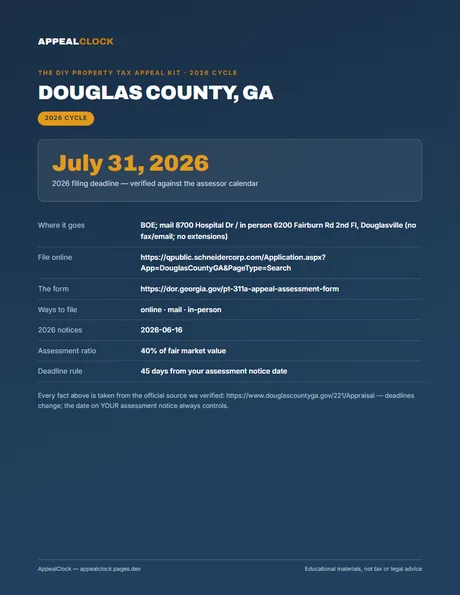
How the 45-day window actually works in Douglas County
Douglas County mails assessment notices once a year, and the appeal clock starts the day the notice is dated — not the day it lands in your mailbox. The county distributes notices in batches, so the date printed on your individual notice is what legally controls. Check the top of your notice first; if your date differs from the countywide date shown above, yours governs.
There are no extensions, and Douglas County explicitly does not grant them — that's not a policy rumor, it's printed in the county's appraisal guidance. Miss the window and your right to challenge this year's value is gone until the next assessment cycle. That's the only reason a countdown exists on this page — the difference between a day-one filing and a day-46 discovery is real money, locked in for a year.
The 40% math that decides whether appealing is worth it
Georgia assesses property at 40% of fair market value (O.C.G.A. § 48-5-7). Your tax bill is that 40% figure — the assessed value — multiplied by Douglas County's combined millage rate. Concrete example: if the county places your home at $310,000 and comparable sales in your neighborhood support $275,000, you've removed $35,000 of appraised value, which is $14,000 off the assessed base. Run that through Douglas County's millage and the annual savings can be substantial — and they repeat every year the lower value holds.
A successful appeal also triggers Georgia's 299(c) freeze in most cases, locking the resolved value for the following two years. That means one afternoon of organized paperwork can pay back several times the effort across a three-year window — which is why the math on even a modest reduction usually favors filing.
What actually wins at the Board of Equalization
Douglas County appeals route to the Board of Equalization — a panel of trained local citizens, not the assessor's staff — and they respond to organized evidence, not frustration. Three things carry the room:
- Comparable sales. Three to five homes near yours, similar in size and age, that sold for less than your appraised value in the period before the assessment date. This is the backbone of nearly every winning residential appeal.
- Record-card errors. Pull your property record from the county's appraisal portal and verify square footage, bedroom and bathroom count, basement finish status, and lot size. Measurement errors are more common than most homeowners expect, and correcting one is the fastest win available.
- Condition evidence. Photos and contractor estimates for anything the county's mass-appraisal model couldn't observe — a deteriorating roof, foundation issues, storm damage, or a structure that no longer functions as described.
Bring your evidence condensed onto one organized page. The BOE rewards homeowners who make their case easy to evaluate. For a broader look at how Georgia's appeal system works statewide, see the Georgia property tax appeal guide.
Filing: portal, mail, in-person, and what happens after
Douglas County offers three filing paths. The fastest is the online qPublic portal, which timestamps your submission instantly and generates a confirmation you can save. If you prefer paper, mail your completed PT-311A form to 8700 Hospital Drive, Douglasville — a USPS postmark on or before the deadline is your legal proof, so take it to the counter rather than using a metered machine. You can also file in person on the second floor of 6200 Fairburn Road, Douglasville. The county does not accept appeals by fax or email, so those three paths are the only options.
After you file, the Board of Assessors reviews your case first and may offer a revised value. If you accept, it's done. If not, your appeal moves to a BOE hearing — typically a 15-minute session where you walk through your comparables. You can also elect arbitration or a hearing officer at the time of filing, but for standard residential appeals the BOE path is free and works well. If the BOE result still feels wrong, Superior Court is the next escalation, though for most homeowners the certainty of a partial win plus the 299(c) freeze is the better stopping point.
Douglas County traps worth knowing
A few local wrinkles catch homeowners every cycle. First, the assessment notice is not a tax bill — it shows the value you can challenge. The actual bill arrives later, after the appeal window has already closed, which is why acting on the notice matters. Second, filing an appeal means your interim bill is calculated at 85% of the disputed value while the case is pending; budget for a reconciliation payment in either direction once it resolves. Third, homestead exemptions are a separate process with their own spring deadline — an appeal doesn't apply them retroactively, so check your exemption status while you're already in paperwork mode.
If your neighborhood was reassessed in a mass revaluation, don't assume the increase is untouchable. County mass-appraisal models are built for speed across thousands of parcels and routinely miss street-level conditions: deferred maintenance, functional obsolescence, or a location problem invisible from satellite data. That's precisely the work the BOE exists to hear. Neighboring counties run similar processes — see how Bartow County and Barrow County handle their BOE appeals for comparison.