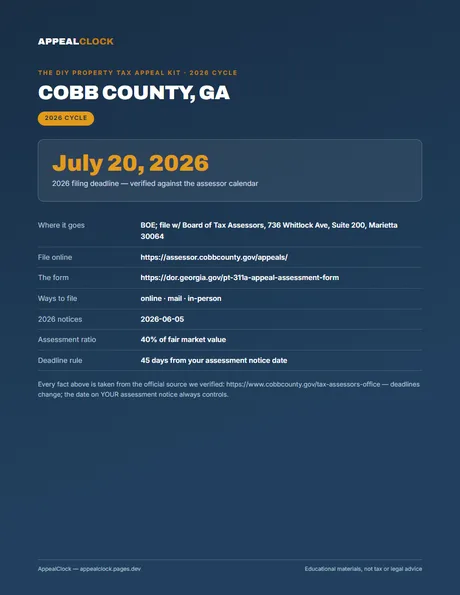
How the 45-day clock works in Cobb County
Cobb's Board of Tax Assessors mails assessment notices in batches throughout the season, which means the date printed on your notice is the date that legally controls your deadline — not the postmark, not the day it arrives, and not any countywide date published online. If the date on your notice differs from what you see above, yours governs. The deadline shown in the band above is the verified countywide date, but confirm the corner of your own notice before you plan your filing.
Let the window close and there is no appeal right to carry forward — it resets entirely with next year's notice. Georgia's cycle is annual, which is why the countdown at the top of this page exists.
The 40% ratio and why it decides whether filing is worth your time
Georgia law (O.C.G.A. § 48-5-7) requires every county — Cobb included — to assess property at 40% of fair market value. Your taxable base is that 40% figure, not the full appraised number. Concrete example: if the county values your home at $400,000 and comparable sales support $360,000, you've removed $40,000 of appraised value, reducing the assessed base by $16,000. Apply Cobb's combined millage rate — county, school, and city if you're in an incorporated municipality like Marietta or Smyrna — to that $16,000 difference and you have your annual savings, repeated every year the lower value holds.
A successful appeal also triggers the Georgia 299(c) freeze, typically locking your appealed value in place for two additional years. One afternoon of evidence gathering can be worth several filings' worth of savings. The statewide Georgia property tax appeal guide covers the statutory framework in full if you want the broader picture before you start.
What actually moves a Cobb County Board of Equalization
Cobb appeals go to the Board of Equalization — an independent panel of trained citizens, not the assessor's staff who produced your value. They are evidence-responsive, not sympathy-responsive. Three categories of evidence carry the most weight:
- Comparable sales. Three to five homes near yours, similar in size, age, and condition, that sold below your appraised value before the assessment date. This is the backbone of nearly every successful residential case. Pull these from Cobb's public property search or any free MLS source.
- Record card errors. The assessor's property record for your parcel is public — download it and verify the square footage, bedroom and bathroom count, basement finish classification, and lot dimensions. An overcounted room or finished space is one of the fastest clean wins available because it requires no comparable at all.
- Condition evidence. Dated photographs and contractor estimates document what a mass-appraisal model cannot see: structural issues, deferred maintenance, water damage, or an outbuilding that no longer functions. Bring originals or high-resolution prints.
Organize everything onto one or two sheets. BOE panels have limited time per hearing, and a clear presentation is itself persuasive — the appeal letter template in the kit is structured around this format.
Filing: portal, mail, in-person, and what comes after
Cobb offers three routes to file, all within the same 45-day window from your notice date:
- Online portal — the fastest option. The county's portal at assessor.cobbcounty.gov/appeals/ timestamps your submission immediately and returns a confirmation — save it. Use this path if you're filing close to the deadline.
- Mail — complete the PT-311A (available at dor.georgia.gov) and mail it to the Board of Tax Assessors, 736 Whitlock Ave, Suite 200, Marietta, GA 30064. The USPS postmark is your legal proof of timely filing. If you're mailing within a few days of the deadline, get a dated receipt at the counter rather than relying on metered mail.
- In person — bring your completed PT-311A to the same Whitlock Ave address during business hours and ask for a date-stamped copy before you leave.
After you file, the Board of Assessors reviews the appeal first and may offer a revised value. Accept it and the appeal closes. Decline, and your case is scheduled for a Board of Equalization hearing — typically 15 to 20 minutes where you walk through your evidence. At filing you may also elect arbitration or a hearing officer; for a standard residential appeal the BOE path is free and well-suited to self-represented homeowners. If the BOE result still feels wrong, escalation to Superior Court is available, though for most owners a partial win combined with the 299(c) freeze is the practical endpoint.
Cobb-specific traps that catch homeowners every cycle
Four patterns catch people in Cobb year after year. First: the assessment notice is not a tax bill. It's the valuation document — the one you can challenge. The actual bill arrives later in the year, after the appeal window has closed. Waiting for a bill before reviewing your value is waiting too long.
Second: while an appeal is pending, Cobb calculates your temporary bill at 85% of the disputed value. That means a reconciliation payment either way when the appeal resolves — a refund if you succeed, a catch-up if the value is upheld. Budget for it either direction.
Third: homestead exemptions are a separate filing with their own spring deadline. An appeal does not apply exemptions retroactively, and the two programs don't overlap. If you haven't filed for homestead, it's often the faster dollar-for-dollar savings opportunity. Counties surrounding Cobb — including Bartow County and Barrow County — run the same exemption calendar, so the same spring timing applies if you hold property across county lines.
Fourth: when Cobb reassesses an entire neighborhood at once, the uniform increase can feel authoritative. It isn't. Mass-appraisal models apply statistical adjustments across large areas and routinely miss street-level problems — foundation issues, drainage problems, proximity to commercial traffic. Those are exactly the conditions a Board of Equalization hearing is designed to surface and weigh.