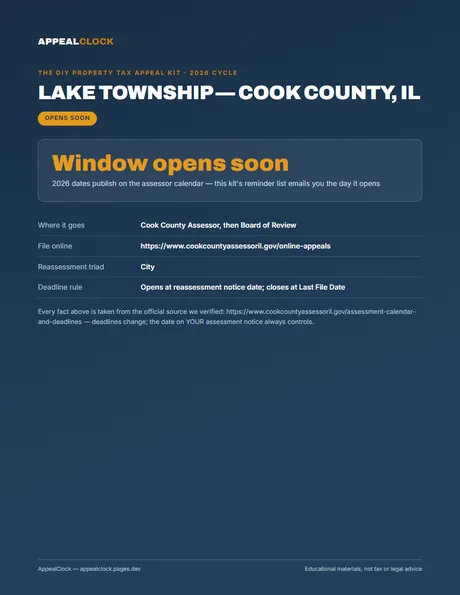
How the Lake Township reassessment window works
Cook County reassesses property on a three-year rotating schedule — the county is divided into three triads (City, North, and South), and Lake Township sits in the City triad. When the Assessor works through the City triad, every parcel in Lake Township gets a fresh valuation and a mailed notice. The appeal window opens when those notices go out and closes at the Last File Date shown above. Miss that date and your appeal right for this reassessment year is gone — the next realistic opening is the following triennial cycle.
The date that legally controls your filing deadline is the date printed on your notice, not the day it arrives in your mailbox. If your notice date differs from the countywide township deadline shown above, yours governs. Check the top of the form before doing anything else.
Cook County also gives you two sequential opportunities that most Illinois jurisdictions don't — first an appeal to the Cook County Assessor, and if that result still feels wrong, a second appeal to the Board of Review. You don't forfeit the Board of Review option by filing with the Assessor first. The two-step structure is built into the system, and each step has its own separate window.
The 10% math that determines whether your appeal pays off
Illinois law sets the assessment level for Cook County Class 2 residential property at 10% of fair market value. Your tax bill, however, isn't just that 10% figure — the Illinois Department of Revenue applies an equalization factor (the "multiplier") each year to bring Cook County assessments in line with the state standard. That multiplier is applied to your assessed value before the local combined tax rate produces the final bill.
Here's what flows through the math: if the Assessor places your home at $400,000 and comparable sales support $350,000, you've removed $50,000 of appraised value. At 10%, that's $5,000 off your assessed value. Multiplied by the current equalization factor and your local tax rate, the dollar savings per year can be meaningful — and the reduced value carries forward through the remainder of the reassessment cycle, not just one tax year. The Cook County appeal overview walks through a worked example with recent equalizer figures.
You can find your current equalized assessed value (EAV) on your most recent tax bill — it's the assessed value after the multiplier is applied, and it's the figure your tax rate actually hits. Appealing reduces assessed value first, which reduces EAV proportionally.
What wins at the Assessor level — and at the Board of Review
The Assessor review is administrative and happens on paper or through the portal — no hearing, no in-person appearance. The Board of Review is a three-member elected body that holds brief hearings and renders its own independent decision. Both levels respond to the same core evidence:
- Comparable sales. Three to five properties near yours, similar in size, age, and condition, that sold for less than your appraised value within the year before the assessment date. This is the dominant evidence in nearly every successful residential appeal.
- Record-card errors. Your property record from the Assessor's office will show square footage, bedroom and bathroom count, lot size, and listed improvements. Errors are common — a few hundred square feet of discrepancy can move the value materially, and corrections are often the fastest win available.
- Condition evidence. The Assessor's mass appraisal model can't see a cracked foundation, flood damage, or a structural defect. Photos and contractor estimates put those facts in the record in a form both the Assessor and the Board can act on.
Homeowners in neighboring Cicero Township and Palos Township use the same evidence framework — the Cook County evidentiary standard is county-wide. One organized summary page carries more weight at a Board of Review hearing than a folder of unsorted printouts.
Filing: portal, process, and what to expect after you submit
The fastest path is the Cook County Assessor's online appeals portal — it timestamps your submission instantly and generates a confirmation to save. Paper filing at the Assessor's office is also accepted; if you mail it, the USPS postmark controls, so obtain a receipt.
After the Assessor's review, one of two things happens: the Assessor issues a revised value, or the assessment holds. If it holds — or if the revision is still too high — you then have a separate window to bring your case to the Board of Review. The Board issues its own decision, which sets the assessed value for the current tax year unless you escalate further to the Illinois Property Tax Appeal Board (PTAB) or Circuit Court. For most residential appeals, the Board of Review outcome is the practical stopping point.
The Board of Review session for Lake Township's group runs on a schedule separate from the Assessor-level window. Track both at the Cook County assessment calendar so neither deadline catches you off guard.
Lake Township traps worth knowing before you file
Four local wrinkles catch people every cycle. First, don't confuse Lake Township with Lake County — they are entirely separate jurisdictions. Lake Township is a Cook County township on Chicago's North Side; Lake County is a different county to the north with its own assessor, deadlines, and appeal process. The portal and deadlines on this page cover Cook County parcels only.
Second, your tax bill is higher than the raw assessed value suggests, because the equalization factor is layered on top of the 10% assessment before the tax rate is applied. If you're calculating whether to appeal, work from the EAV on your bill, not just the assessed value — that's the number your rate actually multiplies.
Third, homestead exemptions are a separate filing with their own deadlines. A General Homestead Exemption, Senior Exemption, or Longtime Occupant Exemption can reduce your EAV independently of an appeal outcome. If you're not currently receiving all the exemptions you qualify for, that's a parallel action worth taking now — an appeal doesn't activate exemptions retroactively.
Fourth, the strongest window to appeal is always during a reassessment year, when the Assessor has actively touched every parcel and the comparable-sales argument is freshest. The upcoming window shown above is exactly that moment for Lake Township. Non-reassessment years allow appeals for specific errors, but the leverage is substantially lower.