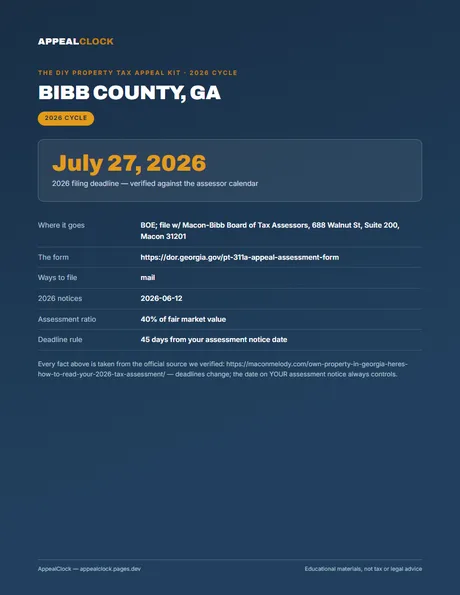
How Bibb County's 45-day appeal window actually works
The clock starts the day your assessment notice is dated — not the day it lands in your mailbox. Macon-Bibb may mail notices in batches across the county, so the date that legally controls is the one printed on your notice. The deadline shown above reflects the reported countywide date for the 2026 cycle, but because this county's data is based on reported information, verify the date on your actual notice before relying on it.
Bibb County has no online portal — this is a mail-only county. A USPS postmark on or before your deadline is your legal proof of timely filing. Take your envelope to a staffed counter and ask for a dated postmark receipt; a drop-box deposit does not give you that confirmation. Miss the window and Georgia's appeal right resets with next year's notice — there is no extension or late-filing exception within the current cycle.
The 40% math that decides whether appealing is worth it
Georgia assesses property at 40% of fair market value under O.C.G.A. § 48-5-7. Your bill is that 40% figure multiplied by the combined millage rate set by Bibb County and the City of Macon. Concrete example: if the county values your home at $275,000 and you can show comparable sales supporting $245,000, you have removed $30,000 of appraised value — which is $12,000 of assessed value. At Macon-Bibb's combined millage, that reduction translates to a real annual savings on every bill that follows.
A successful appeal also triggers Georgia's 299(c) freeze, locking the resolved value for the following two additional years in most cases. One afternoon of paperwork and a trip to the post office can be worth well over a thousand dollars across the freeze period. For a full breakdown of how the statewide math works, the Georgia property tax appeal overview walks through how county and city levies stack in practice.
Evidence that wins at the Macon-Bibb Board of Equalization
Bibb County appeals route to the Board of Equalization — trained citizen panelists, not the assessors who set your value — and they decide based on evidence, not complaints. Three categories carry the most weight:
- Comparable sales. Three to five homes near yours, similar size and age, that sold for less than your appraised value in the period leading up to the assessment date. Concrete market transactions are harder to argue against than a mass-model estimate, and they are the spine of nearly every winning residential appeal.
- Record-card errors. Pull your property record card from the Macon-Bibb Tax Assessors office and check square footage, bedroom and bathroom count, basement finish status, and lot size. A discrepancy of 200–300 square feet is not unusual, and a documented error is the fastest path to a reduction.
- Condition evidence. Photos and contractor estimates for anything the county's model cannot see — a deteriorating foundation, roof damage, an outbuilding in disrepair, or drainage problems that reduce usable lot area.
Bring everything organized on one or two pages. A board member who can follow your argument in the first two minutes is more likely to rule in your favor than one sorting through a folder of loose screenshots.
Filing by mail: what to send and what happens after
Because Bibb County has no online portal, every appeal goes through the mail. Download form PT-311A from the Georgia Department of Revenue, complete it for your parcel, and mail it to the Macon-Bibb Board of Tax Assessors at 688 Walnut St, Suite 200, Macon 31201. The USPS postmark date is your legal timestamp — if you are filing close to the deadline, go to a staffed counter and get a dated receipt. A drop box or metered mail does not produce the same verifiable record.
After the Board of Tax Assessors receives your filing, they review it first and may send a revised value offer. Accept and the appeal closes there. Decline — or hear nothing — and your case moves to a Board of Equalization hearing, typically a brief session where you present your comparables and supporting evidence. You can also elect arbitration or a hearing officer at the time of filing, but for a standard residential appeal the BOE route is free and tends to be the practical choice. If the BOE result still feels wrong, Superior Court is available, though for most homeowners the two-year freeze from even a partial win is a sensible stopping point.
Bibb County traps that catch people every cycle
A few local patterns trip up first-time filers. First, the assessment notice is not a tax bill — it shows the value the county intends to use. Your actual bill arrives later, by which point the appeal window is closed. If you want to contest the number, act on the notice, not the bill.
Second, filing an appeal in Georgia puts your account on an interim basis: you owe 85% of the tax calculated on the new assessed value while the appeal is pending. Budget for a reconciliation payment or refund when the appeal resolves, whichever direction it goes.
Third, homestead exemptions are a completely separate filing with their own spring deadline — an appeal does not apply or renew them. Check your Georgia exemption eligibility while you are already pulling your parcel record.
Finally, if your neighborhood was part of a mass reassessment cycle, do not assume the increase is untouchable. Mass appraisal models are built for speed across thousands of parcels and routinely miss street-level problems — that is precisely what the Board of Equalization exists to address. Homeowners in neighboring counties like Barrow and Bartow face the same 45-day trigger and the same evidence-based process; if you own property in multiple counties, track each notice date separately.