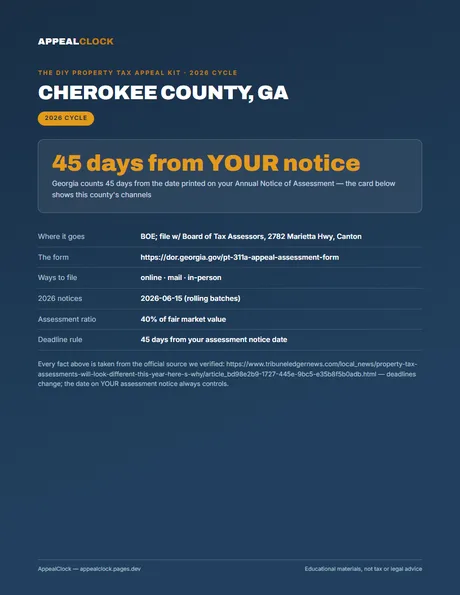
How the 45-day window works in Cherokee County
Cherokee County does not have a dedicated online filing portal. Your PT-311A goes to the Board of Tax Assessors at 2782 Marietta Hwy, Canton — by mail or in person. The clock starts on the date printed on your assessment notice, not the postmark it arrived with or the day you opened it. If you mail the form, get a physical USPS postmark at the counter; metered mail won't stand up in a timing dispute.
The deadline information on this page is drawn from county sources and news coverage — treat it as a guide, and confirm the exact window against the date on your own notice. If your notice date differs from the countywide date shown above, your notice date controls. Miss the window and Georgia's appeal right resets with next year's notice; there is no late-filing exception within the same cycle.
The 40% rule and when appealing pays off in Cherokee
Georgia law (O.C.G.A. § 48-5-7) requires every county to assess property at exactly 40% of fair market value. Your tax bill is that assessed figure multiplied by the local millage rate — Cherokee's combined rate varies by city and school district, but the math works the same everywhere in the state. If the county says your home is worth $350,000 and you can show comparable sales supporting $315,000, you've removed $35,000 of appraised value — that's $14,000 of assessed value. At typical Cherokee millage rates, that difference runs to several hundred dollars off your annual bill, every year the lower value holds.
A successful Georgia appeal also triggers a two-year value freeze under the 299(c) provision in most cases, meaning one afternoon of paperwork can pay off across three tax cycles. Cherokee's residential market has moved quickly in recent years and mass-appraisal models sometimes overreach — making a careful look at your notice worth the time. If you're new to how Georgia appeals layer with exemptions, the statewide overview covers both.
What actually wins at the Cherokee County Board of Equalization
Your appeal routes to the Board of Equalization — a panel of trained county residents, not assessor staff — who evaluate evidence independently. Three categories carry the most weight:
- Comparable sales. Three to five homes near yours, similar in size, age, and condition, that sold for less than your appraised value before the assessment date. Residential boards treat this as the strongest available argument, and it should form the spine of your case.
- Record-card errors. Pull your property record from the county and check square footage, bedroom and bathroom count, garage type, and basement finish. Errors of 200–400 square feet are not unusual, and a clean data correction is the fastest path to a reduced value.
- Condition evidence. Photos and contractor estimates for problems a mass-appraisal model can't see: foundation issues, water intrusion, an outbuilding in disrepair, or deferred maintenance the county's algorithm treats as average when it isn't.
Bring everything organized on a single summary sheet. Boards respond to preparation, and a one-page exhibit with your three best comps is more persuasive than a disorganized stack of printouts. Neighboring counties like Barrow and Bartow follow the same BOE structure, so the same approach applies across the region.
Filing PT-311A: mail, in-person, and what happens next
Download the PT-311A from the Georgia DOR site (linked in the filing table below) and deliver it to the Cherokee County Board of Tax Assessors at 2782 Marietta Hwy, Canton. If you go in person, ask for a date-stamped copy of your submission. If you mail it, use a service that produces a USPS postmark and keep proof — that postmark is your legal evidence of timely filing, so don't rely on metered or drop-box mail.
After you file, the Board of Assessors reviews your appeal first and may issue a revised value. If you accept, the process ends there. If not, your case moves to the Board of Equalization for a hearing — typically a 15-to-20-minute session where you walk through your comparables and the assessor's office responds. You may also elect arbitration or a hearing officer at the time of filing; for a standard residential appeal, the BOE path costs nothing and resolves the vast majority of cases. If the BOE result still feels wrong, an appeal to Superior Court is available, though for most homeowners the 299(c) freeze from even a partial reduction makes escalation unnecessary.
Cherokee County traps that catch homeowners every cycle
A few patterns are worth knowing before you file. First, the assessment notice is not a tax bill — it shows the value you have the right to contest. The actual bill arrives later, when the appeal window has already closed. Don't wait for the bill; act on the notice.
Second, filing an appeal sets your interim bill at 85% of the disputed value until the case resolves. Budget for a reconciliation in either direction — a win generates a credit, a loss may mean a balance due. Third, Cherokee is a fast-growing county and reassessment waves have swept multiple neighborhoods in recent cycles. A mass reassessment doesn't mean the number is accurate — the BOE exists precisely because bulk models miss street-level conditions. If your street was reassessed all at once, compare notes with neighbors and build your comp set from the same sales they would use.
Finally, homestead exemptions are a separate filing with their own spring deadline and are not automatically applied through an appeal. Check your exemption status while you have the notice in hand — details on what's available statewide are at the Georgia property tax appeal overview.