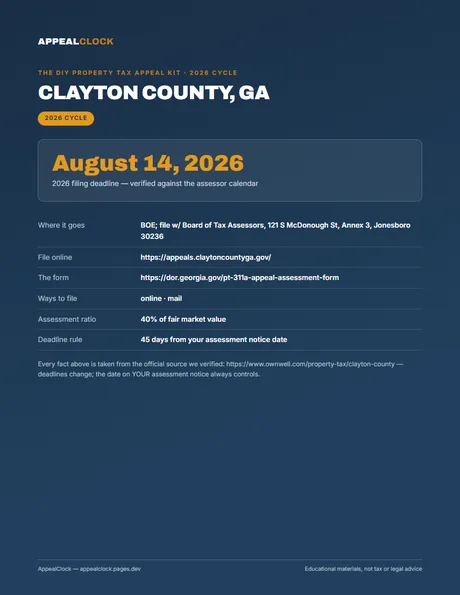
How the 45-day window actually works in Clayton County
Your 45-day clock in Clayton County runs from the date stamped on your assessment notice — not from when it reaches your mailbox, and not from a countywide announced date. Notices go out in batches, so the reference deadline shown at the top of this page may not be your personal cutoff. Flip to the top of your notice the day it arrives and read the date there; that is the date that controls your filing right.
Georgia's appeal statute provides no catch-up option once the window closes — the right resets only when next year's notice arrives, and not a day sooner. Missing by even one day means sitting out a full tax cycle, which is why the live countdown on this page matters more than a static reminder would.
The 40% math that determines whether appealing is worth it
Georgia law (O.C.G.A. § 48-5-7) sets the assessment ratio at 40% of fair market value statewide — the same rule that governs every county in Georgia governs Clayton. Your tax bill is that 40% figure (your assessed value) multiplied by the local millage rate. To make the arithmetic concrete: say the county's mass appraisal places your home at $220,000 and comparable nearby sales support a fair market value of $195,000. That argument removes $25,000 of appraised value, cutting the assessed base by $10,000. At a combined millage rate near 30 mills, that's roughly $300 off the annual bill — and the saving repeats each year the lower value holds.
A resolved appeal also typically triggers Georgia's 299(c) freeze, locking in the adjusted value for two additional tax years. One afternoon of organized evidence can translate into multiple years of compounding savings, which is why the Georgia property tax appeal process rewards preparation even for modest reductions.
What wins at the Clayton County Board of Equalization
Residential appeals in Clayton County go to the Board of Equalization — a volunteer panel trained to weigh evidence independently of the assessor's office. They respond to documentation, not frustration with the bill. Three categories consistently carry weight:
- Comparable sales. Three to five homes near yours — similar size, age, and condition — that sold for less than your appraised value in the period preceding your assessment date. This is the foundation of most winning residential appeals.
- Property record errors. Pull your record card from the county and verify every field: square footage, bathroom count, lot size, and whether any additions or outbuildings are listed accurately. A 200-square-foot overcount is not rare and can be the fastest path to a reduction.
- Condition evidence. Photographs and contractor estimates for anything a mass appraisal model can't observe — foundation issues, storm damage, drainage problems, or a structure the county counts as livable that isn't.
Organize everything onto one summary page before your hearing. Boards work through many cases in a day; a homeowner who arrives with a clear, concise presentation makes the decision straightforward. The Georgia state guide includes a comparable-sales worksheet that works for any Georgia BOE hearing.
Filing: portal, form PT-311A, and what happens next
Clayton County offers two filing paths. The online portal — linked in the filing table on this page — is the faster route; it records a timestamp at submission and issues a confirmation you can save. If you prefer paper, complete form PT-311A (available from the Georgia DOR) and deliver or mail it to the Board of Tax Assessors at 121 S McDonough St, Annex 3, Jonesboro, GA 30236. If mailing, a USPS postmark on or before the deadline is your legal proof of timely filing — a tracking number alone is not sufficient.
After you file, the Board of Assessors reviews your case and may issue a revised value. Accept it and the appeal closes. Decline and your file advances to the Board of Equalization for a hearing — typically a 15-minute session where you walk through your comparable sales and condition evidence. Arbitration and a hearing officer are also available at filing, but the BOE path is free and resolves most residential appeals. If the BOE outcome is still unsatisfying, Superior Court is the next escalation point, though for most homeowners a partial reduction combined with the 299(c) freeze is the sensible stopping point.
Clayton County traps that catch homeowners every cycle
A few local details trip people up year after year. First, the assessment notice is not a tax bill — it shows the value you have the right to contest. The actual bill arrives later, after the appeal window has closed, when it's too late to fight the underlying number. Open anything labeled "assessment" immediately and treat it as time-sensitive.
Second, filing an appeal doesn't pause your tax obligation. A temporary bill goes out calculated at 85% of the contested value while the case is pending; budget for a reconciliation payment in either direction once the appeal resolves. Third, homestead exemptions are a separate application with their own spring deadline, and a successful appeal does not apply them retroactively — check your exemption status while the paperwork is already in front of you. And if your block was swept into a neighborhood-wide reassessment, don't assume the increase is unassailable. Mass valuation models miss individual property conditions, which is precisely what the BOE exists to evaluate.
For the full statewide picture — exemptions, 299(c) freeze mechanics, and escalation paths — see the Georgia property tax appeal guide. If you're also tracking appeal windows in nearby counties, Barrow County and Bartow County follow the same 45-day framework.