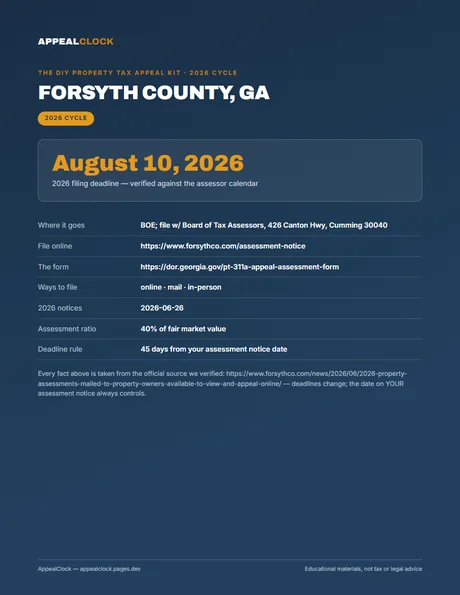
How Forsyth County's 45-day appeal window actually works
Forsyth County mails assessment notices once a year, and your 45-day window starts from the date printed on your individual notice — not the day you open it, and not necessarily a single countywide cutoff. Notices can go out in batches, and the date on your form is the one that legally controls. The county has reported a general 2026 mailing timeline, but treat any countywide figure you read as approximate: the date at the top of your own notice is what counts.
Georgia offers no grace period. Miss the 45-day window and your right to appeal the current assessment is extinguished — the clock resets only when next year's notice arrives. That finality is why this page puts a countdown in front of you.
The 40% assessment math — and why Forsyth's growth makes it matter more
Georgia law assesses property at 40% of fair market value (O.C.G.A. § 48-5-7). Your tax bill is that assessed figure multiplied by the local millage rate. In concrete terms: if Forsyth County appraises your home at $550,000 and comparable sales support $510,000, you've removed $40,000 from the appraised value — reducing your taxable base by $16,000. Multiply that $16,000 by the millage rate on your tax bill and you have your annual savings. Win the appeal, and a successful resolution typically locks in the lower value for the following two years under Georgia's 299(c) freeze provision, turning one afternoon of paperwork into three years of reduced bills.
Forsyth is among the fastest-growing counties in Georgia, and that growth pushes assessed values upward aggressively. Mass appraisal models are calibrated for the county as a whole; they routinely miss street-level conditions on individual parcels. That gap is the opening that makes a well-documented appeal viable. For the statutory framework that governs all Georgia counties, the Georgia property tax appeal overview covers exemptions, timelines, and escalation paths in detail.
What the Board of Equalization actually responds to
Forsyth appeals route to the Board of Equalization — an independent panel trained specifically to hear valuation disputes, not assessor staff defending their own numbers. Three categories of evidence carry the most weight:
- Comparable sales. Three to five nearby homes, similar in size, age, and condition, that sold at prices below your appraised value in the year before the assessment date. This is the backbone of nearly every successful residential appeal.
- Property record errors. Request your record card and check square footage, bedroom and bathroom count, basement finish status, and lot size. A 200-to-300-square-foot discrepancy is more common than people expect, and correcting one is often the fastest path to a lower value.
- Condition evidence. Photographs and contractor estimates for anything the county's mass model cannot see — foundation issues, roof damage, deferred maintenance, a detached structure no longer in use.
Present your case on a single organized page; boards reward homeowners who make the decision easy. The same BOE process applies across the state — neighboring counties like Barrow and Bartow follow identical procedures under Georgia law, so the evidence approach transfers if you own property in multiple counties.
Your three ways to file a Forsyth County appeal
Forsyth County accepts appeals three ways, and any of them preserves your rights equally as long as you file within the window:
- Online. The county portal accepts electronic filings and issues a confirmation immediately — the safest method because it timestamps your submission and eliminates any question of receipt.
- Mail. Complete form PT-311A and send it to the Board of Tax Assessors at 426 Canton Hwy, Cumming 30040. Request a USPS postmark at the counter rather than dropping the envelope in a collection box — the postmark is your legal proof of timely filing.
- In person. Deliver the completed PT-311A directly to 426 Canton Hwy during business hours and ask for a date-stamped copy to keep for your records.
After you file, the Board of Assessors reviews your appeal first. They may respond with a revised value; accept it and the matter closes, or decline and your case moves to a Board of Equalization hearing — typically a brief session where you walk through your evidence. Arbitration and hearing officer options are also available at filing, but the BOE path is free and appropriate for most residential appeals. If the BOE result still feels wrong, escalation to Superior Court is available, though for most homeowners the 299(c) freeze that follows a resolved appeal is the practical endpoint.
Forsyth-specific traps that catch homeowners every cycle
Four patterns trip up Forsyth property owners repeatedly. First, the assessment notice is not your tax bill. The notice shows the value you're entitled to challenge; the actual bill arrives later in the year, after the appeal window has closed. Waiting for the bill to decide whether to appeal means it's already too late.
Second, filing an appeal triggers a temporary billing provision under Georgia law: you'll typically owe taxes on 85% of the disputed assessed value while the appeal is pending. Budget for a reconciliation payment when the case resolves — in either direction.
Third, Forsyth's rapid growth has driven broad countywide reassessments that can feel authoritative. They aren't. A large increase reflects aggregate market data, not the specific condition of your parcel. Mass models built for accuracy at scale routinely miss individual problems — which is exactly the gap the BOE is empowered to close.
Fourth, homestead exemptions are a completely separate filing with a distinct spring deadline. An appeal does not apply exemptions retroactively. If you've recently purchased your home or haven't confirmed your exemption status, check the Georgia property tax exemptions page while you're already in appeal mode — the two savings stack and neither one does the other's job.