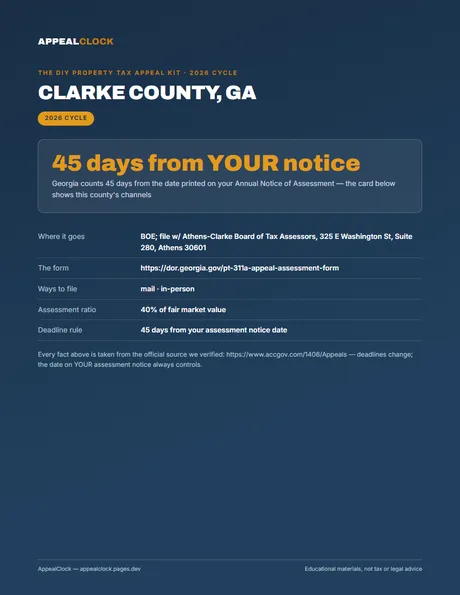
How Clarke County's 45-day window actually works
The Athens-Clarke County Board of Tax Assessors mails assessment notices once a year, and the 45-day appeal window opens on the date printed on your notice — not the day it lands in your mailbox. Notices can go out in batches, so the countywide deadline shown above is a useful reference, but the date on your specific notice is what legally controls. Check the top of the notice before you do anything else.
Clarke County does not offer an online filing portal. Every appeal goes in by mail or in person, which means a mailed PT-311A's USPS postmark is your legal timestamp. If the deadline is close, hand the envelope directly to a postal clerk and keep the dated receipt — a collection-box deposit is harder to prove after the fact. Miss the window and Georgia's appeal right resets with next year's notice; there is no late-filing exception for this cycle.
The 40% assessment math — and why appealing often pays
Georgia law (O.C.G.A. § 48-5-7) requires counties to assess property at 40% of fair market value, so the number driving your actual tax bill is four-tenths of the county's appraised figure, multiplied by the local millage rate. Concrete example: if the Athens-Clarke assessors value your home at $380,000 and comparable sales support $340,000, you've removed $40,000 of appraised value — which is $16,000 off the assessed base. At the millage rates that apply in the Athens-Clarke area, that difference produces real annual savings that repeat each year the lower value holds.
A successful appeal also typically triggers Georgia's 299(c) value freeze for the two years following the resolution, which means one filing can protect you across multiple tax cycles. The Georgia property tax appeal overview explains how the freeze applies statewide and what breaks it.
What actually wins at the Athens-Clarke Board of Equalization
Clarke County appeals are heard by the Board of Equalization — a panel of trained citizen volunteers, not assessor staff — and they respond to evidence, not frustration. Three categories consistently carry the room:
- Comparable sales. Three to five homes near yours, similar in size and age, that sold for less than your appraised value before the assessment date. Athens's active real estate market means comps are often available, but choose carefully — the board will scrutinize anything that looks cherry-picked or geographically remote.
- Record-card errors. Pull your property record from the assessor's office and verify square footage, bedroom and bathroom count, basement finish, and lot size against what you know to be true. Clerical errors in mass-appraisal models are more common than most homeowners expect, and catching one is the fastest route to a reduction.
- Condition evidence. Photos and contractor estimates for anything the county model can't see — deferred maintenance, foundation issues, flood risk, or a deteriorating outbuilding. Bring your evidence organized on one page; a board absorbs a clear summary far better than a folder of screenshots.
The appeal letter template structures this evidence in the format boards expect.
Filing in Clarke County: mail, in person, and what comes next
Clarke County has no online portal. File form PT-311A — available on the Georgia Department of Revenue website — by mailing it to the Athens-Clarke Board of Tax Assessors at 325 E Washington St, Suite 280, Athens, GA 30601, or by delivering it in person to the same address. If you mail, get a dated postmark; if you file in person, ask for a stamped copy as your confirmation.
After you file, the Board of Assessors reviews your appeal first and may offer a revised value. Accept it and the process is complete. If the revised value still seems too high — or the assessors decline to adjust — your case advances to a Board of Equalization hearing, typically a 15-to-20-minute session where you walk through your evidence. You can also elect arbitration or a hearing officer at the time of filing, though the BOE path costs nothing and is the standard route for residential appeals. If the BOE result doesn't resolve the matter, Superior Court escalation remains available — but for most homeowners a partial win combined with the 299(c) freeze is the practical stopping point.
Clarke County traps worth knowing before you file
Three wrinkles catch Athens-Clarke homeowners every cycle. First, the assessment notice and the tax bill are separate mailings — the notice shows the value you can contest; the bill arrives later, when the appeal window is already closed. A delayed bill can create a false sense of time, so watch for the notice specifically.
Second, filing an appeal means your interim tax obligation is calculated at 85% of the new assessed value while the case is pending. Budget for a potential reconciliation payment or refund when the appeal resolves — the direction depends on the final determination.
Third, homestead exemptions are a separate filing with their own spring deadline, and a successful appeal does not apply them retroactively. If you haven't claimed your exemptions, the Georgia property tax appeal guide covers what's available while you're already reviewing your assessment.
One more Clarke-specific note: the rental market near the University of Georgia can pull mass-appraisal values away from owner-occupied sales data. If your neighborhood has substantial student-rental stock, confirm that your comparable sales reflect owner-to-owner transactions rather than investor purchases — the board will notice the mix. If you also own property in neighboring Barrow County, the same 45-day Georgia framework applies there; Bartow County follows the same statewide rules as well, though local assessor contacts and filing addresses differ.