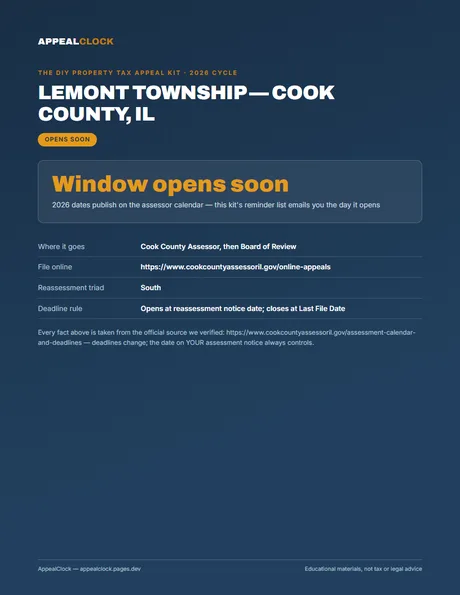
How Lemont Township's appeal window opens and closes
Cook County reassesses properties on a triennial rotation — each of the county's three geographic triads cycles through once every three years. Lemont Township sits in the South Triad, so your assessed value is refreshed on a schedule independent of North Suburban or City townships. When the Cook County Assessor mails reassessment notices for the South Triad, the clock starts. The Last File Date printed on your individual notice is the binding deadline, not a single countywide date — notices can go out in batches, so read the mailing you received before relying on any general calendar.
What makes Cook County distinct from most Illinois counties is that a denied or insufficient Assessor's appeal doesn't end your options. The Board of Review — a separate elected body — opens its own independent window after each township's Assessor period closes. Lemont Township falls in Group 4 of the South Triad's Board of Review schedule; that window is listed in the filing panel above. Two real bites at the apple, with two different decision-makers, is a meaningful structural advantage for Lemont homeowners who come prepared.
The Cook County 10% math — why a smaller appraisal compounds
Cook County assesses residential Class 2 property at 10% of fair market value. That figure is then multiplied by the state equalization factor — the annual "multiplier" the Illinois Department of Revenue publishes to bring Cook County's aggregate level to the statutory standard — producing your Equalized Assessed Value (EAV). Your tax bill is EAV times the composite millage rate for your tax code area, minus any exemptions you carry.
Practical effect: a $30,000 reduction in appraised value cuts your assessed value by $3,000, which the equalizer then scales before the millage is applied. In the south Cook suburbs, effective combined rates have run in a range where removing tens of thousands in appraised value translates to hundreds of dollars per year in tax savings — and Illinois law limits how aggressively the Assessor can raise a value in the two years immediately following a successful appeal, so one afternoon of evidence-gathering can protect your base for an entire triennial cycle.
What wins at the Cook County Assessor
The Assessor's appeal is a document review: a staff analyst compares your evidence to the mass-appraisal model that generated your assessment. Three categories carry the most weight for residential Lemont parcels:
- Comparable sales. Three to five arms-length sales of similar homes in Lemont or an immediately comparable market area, closing before the assessment date. Match on square footage, age, construction type, and bedroom count as tightly as you can. This is the spine of nearly every successful residential appeal.
- Property record errors. Pull your PIN's record card from the Assessor's portal and check square footage, exterior construction, basement finish, bathroom count, and lot size. Mass models depend on this data — a 300-square-foot overstatement is common and can be the fastest win available.
- Condition evidence. Photos and contractor estimates documenting deferred maintenance, structural problems, or a damaged outbuilding that the assessor's drive-by model couldn't capture. Condition gaps are real, and boards take them seriously.
The Cook County property tax appeal guide covers the countywide process in full detail; Lemont's Assessor appeal follows the same evidence rules applied to South Triad market data.
Board of Review: Lemont Township's independent second window
If the Assessor reduces your value but not enough — or declines to move at all — the Board of Review gives you an independent second review. The BOR is a three-member elected body with no institutional loyalty to the Assessor's conclusions; it evaluates your evidence fresh. Lemont Township's Group 4 session dates appear in the panel above.
Filing with the Board of Review uses a separate form and portal from the Assessor's appeal — don't assume your earlier submission carries over. The evidence standard is essentially the same (comps, record corrections, condition documentation), but BOR hearings are typically brief in-person or remote appearances where you walk a reviewer through your key numbers. Many cases settle on the papers. If you previously accepted a revised value from the Assessor, confirm whether you're still eligible for BOR review before assuming you are — acceptance language can affect standing.
Beyond the BOR, escalation routes include the Illinois Property Tax Appeal Board (PTAB) and Circuit Court, though most Lemont homeowners find the two-level Cook County process sufficient: the cost is zero, the second hearing is genuinely independent, and a sustained reduction holds value through the remainder of the triennial cycle.
Lemont Township details worth knowing before you file
Lemont Township shares the South Triad reassessment cycle with neighboring townships across the southwest suburbs. If you own property in an adjacent township — such as Palos Township or Cicero Township — each parcel will carry its own notice with its own Last File Date, so watch for separate mailings and track deadlines individually.
Three traps catch Lemont filers most often. First, the assessment notice is not a tax bill — the value you can fight appears on the notice, well before the bill is calculated and mailed. Once the bill arrives, the appeal window for this cycle has already closed. Second, homestead exemptions (General Homestead, Senior Exemption, Senior Freeze, and others) reduce EAV directly and are filed on a separate spring application deadline; an appeal doesn't apply or restore exemptions retroactively, and exemptions don't substitute for an appeal if the underlying assessed value is wrong. Check both, separately. Third, if your block or subdivision was reassessed en masse, the increase may look systematic — but mass-appraisal models can't observe what makes a specific parcel worth less than the neighborhood median. Localized condition problems, micro-market sales, and record-card errors all become arguments the model missed, which is precisely what the appeal process exists to capture.