The Board of Review: a second chance that doesn't require a first
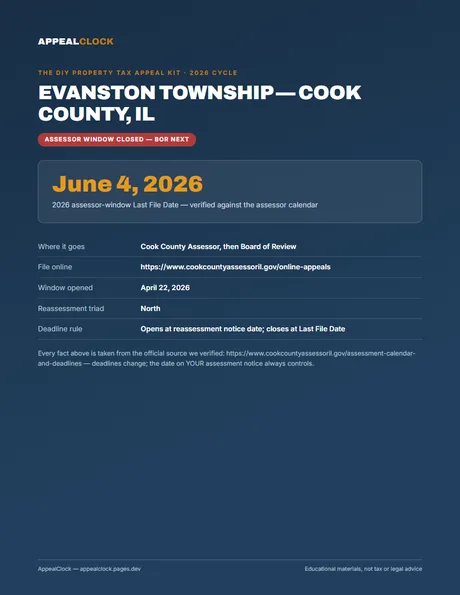
If you missed the Cook County Assessor's Evanston Township window, the case is not closed. The Cook County Board of Review is a separate administrative body — three elected commissioners who hear property-value complaints independently of the Assessor's staff — and filing a BOR complaint does not require that you filed at the Assessor level first. The BOR G1 window dates for Evanston are shown in the band above. While that window is open, your path is straightforward: file before it closes and an independent panel reviews your assessment from the ground up.
The BOR applies two overlapping standards: whether your property is assessed at fair market value, and whether it is assessed uniformly compared to similar parcels. That second standard — the uniformity clause — is distinct from the Assessor's review and frequently produces reductions the Assessor's process misses entirely. For the full overview of how Cook County appeals work across townships, see the county-level guide.
Cook County's 10% assessment ratio and the triennial multiplier
Cook County assesses residential property at 10% of estimated fair market value — lower than most states expect. If the Assessor estimates your Evanston home at $550,000, your assessed value is $55,000. Illinois then applies a state equalization factor (commonly called "the multiplier") that brings county assessments to the statewide 33.33%-of-value standard, producing your equalized assessed value (EAV). In recent Cook County cycles that multiplier has ranged from roughly 2.9 to 3.0, turning a $55,000 assessed value into an EAV near $160,000–$165,000. Your tax bill is that EAV times the composite local rate.
The reason one BOR filing can matter for years: Evanston Township is in the North triad of Cook County's triennial reassessment schedule, meaning the Assessor formally re-establishes market value every three years. A reduction from a successful BOR complaint anchors the base for that entire triennial cycle — the savings repeat each year until the next scheduled reassessment. That compounding effect, not just the single-year reduction, is why filing is almost always worth the time even late in the cycle.
What actually moves a BOR hearing in Cook County
BOR hearings reward organized evidence over emotional arguments. Three categories carry the most weight:
- Comparable sales. Three to five arm's-length sales of similar Evanston homes — comparable square footage, age, condition, and neighborhood — that closed before the assessment date at prices below your appraised value. This is the spine of most successful residential appeals at every level of the Cook County process.
- Record-card errors. The Assessor's property record (available on the county portal) shows the characteristics the mass-appraisal model used: square footage, lot dimensions, bedroom and bathroom count, basement finish, and garage size. Errors here are common, and each one directly inflates your assessed value. A 200-square-foot overstatement on a finished basement can account for a meaningful share of the gap between your value and a neighbor's.
- Uniformity comparables. Pull the assessed values of five to ten structurally similar homes nearby. If those homes are assessed at a lower percentage of market value than yours, the BOR is statutorily required to weigh that disparity — it is a separate ground for relief independent of your absolute market value, and it is the Cook County-specific angle most homeowners miss entirely.
The county-level guide includes a comp worksheet formatted for the Cook County BOR. One organized page of evidence outperforms a folder of screenshots every time.
Filing a BOR complaint for Evanston Township: portal, packet, and what comes next
The fastest path is the Board of Review's online portal — it timestamps your complaint immediately and generates a confirmation number you should save. The filing table on this page has the current portal link and the BOR's mailing address if you prefer paper; a mailed complaint is valid if the postmark falls within the window. There is no filing fee.
After you file, the BOR may schedule a brief in-person hearing or request a written submission. Bring your evidence in a single organized packet — comparable sales first, then the property record card with any errors circled, then condition photos or repair estimates if relevant. The BOR mails its decision; if a reduction is granted, the Cook County Treasurer recalculates your bill accordingly.
If the BOR result is still unsatisfactory, Illinois law allows escalation to the Illinois Property Tax Appeal Board (PTAB) — no filing fee, but a backlog measured in years. For most Evanston homeowners a partial BOR win plus the triennial carry-forward is the sensible stopping point. Two neighboring townships on the same BOR cycle — Cicero and Palos — follow the identical process if you own property in either area.
If the BOR window closes: building toward the North triad reassessment
If the BOR G1 window shown above has already closed by the time you read this, the right move is preparation — not resignation. Set the free deadline reminder above and AppealClock will email you when the next Evanston Township window opens. Three things you can do now that pay off at the next opportunity:
- Pull your property record card from the Cook County Assessor's portal and verify every field — square footage, lot size, room count, basement finish. Flag any errors in writing now while the current assessment is fresh.
- Save comparable sales data for nearby homes that have recently closed. Sale records grow harder to locate as time passes; a comp that is 18 months old at the next window is still useful, but current data is always stronger.
- Document your uniformity position by pulling assessed values for five to ten structurally similar parcels on or near your street. A gap you can demonstrate before the window opens means you can file confidently on day one.
The North triad reassessment year is the highest-leverage filing opportunity in the cycle — that is when the Assessor sets the base value that carries forward for three years. Arriving at that window with a prepared file is what separates homeowners who win from those who let the cycle repeat unchallenged.