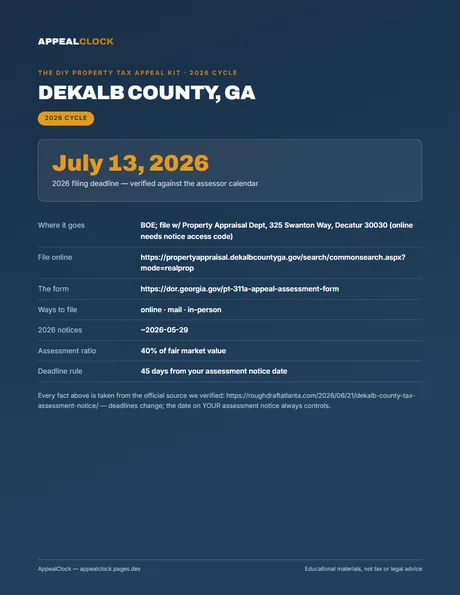
How DeKalb County's 45-day window actually works
DeKalb mails assessment notices and your appeal clock starts on the date printed on yours — not the postmark date, not the day it clears your mailbox. The countywide window shown above is reported; the date that legally governs your filing is the one in the header of your specific notice. Notices sometimes go out in batches, meaning neighbors on the same street can face different controlling dates.
Miss the window and you lose all appeal rights for this cycle. Georgia provides no extension, no hardship exception, and no way to file retroactively — the right resets only when next year's notice arrives. That's why reading the date on your own notice, not a neighbor's or a news article's, is the first step.
The 40% math: when filing is worth your afternoon
Georgia law (O.C.G.A. § 48-5-7) requires assessment at 40% of fair market value, and DeKalb applies the same ratio. Your tax bill is that 40% assessed figure multiplied by the local millage rate. As a concrete example: if DeKalb's model values your home at $380,000 and comparable sales support $345,000, you've removed $35,000 of appraised value — which is $14,000 off your assessed base. At a combined millage rate in the mid-30s, that translates to several hundred dollars per year. More importantly, a resolved appeal typically activates Georgia's 299(c) freeze, holding the new lower value for two additional years. One afternoon of preparation can eliminate three years of inflated bills. See the Georgia property tax appeal overview for full statewide context on millage rates and exemptions.
What actually moves the Board of Equalization
DeKalb appeals go to the Board of Equalization — an independent panel of trained citizens, not the assessor's staff — and they decide based on evidence, not on how frustrating the situation feels. Three categories consistently carry residential appeals:
- Comparable sales. Three to five homes near yours, similar in size and age, that sold for less than your appraised value before the assessment date. This is the backbone of nearly every winning appeal.
- Property record errors. Pull your record card through the county portal and check square footage, bedroom and bathroom count, basement finish level, and lot size. Large counties run mass-appraisal models, and data errors are not rare — a square-footage discrepancy is one of the fastest corrections available.
- Condition evidence. Photographs and contractor estimates for anything DeKalb's model can't observe: foundation issues, a damaged roof, deferred maintenance, or a non-functional outbuilding. The model prices a generic property; you're showing the board your specific one.
Organize your case to fit on a single page. Boards respond to homeowners who make the arithmetic obvious, not those who arrive with a disorganized folder of screenshots.
Filing in DeKalb: portal, mail, and in-person
Three paths are available. Online filing is the fastest — but DeKalb's portal requires the access code printed on your assessment notice, so have the notice in front of you before you start. The portal timestamps your submission and generates a confirmation you can save. Mail is equally valid: send form PT-311A to the Property Appraisal Department at 325 Swanton Way, Decatur 30030, and get a USPS postmark at the counter rather than dropping the envelope in a box — the postmark is your proof of timely filing. In-person filing works at the same address during regular business hours.
After you file, the Board of Assessors reviews first and may offer a revised value. If you accept, the appeal closes. If not, your case moves to a Board of Equalization hearing — typically a 15-to-20-minute session where you walk through your comparable sales. Arbitration and a hearing officer are additional options at filing, but for a standard residential appeal the BOE path is free and generally sufficient. A Superior Court challenge is available after a BOE decision, but most homeowners find the 299(c) freeze from a partial win the practical stopping point.
DeKalb-specific traps worth knowing before you file
Several local patterns catch property owners every cycle. First, the assessment notice is not a tax bill — it shows the value you have the right to fight; the actual bill arrives later, after the appeal window has already closed. Don't wait for the bill and expect to appeal. Second, an active appeal means your interim payment is calculated at 85% of the new assessed value while the case is pending; plan for a reconciliation payment or refund once it resolves, depending on the outcome. Third, homestead exemptions carry their own application deadline earlier in the year — appealing your value does not apply an exemption retroactively, so confirm yours is already on file while you have the notice out. Finally, if your neighborhood was reassessed as part of a countywide revaluation, don't assume a mass increase is untouchable — mass-appraisal models are built for scale, not street-level nuance, which is exactly the gap a BOE hearing exists to correct. If you own property in other parts of Georgia, the same 45-day framework applies; see the guides for Barrow County and Bartow County for county-specific wrinkles.