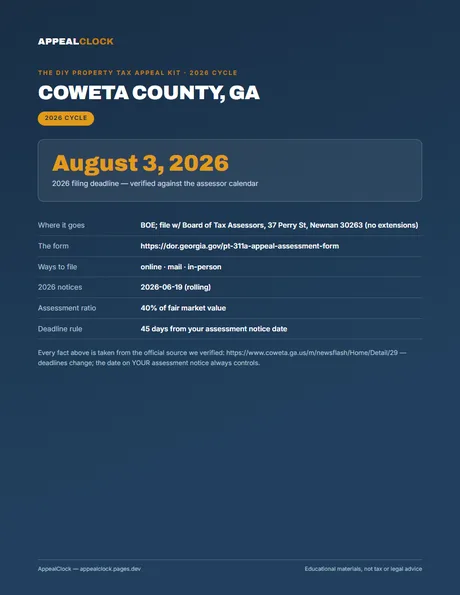
How the 45-day clock actually works in Coweta County
Coweta County mails assessment notices once a year, and the 45-day appeal window starts on the date printed on your notice — not the day it arrived in the mailbox, and not the day you opened it. The Board of Tax Assessors is explicit: no extensions. If notices go out in batches and your neighbor's is dated a few days earlier than yours, their deadline is also a few days earlier.
Miss the window and Georgia's appeal right does not carry over — you wait for next year's notice to reset the clock. There is no hardship exception, no informal reconsideration process, and no late-filing grace period. That is the structural reason this page keeps a live countdown: the controlling date is on your notice, not in a news headline.
The 40% math that decides whether appealing is worth your time
Georgia assesses property at 40% of fair market value (O.C.G.A. § 48-5-7), and Coweta applies that ratio like every other county in the state. Your tax bill equals that 40% assessed value multiplied by the local millage rate. A practical example: if the county values your home at $300,000 and comparable sales support $265,000, you have removed $35,000 of appraised value — which is $14,000 of assessed value. At a combined millage around 25–30 mills, that translates to roughly $350–$420 trimmed from your annual bill, every year the lower value holds.
A successful appeal also triggers Georgia's 299(c) freeze, which typically locks your assessed value for the two years following resolution. That is why one afternoon of pulling comparable sales can be worth four figures over the full appeal cycle. The numbers for your parcel are in Coweta's public assessment records — run the math before you decide whether to file.
What actually wins at the Coweta Board of Equalization
Coweta appeals not resolved at the Board of Assessors level move to the Board of Equalization — a panel of trained property owners, separate from the assessor's office, who decide on evidence. Three categories carry the room consistently:
- Comparable sales. Three to five homes near yours, similar in age, size, and condition, that sold for less than your appraised value in the period leading up to the assessment date. This is the foundation of nearly every winning residential appeal in Georgia.
- Record-card errors. Pull your property record and verify square footage, bedroom and bathroom counts, basement finish, and lot size. A 200- or 300-square-foot discrepancy is not unusual, and correcting it is the fastest path to a lower value — no sales data required.
- Condition evidence. Photographs and contractor estimates for anything the county's mass-appraisal model cannot see: foundation problems, flood damage, or deferred maintenance that makes your property worth materially less than a comparable house nearby.
Organize your evidence on one or two pages. Boards respond to homeowners who make the decision easy. The Georgia property tax appeal overview covers the statewide legal framework and a step-by-step comp-selection walkthrough.
Filing PT-311A: Coweta's mail-and-in-person process
Coweta County does not offer an online submission portal for appeals. You file by downloading form PT-311A from the Georgia Department of Revenue, completing it, and delivering it to:
Board of Tax Assessors — Coweta County
37 Perry Street, Newnan, GA 30263
By mail: the USPS postmark is your legal proof of timely filing — send it certified or with delivery confirmation so you have a receipt. In person: ask for a date-stamped copy at the counter before you leave.
After filing, the Board of Assessors reviews your appeal first and may send a revised value. Accept it and the case closes. Reject it and your case moves to the Board of Equalization for a hearing — usually a short meeting where you walk through your comparable sales. You can also elect arbitration or a hearing officer at the time of filing, but the BOE path is free and resolves most residential cases. If the BOE decision still feels wrong, escalation to Superior Court is available, though for most homeowners a partial win and the accompanying freeze is the practical endpoint.
Coweta-specific traps that catch homeowners every cycle
Four local wrinkles are worth knowing before you file. First, the assessment notice is not your tax bill — it shows the value you can contest, and the actual bill arrives later, when the appeal window has already closed. Second, while an appeal is pending, your interim payment is calculated at 85% of the new assessed value; budget for a reconciliation payment or refund once the case resolves. Third, homestead exemptions are a separate filing with their own spring deadline — an appeal does not apply exemptions retroactively, so confirm your exemption status while you have the paperwork out. The Georgia overview lists the available exemption types and their deadlines for the whole state.
Fourth, if your neighborhood was reassessed in a countywide update, do not assume the new value is fixed. Mass-appraisal models apply broad market trends and miss street-level problems — exactly the kind of evidence the Board of Equalization is built to weigh. Homeowners in neighboring Barrow County and Bartow County follow the same appeal mechanics; the Georgia 40% ratio and 45-day window are statewide constants, so the same preparation approach carries across county lines.