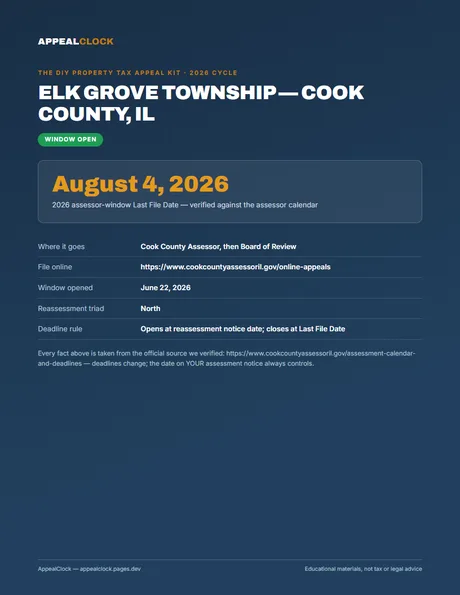
How Elk Grove Township's reassessment window works
Elk Grove Township sits in Cook County's North Triad, which means the township goes through a full mass reassessment on a three-year cycle. When the Assessor completes that reassessment, notices go out and the appeal window opens — it closes on the Last File Date shown in the band above. Because North Triad reassessments happen once every three years, this window carries the weight of three cycles of accumulated value change. If the status banner says open, the window is live right now — don't wait.
Cook County gives you two sequential chances to challenge your value. The first is with the Cook County Assessor directly — the same office that set the value. The second is the Board of Review, an independent three-member panel that hears appeals after the Assessor's window closes. The 2025 Board of Review G2b session covers Elk Grove Township after the Assessor deadline passes. Missing the Assessor window doesn't end your options, but filing at both levels gives you the best odds — Assessor corrections come back quickly and can arrive before the BOR window even opens.
The 10% math that makes every reduction count
Illinois law sets residential assessments in Cook County at 10% of estimated fair market value for Class 2 properties (35 ILCS 200/9-145). That 10% figure is your assessed value — but it is not what your tax rate is applied to directly. The Illinois Department of Revenue calculates an annual State Equalization Factor for Cook County that brings local assessments in line with the statewide standard. Your Equalized Assessed Value (EAV) is your assessed value multiplied by that factor, and your bill is your EAV multiplied by the local combined tax rate.
That structure means every reduction compounds through two layers before the tax rate touches it. A $30,000 drop in appraised value produces $3,000 in assessed value relief — and after the state equalizer, the EAV reduction is larger still. At the rates that apply to most Elk Grove Township parcels, a well-supported appeal can move your annual bill by hundreds of dollars, and the lower value carries forward until the next reassessment cycle. One afternoon of paperwork, three years of savings.
What actually wins at the Assessor and Board of Review
Both levels respond to evidence. The same core package works at each stage:
- Comparable sales. Three to five arm's-length sales of similar nearby homes — same neighborhood, similar size and age — that closed below your assessed-value-implied market price within roughly 12 to 18 months before the assessment date. This is the spine of nearly every successful residential appeal in Cook County.
- Property record errors. Pull your record card through the Assessor's portal and check gross living area, room and bathroom count, basement finish status, lot size, and property class code. Errors are common after a mass reassessment, and a factual correction is the fastest win available.
- Condition evidence. Photos, contractor estimates, or inspection reports for anything the mass model can't see — structural problems, deferred maintenance, an easement limiting use. These rarely move the needle alone but can close a gap in combination with comps.
At the Board of Review, organization matters more than volume. Present your evidence on one page: comp addresses and sale dates, the implied value, and a clear ask. The same discipline that works in Elk Grove travels across the county — see how neighboring townships approach it in the Cicero Township appeal guide and the Palos Township appeal guide.
Filing: Assessor portal, then Board of Review
The Cook County Assessor's online portal is the fastest path — it timestamps your submission instantly and sends a confirmation you can save. Paper filings are accepted at the Assessor's office; if you mail anything, a USPS postmark is your proof of timely filing, so get one at the counter explicitly rather than relying on a metered stamp.
After you file, the Assessor reviews your submission and may issue a revised value. If you accept, the process ends there. If the result doesn't satisfy you — or if you missed the Assessor window entirely — the 2025 Board of Review G2b session is your independent backstop. BOR hearings are typically a brief evidence-driven conversation; you present your comps and the board sets a value independently of the Assessor's position. Filing with the BOR is also free. If the Board of Review result still feels wrong, escalation to the Illinois Property Tax Appeal Board or Circuit Court is available, though for most homeowners the savings from a partial win at the BOR are the sensible stopping point.
Cook County traps specific to Elk Grove Township
Three wrinkles catch North Triad homeowners every reassessment cycle. First, the reassessment notice is not your tax bill — it shows the proposed value you have the right to fight. The actual bill arrives later, after the appeal window has closed. React to the notice, not the bill.
Second, because Elk Grove Township is reassessed as a unit, your neighbors received new values at the same time you did. A mass reassessment doesn't make every value accurate; it means the Assessor applied the same model to every parcel simultaneously. That model misses street-level problems — a difficult lot, a structural issue, a functionally obsolete floor plan — which is precisely what the appeal process exists to surface and correct.
Third, Cook County homeowner exemptions — the Homeowner Exemption, Senior Exemption, Senior Freeze, and others — are separate filings with their own deadlines. An appeal doesn't apply or restore them retroactively. Verify your exemptions are in place while you're already reviewing your property record card. The Cook County appeal overview covers the full exemption landscape alongside the appeal mechanics that apply to every township in the county.