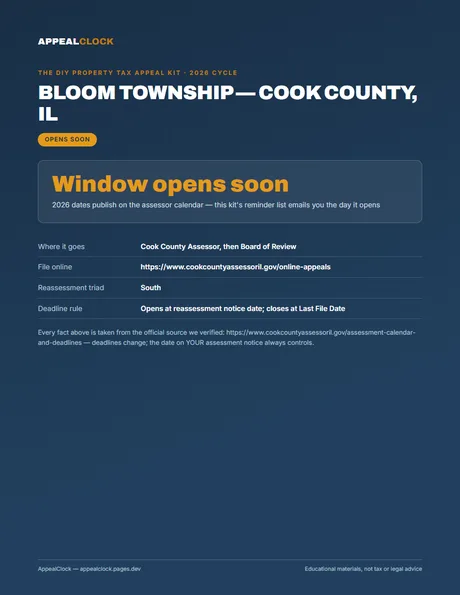
How Bloom Township's appeal window works — and why 2026 matters more than most years
Cook County divides its townships into three reassessment triads, and Bloom sits in the South triad — which means 2026 is a full triennial reassessment year. The Assessor's office re-models every parcel from the ground up using recent sales data, and the resulting value changes are often larger (and sometimes less precise) than the incremental adjustments that happen in off-cycle years. Filing volume spikes in reassessment years because more homeowners have reason to push back, and that's not a coincidence worth ignoring.
The appeal clock starts the date printed on your reassessment notice, not the day it lands in your mailbox. Cook County mails notices in batches within a township, so your notice date and your neighbor's may differ by days. The controlling deadline is the Last File Date shown on the county's assessment calendar and in the filing panel above — verify yours against the actual notice before assuming you know the cutoff.
For the broader mechanics of how Cook County structures its appeal process across all townships, the Cook County property tax appeal overview is the right starting point.
The 10% rule and why it matters for your bill
Illinois sets the assessment level for Class 2 residential property at 10% of fair market value. If the Assessor values your home at $350,000, your assessed value is $35,000. That number is then multiplied by the state equalization factor — a figure the Illinois Department of Revenue sets annually to bring Cook County's average assessment level in line with the statewide standard — producing your equalized assessed value (EAV). Your tax bill is EAV times the composite local rate, which varies by municipality and overlapping taxing districts and can differ substantially across south suburban Cook County.
The compounding effect makes the math work in your favor: every dollar removed from your appraised value reduces the assessed value by 10 cents before the multiplier and rate amplify that into actual savings. In a reassessment year the impact is front-loaded — a successful appeal establishes the lower value as the baseline the Assessor models from until the next triennial cycle, so the benefit persists.
What actually wins at the Assessor level and at the Board of Review
Cook County gives you two sequential opportunities to contest your assessed value, and the evidence that wins is similar at both levels.
- Comparable sales. Three to five arms-length sales of similar nearby properties — comparable size, age, and condition — that closed before the assessment date and support a lower value than the one assigned. This is the backbone of nearly every successful residential appeal.
- Property record card errors. The Assessor's mass-appraisal model is only as accurate as the underlying data. Pull your record on the Assessor's website and verify square footage, lot size, bedroom and bathroom count, basement finish, and improvement codes. A factual error is the fastest path to a correction — and corrections can happen before any hearing is scheduled.
- Condition and functional issues. Structural problems, significant deferred maintenance, an unusable outbuilding, or anything the model cannot detect from public records. Document these with photos and contractor estimates.
At the Assessor level the process is informal — you upload evidence through the portal and may receive a revised assessment without a hearing. If you're unsatisfied, the Board of Review (BOR) offers a second, independent review. The BOR is a separately elected three-commissioner body; you file a new complaint during the BOR's scheduled window for your township group, and cases that aren't resolved on the papers receive a hearing. Further appeal to the Illinois Property Tax Appeal Board (PTAB) or Circuit Court is available, though most residential cases resolve at one of the first two levels.
South triad neighbors like Palos Township follow the same two-step structure, so comparable sales near the Bloom–Palos boundary can occasionally reinforce a case when your subject property sits close to the township line.
Filing through the Assessor's portal — and what happens next
The Cook County Assessor's online appeals portal is the fastest and most reliable path. It timestamps your submission, provides a confirmation number, and lets you attach comparable sales and supporting documents in the same session. In-person and mailed filings are also accepted, but the portal eliminates any dispute about whether your appeal reached the office before the Last File Date.
After filing, the Assessor's office reviews your evidence and either issues a corrected notice or holds the original value. If the result is unsatisfactory — or no change is made — you retain the right to file a second appeal with the Board of Review during the BOR's scheduled window for Bloom's township group. The BOR uses its own complaint form and its own timeline, entirely separate from the Assessor's window. If the BOR result still feels wrong, PTAB or Circuit Court are the next steps, though for most homeowners the outcome at one of the first two levels is the practical endpoint.
Neither level charges a filing fee for residential appeals.
South triad timing, Cook County installment bills, and what to do now
Because 2026 is a reassessment year for the South triad, the Assessor's office is processing more files than in a typical cycle. Filing early in the window — as soon as your notice arrives and you've assembled your comparable sales — gives your submission more review time and avoids the late rush. Organized evidence matters more, not less, when reviewers are working through high volume.
Cook County property taxes arrive in two installments. If your appeal is unresolved when the second installment is calculated, you may receive an estimated bill; any reduction flows through as a credit or refund after the appeal closes. Pay on time regardless — late penalties accrue on the bill amount irrespective of appeal status, and no appeal outcome retroactively waives them.
Homestead exemptions — General Homestead, Senior, Senior Freeze, and others — are applied separately and have their own annual deadlines. An appeal does not activate exemptions retroactively, so check whether you're receiving every exemption you qualify for while your property record is open. If you're researching comparable sales, neighboring townships like Cicero can provide context on how the Assessor is valuing similar property types across the South triad when you need to broaden your comp pool.