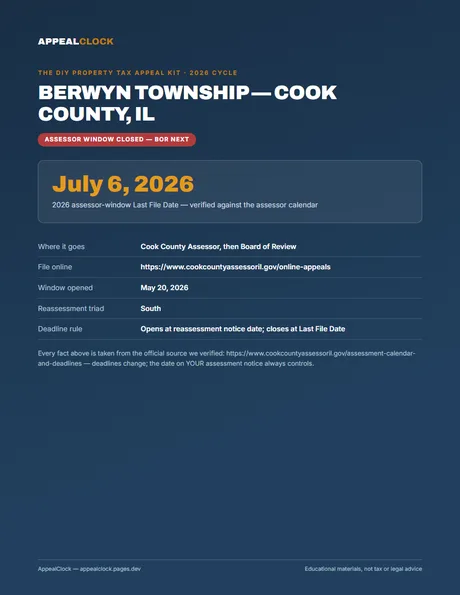
Cook County's two-level appeal process — and where Berwyn stands
Cook County runs a two-step appeal system. The first step is the Cook County Assessor's office, which opens a township-specific window when reassessment notices go out. For Berwyn Township — part of the South triad — that Assessor window is currently closed for this cycle. The second step, run independently, is the Board of Review, which opens its own filing window for South triad townships on a separate calendar shown in the panel above.
These two steps are independent: you do not need to have filed with the Assessor to appeal to the Board of Review, and filing with both is permitted. If the Assessor window closed before you could act, or if you filed and received an unsatisfactory result, the Board of Review is the remaining path for this cycle. For context on how Cook County's full system works across all three triads, see the Cook County property tax appeal guide.
The Board of Review: Berwyn Township's second chance
The Cook County Board of Review is a three-member elected body, independent from the Assessor's office, empowered to lower, confirm, or raise assessed values. It hears fresh South triad appeals on its own schedule — the current window dates are shown in the panel above, and you can verify the live calendar at the county's assessment calendar page.
Filing is done through the Cook County Assessor's online portal, which accepts Board of Review submissions during the open window. The portal timestamps your filing instantly and generates a confirmation — save it. If you prefer paper, the Board accepts filings by mail, but a USPS postmark on or before the deadline shown above is your legal proof of timely filing. After you submit, the Board schedules a hearing — typically a brief session where you walk through your evidence packet.
If the Board of Review result is still unsatisfactory, you can escalate to the Illinois Property Tax Appeal Board (PTAB) or Circuit Court, but for most Berwyn homeowners the Board of Review is the sensible stopping point: it costs nothing, it's designed for self-represented owners, and a win there holds through the end of the current reassessment cycle.
What evidence wins at the Board of Review
The Board of Review responds to organized evidence, not to general frustration about a high bill. For a Berwyn residential property, three categories carry the most weight:
- Comparable sales. Four to six homes near yours — similar age, square footage, and condition — that sold at or below your assessed market value before the assessment date of the tax year at issue. This is the spine of nearly every winning residential appeal and the first thing the Board looks for.
- Property record card errors. Pull your card from the Assessor's portal and check finished square footage, bedroom and bathroom count, basement type, and lot size. Measurement errors are common in Cook County's mass-appraisal system, and a corrected square footage is often the fastest path to a reduction.
- Condition evidence. Photos, contractor estimates, or an inspection report documenting anything the mass model can't see — foundation issues, persistent drainage problems, deferred maintenance, storm damage. If the county appraised your home as typical of the neighborhood and it clearly isn't, show them the difference.
Bring everything organized into a single packet. The Board hears dozens of cases per session; a one-page comp summary and a highlighted record card move faster than a folder of screenshots. The appeal letter template shows the format that works.
The Cook County math — why an appeal is worth the paperwork
Cook County assesses Class 2 residential property (single-family homes, condos, and two- to six-flats) at 10 percent of fair market value under Illinois statute. The state then applies an equalization factor — the so-called "multiplier" — to produce your Equalized Assessed Value (EAV). Your tax bill is your EAV multiplied by the combined millage rates of all your taxing districts (school, park, municipal, library, and others), then reduced by any exemptions you qualify for.
The layered math matters: every dollar you remove from the assessed fair market value ripples through both the statutory percentage and the state multiplier before hitting the millage rate. Berwyn homeowners typically carry a significant combined levy from overlapping school and municipal districts, so even a modest reduction in appraised value compounds into meaningful annual savings. A lower value established at the Board of Review generally holds through the rest of the current South triad reassessment cycle — so one afternoon of preparation can pay off across multiple tax years.
What to do right now while the window is closed
The interval between the Assessor window closing and the Board of Review window opening is the best time to build your case — sales data is still fresh and evidence is easier to gather without deadline pressure.
- Pull your property record card. Download it from the Cook County Assessor's portal now and check every line. Flag any error in writing while it's visible.
- Collect comparable sales. The same sales that win at the Assessor level win at the Board of Review. Gather them before the BOR window opens so you're not searching under pressure.
- Photograph condition issues. Anything that puts your home below the neighborhood average — deferred repairs, drainage problems, a non-functional outbuilding — is easier to document now.
- Verify your exemptions. A Homeowner Exemption, Senior Freeze, or Veterans' exemption reduces your bill independently of the assessed value outcome. Confirm you have every one that applies before the next billing cycle.
Set a reminder using the form above and AppealClock will alert you when the Berwyn Township window opens for the next cycle. Neighboring South triad townships Cicero and Palos run on the same reassessment schedule — their windows track closely with Berwyn's.