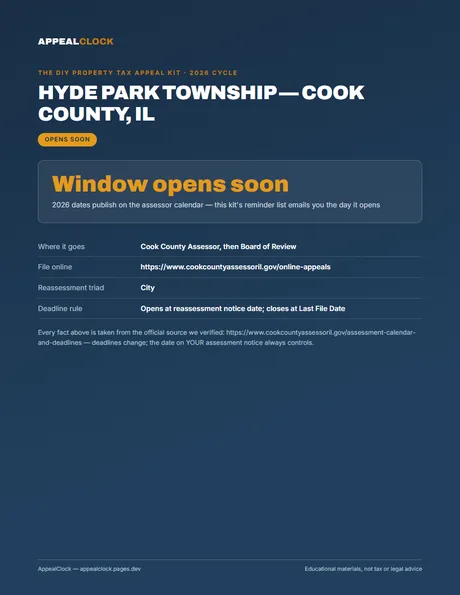
How Hyde Park Township's triennial cycle shapes your window
Cook County reassesses property on a three-year rotation — the City triad, which covers Chicago townships including Hyde Park, turns over as a group. That means your reassessment notice doesn't arrive every year. When it does land, the filing window it opens is the only Assessor-level appeal opportunity you get until the next triennial roll. Missing it isn't a one-year setback; it can mean waiting up to three years before your assessed value is open to challenge again.
The clock starts when your notice is mailed, and the hard cutoff is the Last File Date shown in the panel above. Hyde Park Township notices may go out in batches, so the date printed on your notice is the one that legally controls — verify the current open window at the Assessor's calendar and cross-check against your own paperwork before assuming you know your deadline.
What Cook County's 10% assessment ratio means for your bill
Illinois law targets residential property (Class 2-00) at 10% of estimated fair market value. If Cook County appraises your home at $400,000, your assessed value is $40,000. That figure is then multiplied by the state's equalization factor — the annual "multiplier" — to produce your equalized assessed value (EAV), which is the base your total tax rate actually hits. The multiplier shifts year to year, so your bill can move even when your assessment doesn't.
The leverage matters in both directions. A $30,000 reduction in appraised value removes $3,000 from assessed value, and that $3,000 is then amplified by the equalizer before the tax rate applies. One successful appeal year compounds across multiple billing cycles if your corrected value holds. For a broader look at how Cook County's assessment structure works across all townships, the Cook County property tax appeal overview covers the mechanics in full.
Two bites: the Assessor appeal, then the Board of Review
Cook County gives residential owners two distinct administrative stages, which makes the system more homeowner-friendly than most Illinois counties. Stage one is the Cook County Assessor — file during the open window and the Assessor's staff reviews your evidence and may issue a corrected value. Many cases resolve here, and the online portal makes it the fastest route to a confirmation on record.
If the Assessor's decision doesn't move far enough, stage two is the Board of Review — an independent three-member body that conducts its own hearings on a separate township-by-township calendar. The BOR can set value independently of whatever the Assessor decided, and its window for Hyde Park Township is shown in the panel above. Missing the BOR window closes your administrative options for this cycle.
Evidence that works at both levels: three to five closed sales of comparable homes near yours — similar size, age, and property type — that sold before the assessment date at prices below your appraised value. That's what drives most successful residential cases. Also pull your property record card and check square footage, bedroom and bathroom count, and lot size for data-entry errors; a 200-square-foot mistake in the county's records is a fast, clean win. Photos and repair estimates for deferred maintenance or structural problems round out the file for condition-based arguments.
Filing: portal, BOR form, and what comes after
The Cook County Assessor's online portal at cookcountyassessoril.gov/online-appeals is the fastest first-stage path — it timestamps your submission and generates a confirmation number to save. The filing table above links directly to both the Assessor portal and the Board of Review's own process so you don't have to navigate mid-deadline.
After the Assessor issues a decision, you have the choice to accept or let your case roll to the BOR window. A Board of Review hearing is typically brief — you present your comparable sales and record-card corrections, and the panel deliberates. If the BOR result still feels wrong, you can escalate to the Illinois Property Tax Appeal Board (PTAB) or Circuit Court, though for most Hyde Park homeowners a settled BOR decision — even a partial reduction — is the practical endpoint. PTAB proceedings take longer and carry more complexity; they make sense when the dollars at stake justify it.
Cook County traps specific to Hyde Park Township
Four patterns catch people in this township every cycle. First, the reassessment notice is not a bill — it reflects the value you have the right to fight, and it arrives well before the tax bill that reflects it. Don't wait for the bill; the appeal window is closed by then. Second, Cook County homeowner exemptions — including the standard Homeowner Exemption and the Senior Freeze — file on their own spring schedules and are entirely separate from the appeal process. Winning an appeal doesn't apply exemptions retroactively.
Third, Hyde Park's dense urban market includes a mix of condominiums, vintage two-flats, and converted buildings where matching comparables requires extra care — property type, unit floor level, and parking configuration all affect value in ways a mass-appraisal model tends to average away. A comp set that ignores those distinctions weakens your case; one that controls for them carefully tends to hold up. Fourth, if your block was caught in a neighborhood-wide reassessment sweep, file anyway — mass models miss street-level problems by design, which is exactly what the BOR exists to hear. For how Hyde Park compares with other Cook County townships, see the Cicero Township appeal page and the Palos Township appeal page.