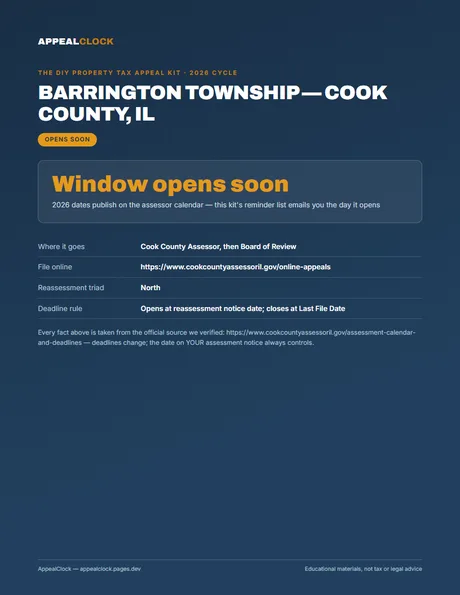
How Cook County's two-level system works — and why both windows matter
Cook County is one of the few jurisdictions in Illinois with a two-stage appeal process, and missing that context is the most common mistake Barrington Township homeowners make. The first level is the Cook County Assessor's office — the window this page tracks. File during that window and the Assessor reviews your evidence and may issue a revised value. Accept the revision and the appeal is complete; reject it and your case advances automatically to the Board of Review.
The Board of Review is an independent, three-member elected body that hears your case fresh — it is not bound by the Assessor's position. The North Triad BOR session dates are shown in the filing panel above. The critical constraint: you must file at the Assessor level first to preserve your right to a BOR hearing. Miss the Assessor window and both opportunities close for this cycle. That is the whole reason this page has a countdown on it.
The 10% assessment math — and why the state equalization factor compounds the stakes
Illinois law assesses residential property at 10% of estimated fair market value — for a home the Assessor values at $400,000, the Cook County assessed value is $40,000. That is the starting point, not the finish. The Illinois Department of Revenue then applies an annual equalization factor (commonly called the "multiplier") to Cook County assessed values to bring them to the statewide 33.33% standard. Cook County's equalization factor has historically run above 2.0, so that $40,000 assessed value becomes an equalized assessed value above $80,000 before your local tax rate is applied.
What that means in practice: a $50,000 reduction in your appraised market value produces a $5,000 reduction in assessed value, which the equalization factor then multiplies before the tax rate is applied. The compounding effect means market-value corrections produce proportionally larger savings than the 10% figure alone suggests. A reassessment year — when the Assessor's model updates values across the entire township at once — is when this math works hardest for or against you.
What wins at the Assessor level — and what escalates to the Board of Review
The evidence that carries weight at both the Assessor and the Board of Review is the same: documentation that your assessed market value exceeds what the property would actually sell for. Three categories consistently move the needle:
- Comparable sales. Three to five arms-length sales of similar homes in your area, closed before the assessment date, that support a lower market value. Recent comps in Barrington Township are the backbone of most successful residential appeals.
- Property record errors. Pull your property record card from the Assessor's website and check square footage, bedroom and bathroom counts, lot size, and listed features against what is actually on your property. A 200-square-foot discrepancy is common enough to check first — it is the fastest correction available.
- Condition evidence. Photographs and contractor estimates for anything the mass appraisal model would not capture: a failing foundation, water intrusion, a finished basement the record shows as unfinished (or vice versa).
The Cook County appeal overview explains how these same standards apply across Cook townships, including how the Assessor's stipulation process works if you would rather settle without a full BOR hearing.
Filing through the Assessor's portal and what comes next
The Cook County Assessor's online portal is the fastest path — it timestamps your appeal immediately and generates a confirmation number you should save. The portal link is in the filing table above. Paper appeals are accepted at the Assessor's office as well; if you mail your filing, the USPS postmark controls the deadline, so use certified mail and keep the receipt.
After filing, the Assessor's office may send a written stipulation — a proposed revised value. You can accept it and close the matter, or reject it and proceed to the Board of Review, where a brief hearing (typically 10–15 minutes) gives you a chance to walk through your evidence before an independent panel. If the BOR outcome still feels wrong, Illinois homeowners can escalate to the Property Tax Appeal Board (PTAB) or Circuit Court, though for most residential appeals in Cook County townships like Cicero and Palos, the BOR result is the practical endpoint.
Why the North Triad reassessment cycle makes this window matter more than most
Cook County divides its townships into three triads — North, South, and City — that rotate through full reassessment on a three-year cycle. Barrington is in the North Triad, which means every third year the Assessor's office conducts a comprehensive market analysis and resets values across the township. The intervening years see only minor adjustments anchored to that reassessment baseline.
A reassessment year is the most consequential time to appeal for two reasons. First, new values can jump significantly to catch up with market appreciation since the last reassessment, making overvaluation more likely. Second, the value set in a reassessment year becomes the floor from which the next two years of minor adjustments are calculated — a successful reduction now compounds. One afternoon of organized paperwork is worth more in a reassessment cycle year than in any other.
Cook County mechanics that catch Barrington Township homeowners off guard
Several Cook County quirks are worth knowing before you file. First, your assessment notice is not your tax bill — the notice shows the value you can fight, and the actual bill arrives months later after rates are set, by which point the appeal window is long closed. Second, homestead exemptions available to Cook County homeowners — the General Homestead Exemption, the Senior Citizen Assessment Freeze, and others — have their own application deadlines and are entirely separate from the appeal process. An appeal does not apply or preserve exemptions; check that yours are in place while you are already reviewing your record card. Third, if your neighborhood was updated as part of a block-level reassessment, do not assume the new figure is accurate — mass appraisal models aggregate large geographies and routinely miss street-level variation that a comparable-sales analysis would catch. The county-wide appeal page has additional context on how mass reassessments are successfully challenged across Cook townships.