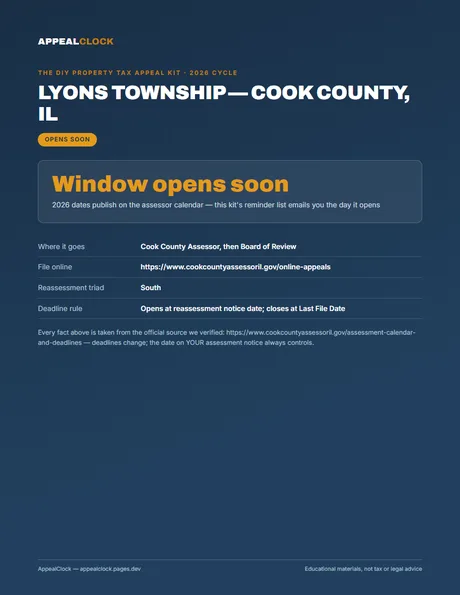
How the Lyons Township reassessment window actually works
Lyons Township sits in Cook County's South Triad, which means every parcel is reassessed on a three-year cycle — not annually. When the Cook County Assessor mails your reassessment notice, the appeal clock starts immediately and closes at the Last File Date shown in the panel above. Because this window comes around only once every three years, it carries more weight than it might look like on paper.
The date that legally controls is the one printed on your specific notice. The countywide Last File Date covers most parcels, but notices occasionally go out in batches — if your notice shows a different date, that date is the one that matters. Check it before you rely on any reminder.
Missing the Assessor's window doesn't eliminate every option. The Board of Review hears appeals on its own group schedule (the 2025 window for Lyons Township is shown above) and can set values independently from the Assessor. But the Assessor pass is where the fastest, cheapest corrections happen — use it first.
The Cook County math: 10% assessed value plus the state multiplier
Cook County assesses Class 2 residential property — single-family homes, condos, and small multi-units — at 10% of estimated market value. Illinois then applies a state equalization factor, commonly called the multiplier, to bring the equalized assessed value (EAV) closer to the statutory 33.33% of market value. That multiplier has historically run between 2.5 and 3.5 for Cook County.
Here's why that matters in practice: if you demonstrate that your home's market value should be $40,000 lower than the Assessor's figure, your assessed value drops by $4,000, and the multiplier turns that into roughly $10,000–$14,000 less EAV. Your tax bill is EAV multiplied by your total local tax rate, which in southwest Cook County suburbs can exceed 10%. That means a $40,000 market-value reduction could move the bill by $1,000 or more — and because Lyons Township is in a triennial cycle, a successful appeal carries that lower base forward for three years. Filing in year one of the cycle is the highest-leverage position available.
What wins at the Assessor's office and the Board of Review
Both the Cook County Assessor's staff and the Board of Review respond to organized evidence, not objections. Three categories reliably move assessments:
- Comparable sales. Three to five arms-length sales of similar homes in or near Lyons Township — close in size, age, and location — that closed below your implied market value within the year before the assessment date. If recent local sales are thin, nearby South Triad sales from Palos Township or Cicero Township can supplement your package when properties are comparable.
- Property record errors. Pull your record from the Assessor's portal and verify square footage, room count, lot dimensions, basement finish, and garage details. Errors of 200–400 square feet are common in older Cook County records, and a documented error is among the fastest wins available.
- Condition evidence. The Assessor's mass-appraisal model cannot see deferred maintenance, structural issues, flood exposure, or an improvement that shows as finished on the card but isn't. Dated photos and contractor estimates are direct evidence the model missed.
Organize everything on a single page before you file. Reviewers at both the Assessor level and the Board of Review make faster decisions when the evidence is presented cleanly rather than buried in a folder of screenshots. See the Cook County appeal guide for a detailed walkthrough of the Cook-specific evidence standard.
Filing the appeal and what happens after
The fastest path is the Cook County Assessor's online appeals portal — it timestamps your submission immediately and returns a confirmation number you can save. Paper appeals are also accepted at the Assessor's office; if you mail one, the USPS postmark is your proof of timely filing, so get a dated receipt at the counter.
After you file, the Assessor's staff reviews your submission and may issue a revised value. If you accept it, the process ends there. If the result is unsatisfactory — or if you've already passed the Assessor's window — the Board of Review is the next step. The BOR operates independently of the Assessor, hears testimony, and can change values the Assessor's staff declined to move. BOR appeals cost nothing to file. The 2025 Group 2b window for Lyons Township is shown in the panel above; verify the current calendar at the Assessor's deadline page before relying on any cached date.
If the BOR result is still unsatisfactory, further escalation to the Property Tax Appeal Board (PTAB) or circuit court is available under Illinois law — but for most residential owners, a BOR win or partial win is the practical stopping point, especially combined with the three-year carry.
South Triad context and Lyons-specific traps
Three things specific to Lyons Township and the South Triad catch property owners off guard. First, a triennial reassessment reprices every parcel at once using mass-appraisal models. If your block saw uniform increases, that doesn't mean the model is correct — it may mean the model applied the same wrong assumptions uniformly. Mass models systematically miss street-level conditions, and that's precisely what the Board of Review exists to correct.
Second, Cook County has multiple overlapping taxing bodies — township, municipality, park district, school district — and your total tax rate is the sum of all of them. The Assessor controls only assessed value, not the rates. A successful appeal shrinks the base those rates apply to, which is why the multiplier math in the section above is worth understanding before you decide whether to file.
Third, Cook County exemptions — the homeowner exemption, senior freeze, senior exemption, and others — each carry their own annual filing deadlines separate from an appeal. An active appeal does not apply exemptions retroactively, and the two processes don't overlap. If you haven't confirmed your exemptions are posted on the Assessor's portal, check now; a missed exemption and an inflated assessment together are two separate problems with two separate fixes. The Cook County overview has the exemption checklist.