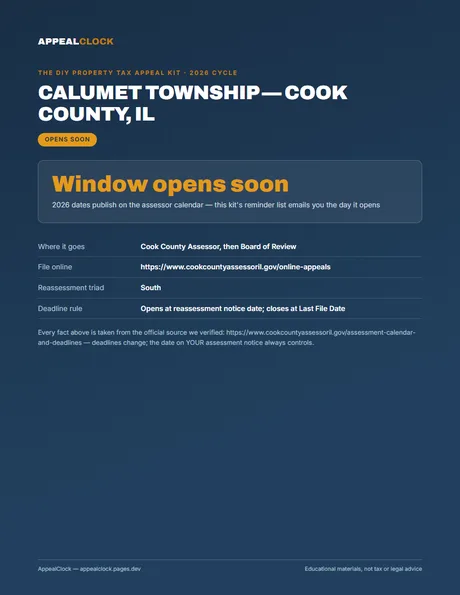
How the Calumet Township appeal window opens and closes
Calumet Township sits in Cook County's South Triad, which means its residential parcels go through a full reassessment on a three-year cycle. When reassessment notices go out, the appeal window at the Assessor's office opens — and it closes at the Last File Date shown in the filing panel above. That date is confirmed against the Assessor's official calendar and controls regardless of when your individual notice arrived in the mail.
Miss the Assessor-level window and you lose access to that first tier this cycle. That is not necessarily the end of the road — the Board of Review holds a separate fall filing window (the 2025 Calumet session is shown above), and it can hear appeals on assessed value whether or not you filed with the Assessor first. But the Assessor step is faster, often resolves cases without a hearing, and gives you two bites at the same cycle if it doesn't. The countdown above exists because that first window is shorter than most South Side homeowners expect.
The Cook County assessment math — what a reduction actually saves
Illinois law sets residential Class 2 property at 10% of estimated market value. The Illinois Department of Revenue then applies an annual equalization factor — the state multiplier — to lift Cook County assessments to the statutory 33.33% standard; in recent years that multiplier has run near 3.0, though it adjusts each cycle. Multiply assessed value by the equalizer and you get your Equalized Assessed Value (EAV) — the number the tax rate actually hits.
Practical illustration: if the Assessor values your home at $260,000, your assessed value is $26,000 and your EAV is roughly $78,000 before exemptions. Knock $20,000 off the market value and you've removed $2,000 from assessed value and around $6,000 from EAV — real savings at any local rate, held until the next triennial reassessment. The Cook County appeal overview walks through the full EAV calculation and how each available exemption stacks on top of a successful appeal.
What wins at the Assessor and Board of Review
Both the Assessor's first-level review and a Board of Review hearing respond to organized evidence, not to frustration about a large increase. Three categories carry the argument consistently:
- Comparable sales. Three to five arms-length sales of homes near yours — similar square footage, age, and condition — that closed before the assessment date and support a lower market value. This is the spine of nearly every successful residential case in Cook County.
- Record-card errors. Pull your property record from the Assessor's portal and check square footage, bedroom and bathroom count, basement finish status, and lot size. A 250-square-foot overcount on a South Side bungalow is not unusual, and correcting it is one of the fastest paths to relief available.
- Condition evidence. The Assessor's mass-appraisal model cannot see a cracked foundation, a roof past its useful life, or a garage converted without permits. Photos and repair estimates documenting what the model misses give the Board of Review something concrete to act on.
Bring your numbers organized on a single page. The Board responds to homeowners who make the decision straightforward — a folder of unsorted screenshots is not that.
Filing: the two-step Cook County process
Cook County's appeal process runs two sequential tiers, and you can use both in the same tax cycle. Step one is the Cook County Assessor's office — file online at the portal linked in the filing panel above for an instant timestamp and electronic confirmation. The Assessor reviews your submission and may issue a revised value; if you accept, it's over. If the reduction is insufficient or absent, you proceed to step two.
Step two is the Board of Review, a three-member elected body independent of the Assessor. It holds its own fall filing window — the 2025 session dates are shown above. You submit a separate BOR appeal form with your evidence package and receive a hearing date; hearings are brief and informal, typically a focused walk-through of your comparable sales. Filing is free at both tiers, and you are not required to have filed at the Assessor level to file at the Board of Review, though doing both maximizes your options.
Neighboring South Triad townships like Palos and Cicero follow the same two-step structure on similar timelines — if you own property in more than one township, each appeal is filed separately with the relevant township's Assessor submission.
Calumet Township traps worth knowing before you file
A few Cook County mechanics catch South Side homeowners every reassessment cycle. First, the reassessment notice is not a tax bill — it shows the proposed market value you have the right to contest; the actual bill arrives later, when the assessment is already locked. Contest the value now, or wait for the next triennial window.
Second, Cook County homeowner exemptions — the standard Homeowner Exemption, the Senior Exemption, and the Senior Freeze — are separate filings with their own deadlines and are not applied automatically by a successful appeal. A winning appeal lowers your assessed value; exemptions then stack on top of that. If you're unsure which exemptions are already on your parcel, check the Assessor portal while you have the record card open. Third, if Calumet's mass reassessment produced a wave of similar increases across your street, that's often a signal the model relied on mismatched or stale comparables — exactly the scenario where organized comp evidence outperforms the reassessment. Don't assume a neighborhood-wide increase is untouchable.