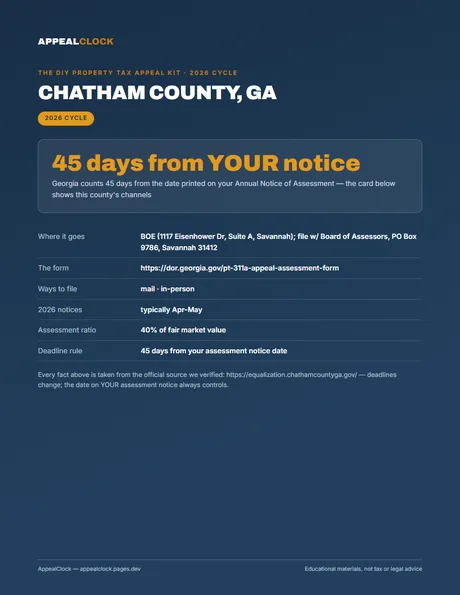
How the 45-day window actually works in Chatham County
Chatham County mails assessment notices once a year, and your appeal clock starts on the date printed on that notice — not the day you find it in your mailbox. The countywide window is shown in the band at the top of this page, but the date that legally controls is the one on your specific notice, because the county can release notices in batches. Check the top of your notice first; if your date differs from the countywide date posted here, yours is the one that matters.
Chatham is a paper-and-mail county — there is no online filing portal. You must submit form PT-311A by mail to the Board of Assessors (PO Box 9786, Savannah, GA 31412) or deliver it in person. If you mail it, the USPS postmark is your proof of timeliness. Get that postmark at the post office counter rather than dropping the envelope in a blue collection box — the counter receipt is the record you can actually show.
Miss the 45-day window and there is no administrative remedy until next year's notice arrives. Georgia's appeal right resets with each annual assessment — that's the whole reason this page has a countdown on it.
The 40% math that decides whether appealing is worth your afternoon
Georgia law (O.C.G.A. § 48-5-7) requires every county to assess property at 40% of fair market value. Your tax bill is that 40% figure multiplied by Chatham County's combined millage rate. Concrete example: if the county appraised your home at $380,000 and you can document comparable sales supporting $345,000, you've removed $35,000 of appraised value — which is $14,000 off your assessed value. At Chatham's combined city-county millage rate, that gap produces real annual savings, and the effect compounds.
A successful appeal also typically triggers the Georgia 299(c) value freeze, which locks your appraised value for the following two years in most cases. A single filing can therefore protect your bill across three consecutive tax cycles. The Georgia property tax appeal overview walks through the freeze mechanics and eligibility rules in more detail — worth reading before you file.
What actually wins at the Chatham County Board of Equalization
Once your appeal clears the Board of Assessors' internal review, it moves to the Board of Equalization at 1117 Eisenhower Dr, Suite A, Savannah — a panel of trained citizen reviewers, not the assessor's staff. They respond to organized evidence, not frustration. Three things carry the room:
- Comparable sales. Three to five homes near yours, similar in size, age, and condition, that sold for less than your appraised value in the year before your assessment date. This is the backbone of nearly every winning residential appeal.
- Record-card errors. Pull your property record from the county and verify square footage, bedroom and bathroom counts, basement finish status, and lot size. Clerical errors are more common than most homeowners expect and represent the fastest win available — the county must correct a factual mistake.
- Condition evidence. Photographs and contractor estimates for anything the county's mass-appraisal model can't see: foundation problems, water intrusion, deferred maintenance, an outbuilding in disrepair. The model values your home as if it's in average condition; show them it isn't.
Bring everything organized on a single page — boards hear many cases in a day and reward homeowners who make the decision easy. The same evidentiary discipline that works in Chatham applies across the state; see how Barrow County and Bartow County run their BOE hearings if you want a broader sense of what Georgia panels expect.
Filing in Chatham County: mail, in-person, and what happens after
Download form PT-311A from the Georgia DOR (linked in the filing table below) and submit it one of two ways: mail it to the Board of Assessors at PO Box 9786, Savannah, GA 31412, or deliver it in person to their office. Chatham County does not have an online filing portal, so there is no shortcut past paper. If mailing, go to the post office window and ask for a postmark on your envelope — keep the receipt. If filing in person, ask for a date-stamped copy of your submission. Either way, your deadline proof needs to be something you can produce later.
After you file, the Board of Assessors conducts an internal review and may respond with a revised value. If you accept, the appeal is resolved. If not — or if the county doesn't revise — your case advances to a hearing before the Board of Equalization. BOE hearings are typically brief and conversational: you walk through your evidence, the board asks questions, and a decision follows. The process is free, and for most residential appeals it is the right place to stop — especially when a partial reduction triggers the 299(c) freeze for two additional years.
If the BOE result still feels wrong, you can escalate to a hearing officer, arbitration, or Superior Court, though for most homeowners the compounding value of an early freeze outweighs the cost and uncertainty of further litigation.
Chatham County traps that catch homeowners every cycle
Four local wrinkles are worth flagging before you file. First, the assessment notice is not a tax bill — it shows the value you are entitled to challenge. The actual bill arrives later, by which point the appeal window has long closed. Act on the notice, not the bill.
Second, filing an appeal does not pause your payment obligation. While the appeal is pending, Chatham calculates your temporary bill at 85% of the disputed value; budget for a reconciliation once the case resolves, whether that means a refund or a balance due.
Third, homestead exemptions are a completely separate filing with their own spring deadline. An appeal does not apply an exemption, and an exemption does not substitute for an appeal — you may need both. Check your exemption status on the county's assessor site while you already have the notice in hand.
Fourth, if your neighborhood was mass-reassessed, do not assume the new value is untouchable. Mass-appraisal models apply broad market trends and miss property-level problems: condition issues, micro-location factors, lot constraints, and access limitations. Those are exactly the facts the Board of Equalization exists to hear. County-wide reassessment years historically bring the highest appeal volume — and some of the most favorable outcomes. For a broader look at how Georgia structures these rights, see the state-level guide.