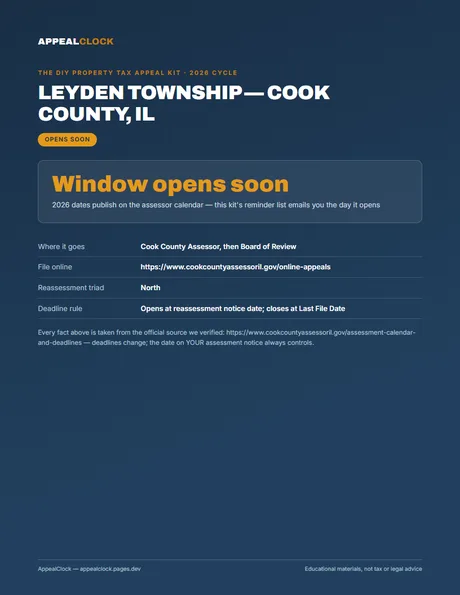
How the Leyden Township reassessment window opens — and why missing it costs three years
Cook County divides its townships into three reassessment triads on a rotating schedule. Leyden Township sits in the North triad, which means every three years the Assessor's office revisits every parcel and mails new assessment notices. When your notice arrives, the appeal clock starts. The controlling deadline is the Last File Date printed on your notice — the date in the band above applies to most Leyden parcels this cycle, but your personal notice date is what the statute honors.
Miss the Assessor's window and you lose your chance to challenge the value at that level for this reassessment cycle. The next Assessor-level appeal for Leyden won't come until the North triad rotates back — roughly three years out. That's what makes acting during this window matter. For countywide rules that apply across all Cook townships, the Cook County property tax appeal overview covers the full framework.
The Cook County math that determines whether appealing pays off
Illinois law targets a 33.33% assessment level, but Cook County uses a property classification system. Most residential parcels — single-family homes, condos, small residential buildings — are classified Class 2 and assessed at 10% of fair market value. The state then applies an annual equalization factor (the multiplier) to bring the county's aggregate assessment closer to the statutory target. Assessed value times the multiplier equals your Equalized Assessed Value (EAV), and it's the EAV — after any exemptions — that the local tax rate is applied to.
What this means in practice: every dollar you remove from the Assessor's market value figure reduces your assessed value by 10 cents, which the multiplier then amplifies. A homeowner exemption separately reduces EAV by a fixed amount each year — it's a different program with its own spring filing deadline, not a substitute for an appeal, and the two can stack. Knowing your current assessed value and EAV before you build a comp set is the first step; both are visible in the Assessor's online property search.
What actually wins at the Assessor and Board of Review
Both levels respond to organized evidence. Three categories carry the most weight in Cook County residential appeals:
- Comparable sales. Arm's-length sales of similar homes near yours — comparable size, age, and condition — from the valuation period the Assessor used. Three to five tight comps with the subject property side-by-side is the backbone of most winning appeals. Loose, distant, or distressed sales dilute the argument.
- Property record card errors. The Assessor values your home from a record card that lists square footage, bedroom and bathroom count, basement finish, and property classification. Pull yours from the Assessor's site and check every field. A square-footage error or incorrect classification corrects automatically once flagged — it's the fastest win available.
- Condition evidence. Photos, contractor estimates, or inspection reports for anything a mass-appraisal model misses — structural problems, deferred maintenance, flood or noise exposure, an uninhabitable structure on the lot. The model uses drive-by data; you know what's inside.
The Cook County appeal guide covers how to pull your record card and build a comp set before the deadline closes.
Filing with the Assessor: portal, documents, and what happens next
The Cook County Assessor's online appeals portal is the fastest route — enter your PIN from the assessment notice, upload your evidence, and the system timestamps the submission and sends a confirmation you can save. Paper filing is accepted at Assessor offices if you prefer it, but the portal eliminates postmark risk and gives you an instant record of filing.
After submission, the Assessor's office reviews your evidence and may offer a reduced value or issue a denial. If the revised value is acceptable, the matter is closed. If not — or if the appeal is denied outright — your case can move to the Board of Review, which operates independently of the Assessor and is not bound by its determinations. You do not start from scratch; much of your evidence carries forward, though the BOR requires its own form and portal submission. The BOR's filing window for Leyden Township is shown in the filing panel above.
The Board of Review as a second appeal — and how it fits the Leyden cycle
Cook County's two-step structure gives Leyden homeowners two independent opportunities to reduce their assessment in the same tax year. The Board of Review is an elected body separate from the Assessor; even if you received a partial reduction at the first level, you can seek a further reduction at the BOR. The BOR's 2025 Group 4 session covers Leyden Township — the filing window is shown in the filing panel above.
If you are reading this page after the Assessor's deadline has passed, check the filing panel: the BOR window may still be open. Neighboring townships follow the same two-step structure — the Cicero Township appeal page and the Palos Township appeal page detail how the process plays out in adjacent triads. Using both windows in sequence does not waive either right and costs nothing additional to file.
Leyden-specific traps that catch homeowners every reassessment cycle
Four patterns come up every North triad reassessment in Leyden and the surrounding suburbs. First, the assessment notice is not a tax bill — it shows the value the Assessor has assigned, and that is what you can challenge. The actual bill arrives later, by which point both appeal windows are closed. Act on the notice.
Second, exemptions are a separate application with their own spring deadline — the homeowner exemption, senior freeze, and similar programs are not added automatically when you file an appeal. Confirm your exemptions are already on file; an appeal alone won't apply them.
Third, if your neighborhood was reassessed en masse — which is standard in triad cycles — the increase can feel untouchable. It isn't. Mass models work from aggregate data and regularly miss street-level problems: a busy road behind the lot, adjacent commercial uses, condition issues the drive-by didn't capture. The Board of Review exists because mass assessments produce individual errors.
Fourth, the state equalization factor shifts each year, which changes the EAV target even when the Assessor's market value figure stays flat. Before building your comp analysis, verify the current assessment calendar and multiplier at the Assessor's official calendar and deadlines page.