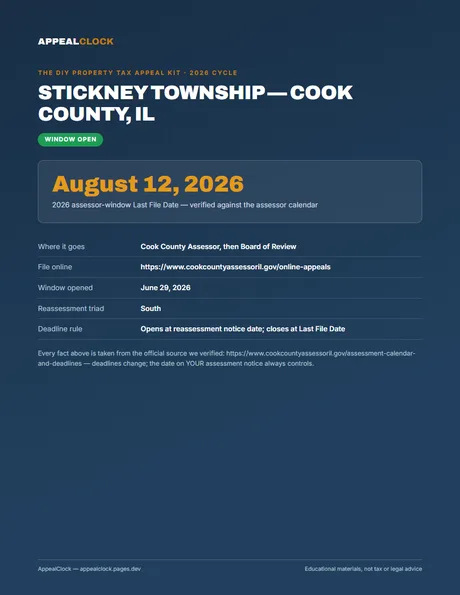
Stickney's two-stage appeal path: Assessor first, Board of Review second
Cook County runs a two-bite system that most township homeowners don't know about. Your first opportunity is with the Cook County Assessor — file during the reassessment window shown above, and the Assessor's office reviews your evidence and may revise the value before you ever need a hearing. Many cases resolve here at no cost and no hearing required.
If the Assessor's result doesn't move far enough, you get a second shot at the Board of Review — an independent three-member panel that hears appeals after the Assessor's window closes. The South triad Board of Review window is shown in the filing panel on this page. Missing the Assessor's window doesn't always mean missing the BOR window, but the strongest cases start at stage one: the Assessor's portal timestamps your evidence and creates a record the BOR will reference. The window open right now is the one that matters most — don't let it close.
The 10% math behind every Cook County appeal
Cook County assesses residential property (Class 2) at 10% of its estimated market value. The state then applies an equalization factor — the annual multiplier the Illinois Department of Revenue uses to bring Cook assessments toward the statutory 33.33% level — which amplifies every dollar of assessed-value reduction you win. A concrete example: if the Assessor values your Stickney home at $320,000 and comparable sales support $280,000, that $40,000 reduction in estimated market value becomes $4,000 off your assessed value before the state multiplier is applied. Run that through the combined tax rate of Stickney-area taxing districts and the annual saving is real money — and it compounds across the reassessment cycle while the lower value holds.
The math also clarifies why small errors on your property record card are worth fixing. A 200-square-foot overcount or a misclassified basement finish appears in the assessed value line, and every dollar there is magnified twice: once by the equalization factor, once by the tax rate.
What actually wins at the Cook County Assessor and Board of Review
Both the Assessor's staff and the Board of Review respond to organized evidence, not frustration. Three categories carry the most weight:
- Comparable sales. Three to five arms-length sales of homes near yours — similar size, age, and style — that closed before the assessment date and support a lower value than the Assessor assigned. This is the spine of nearly every successful residential appeal in Cook County.
- Property record card errors. Pull your PIN record from the Assessor's website and check square footage, bedroom and bathroom count, basement finish status, and any special features listed. Mass-appraisal models carry data errors, and a documented correction is among the fastest wins available.
- Condition evidence. The model used across the South triad cannot see a cracked foundation, a deferred-maintenance roof, or an outbuilding that no longer functions. Photos and contractor estimates for genuine physical deficiencies are persuasive at the BOR and can't be disputed with a spreadsheet.
Neighboring townships Cicero and Palos share the same South triad reassessment cycle and the same evidence standards — if you own property in more than one, the same comparable-sales research often serves both appeals.
Filing online: the portal and what to expect after
The Cook County Assessor's online portal is the fastest and safest route — it timestamps your submission, stores your uploaded evidence, and generates a confirmation number you should save. Have your PIN (property index number) ready; it appears on your assessment notice and every tax bill. You can upload comparable sales, record-card correction notes, and condition photos in a single session.
After you file, the Assessor's office reviews the submission and may issue a revised notice of value. If you accept, the appeal is closed. If the revision is insufficient — or no revision arrives — your case becomes eligible for the Board of Review. At the BOR stage a brief hearing is scheduled; most residential hearings run under twenty minutes and follow the same evidence you already submitted. The BOR decision is the end of the administrative road for most homeowners, though cases can escalate to the Illinois Property Tax Appeal Board or circuit court if the stakes justify it.
Cook County wrinkles that catch Stickney owners every cycle
Three patterns recur. First, homestead exemptions — the General Homestead Exemption, the Senior Exemption, the Senior Freeze — are applied through a separate process with their own deadlines and do not attach automatically to a successful appeal. Check your current exemption status on the Assessor's site while you have your PIN out; an unapplied exemption can cost as much as a lost appeal. The Cook County overview covers exemption filing mechanics in detail.
Second, South triad reassessment means the Assessor updated values across the entire township this cycle using a mass-appraisal model calibrated to regional sale data. A model optimized for the township median will miss neighborhood-level problems and property-specific conditions. The fact that many neighbors also received increases doesn't make the model's value for your parcel correct — it makes comparable-sale evidence more important, not less.
Third, filing an appeal does not suspend your obligation to pay the tax bill when it arrives. Pay on time to avoid penalties; if you win, the reduction comes back as a credit or refund depending on timing. Don't let the appeal process become a reason to miss a payment deadline — those run on a separate track entirely.