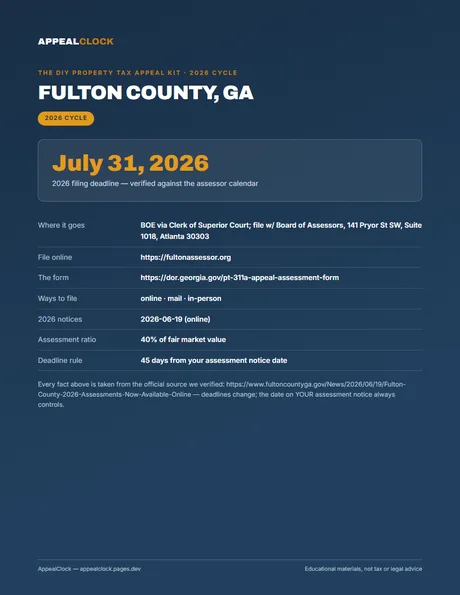
How Fulton County's 45-day appeal window actually works
The Board of Assessors mails assessment notices once a year, and your 45-day window opens the day your notice is dated — not the day it arrives in your mailbox. Fulton sends notices in batches, so while the countywide date shown above covers most parcels, the date printed in the top-right corner of your specific notice is the one that legally controls. If it differs from the reference date on this page, yours wins.
There is no extension and no second chance within the same cycle. Georgia law resets the appeal right only when next year's notice arrives. That is the whole reason this page runs a countdown: a notice dated one day and opened a week later has already burned seven days of the window without the owner knowing it.
The 40% rule and what it actually means for your bill
Under O.C.G.A. § 48-5-7, Georgia assesses property at 40% of fair market value. Your tax bill is that assessed figure — not the full appraised value — multiplied by the local millage rate. Here is what that looks like in practice: suppose Fulton County values your home at $500,000 and comparable sales support $460,000 instead. You have removed $40,000 from the appraised value, which translates to $16,000 less in assessed value. At a combined city-county millage around 30 mills, that is roughly $480 back in your pocket — and it recurs every year the lower value holds.
Winning an appeal can also trigger a value freeze under Georgia's 299(c) provision, locking the resolved assessment for the following two years in most cases. One afternoon of research and paperwork can carry real multi-year value. For a full picture of how state assessment rules shape your options, the Georgia property tax appeal guide covers the statewide framework in detail.
What actually wins at the Fulton County Board of Equalization
Fulton County appeals go to the Board of Equalization — a panel of trained citizen reviewers, not the assessor's own staff — and they respond to organized evidence, not frustration. Three categories of evidence do the work in nearly every successful residential case:
- Comparable sales. Three to five properties near yours, similar in size, age, and condition, that sold for less than your appraised value in the year before the assessment date. This is the foundation of most winning appeals.
- Property record errors. Pull your record card at fultonassessor.org and verify square footage, bedroom and bathroom count, basement or bonus-room finish, and lot size. Clerical errors appear more often than homeowners expect and are the fastest path to a lower value.
- Condition documentation. Photographs and contractor estimates for anything the county's mass-appraisal model cannot see — water intrusion, structural problems, deferred maintenance, or storm damage.
Present everything on one organized page. Boards reward homeowners who make the decision easy; a disorganized folder of screenshots rarely moves the needle.
Filing: online portal, mail, in-person, and what happens after
Fulton offers three ways to submit an appeal. The fastest is the online portal at fultonassessor.org, which timestamps your filing immediately and generates a confirmation you should save. Prefer paper? Download form PT-311A from the Georgia Department of Revenue and mail or hand-deliver it to the Board of Assessors at 141 Pryor St SW, Suite 1018, Atlanta 30303. In-person filing is accepted at that address during business hours. If you mail your appeal, use certified mail or request a USPS postmark — that date is your legal proof of timely filing.
After you submit, the Board of Assessors reviews the appeal first and may send a revised value. Accept it and the matter is closed. Decline and your case advances to the Board of Equalization for a hearing — typically a brief conversation where you walk through your comparables. Arbitration and a hearing officer are also available at election, but for a standard residential appeal the BOE path is free and practical. If the BOE result still feels wrong, Superior Court is the next step, though for most homeowners the 299(c) freeze attached to a resolved partial win is the sensible stopping point.
Homeowners in nearby counties can find jurisdiction-specific filing details at the Barrow County appeal page and the Bartow County appeal page.
Fulton County traps that catch homeowners every cycle
Four local wrinkles are worth understanding before you file. First, your assessment notice is not a tax bill — it shows the value you have the right to contest. The actual bill arrives later in the year, after the appeal window has closed, so waiting for the bill means waiting too long. Second, while an appeal is pending Fulton issues an interim bill calculated at 85% of the disputed assessed value; budget for a reconciliation payment either way once your case resolves. Third, Georgia homestead exemptions operate under a separate spring filing deadline and are not applied retroactively by a successful appeal — check your eligibility in the Georgia exemptions overview while you still have time this cycle. Fourth, if your neighborhood was swept into a mass reassessment, do not assume the increase is untouchable because your whole street received the same notice — mass-appraisal models cannot see street-level condition differences, and that is exactly the kind of evidence the Board of Equalization is designed to weigh.