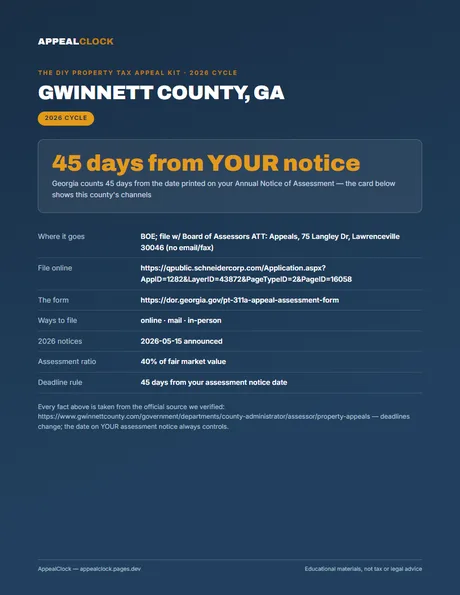
How the 45-day clock actually runs in Gwinnett County
Gwinnett mails annual assessment notices, and the 45-day appeal window opens the day that notice is dated — not the day it lands in your mailbox, and not the day you get around to opening it. The date that legally controls is the one printed on your notice. Gwinnett may publish a countywide reference deadline (shown in the panel above), but if your notice carries a different date, your notice wins.
Georgia offers no grace period and no late-appeal provision within the same tax cycle. Miss the 45-day window and your right to challenge this year's value is gone — the clock resets only when next year's notice arrives. The countdown at the top of this page exists because that window is genuinely short, and assessment notices don't come with warning sirens.
The 40% math: figuring out whether an appeal is worth your time
Georgia law (O.C.G.A. § 48-5-7) requires all counties — Gwinnett included — to assess property at 40% of fair market value. Your tax bill is that 40% figure multiplied by the combined county and school millage rate. The math matters: if Gwinnett values your home at $400,000 and comparable sales support $360,000, you've removed $40,000 of appraised value. Forty percent of $40,000 is $16,000 of assessed value. Run that against Gwinnett's combined millage and you can calculate your annual savings before you file a single form.
A successful appeal can also trigger Georgia's 299(c) value freeze, which typically holds the lower appraised value in place for the two following years. That turns one afternoon of paperwork into multi-year savings — a ratio that makes appealing worth it even when the immediate dollar figure looks modest.
What the Board of Equalization actually responds to
Gwinnett appeals route to the Board of Equalization — an independent panel of trained property owners, separate from the assessors' staff — and the board rewards specific evidence, not general dissatisfaction. Three categories do most of the work:
- Comparable sales. Three to five homes near yours, similar in size, age, and condition, that sold for less than your appraised value in the year preceding the assessment date. This is the backbone of nearly every winning residential appeal.
- Record-card errors. Gwinnett maintains a property record for every parcel — pull yours and check square footage, bedroom and bathroom count, basement finish, and lot size. A floor-area discrepancy of a few hundred square feet is more common than most homeowners expect, and it's often the fastest win available.
- Condition evidence. Photos and contractor estimates for anything the county's mass-appraisal model can't see from the road: foundation problems, deferred maintenance, an uninhabitable outbuilding, or storm damage. Attach estimates to quantify the impact.
Present everything on a single organized page. The appeal letter template and comparable-sales worksheet in the kit were built because boards give more weight to homeowners who make the decision easy, not harder.
Filing: three paths in, and what happens after
Gwinnett accepts appeals three ways. The online portal (linked in the filing panel above) is the fastest route — it timestamps your submission and returns an immediate confirmation you can save as proof. Mail works too: send form PT-311A to the Board of Assessors, ATT: Appeals, 75 Langley Dr, Lawrenceville GA 30046; if you mail it, the USPS postmark is your legal proof of timeliness, so get a dated receipt at the counter. In-person filing is also accepted at the same Lawrenceville address during normal business hours.
After you file, the Board of Assessors reviews the appeal first and may offer a revised value. Accept it and the case closes; reject it — or receive no revision — and your appeal moves to a Board of Equalization hearing, typically a 15-to-20-minute conversation where you walk through your comparables. Arbitration and hearing-officer paths are also available at filing time, but for a standard residential appeal the BOE route is free and sufficient. If the BOE result is still unsatisfactory, escalation to Superior Court is possible, though most homeowners find that a partial BOE win plus the freeze protection is the rational stopping point.
Gwinnett-specific traps that catch homeowners every cycle
A few local wrinkles are worth knowing before you file. First, the assessment notice Gwinnett mails is not a tax bill — it shows the value you have 45 days to fight. The actual bill arrives later, after the appeal window has closed. Acting on the notice rather than waiting for the bill is the single most important habit to build.
Second, filing an appeal means Gwinnett will issue a temporary bill calculated at 85% of the assessed value while the appeal is pending. Budget for a reconciliation payment (or refund) once the case resolves — it's not a penalty, just a statutory hold.
Third, homestead exemptions and property-value appeals are entirely separate filings with separate deadlines. A successful appeal does not apply exemptions retroactively. If you haven't confirmed your homestead status, the Georgia property tax appeal overview covers the exemption filing calendar — checking both in the same season makes sense.
Finally, Gwinnett has grown rapidly, and mass-reassessment waves in high-growth neighborhoods are common. If your entire street was reassessed upward at once, don't assume the increase is untouchable — the BOE exists precisely to hear individual evidence that a mass model can't capture. Homeowners in neighboring counties like Barrow and Bartow face the same mass-appraisal dynamics, and the evidence standards are identical across all Georgia counties.