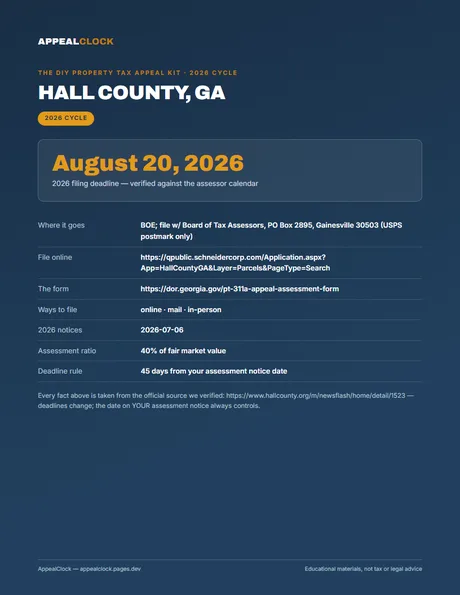
How Hall County's 45-day window actually works
Hall County mails assessment notices annually, and your filing window opens the day your notice is dated — not the day it arrives in your mailbox. The countywide deadline shown above applies to most parcels, but notices can go out in batches, so the date legally controlling your appeal is the one printed on your notice. Check the top corner of the mailer before relying on the countywide date; if yours differs, your notice date governs.
Miss the window and Georgia's appeal right doesn't carry over — the clock resets only with next year's notice. That single constraint is the reason this page has a countdown: there is no administrative grace period, no late-acceptance discretion, and no second path into this cycle.
The 40% assessment math — and why it magnifies every dollar you win
Georgia law (O.C.G.A. § 48-5-7) requires county assessors to value property at 40% of fair market value. That 40% figure — the assessed value — is what the local millage rate multiplies to produce your bill. A reduction in appraised value is therefore amplified when it hits your taxes.
Concrete example: if Hall County appraises your home at $380,000 and you can show comparable sales supporting $340,000, you've removed $40,000 from the appraisal, trimming $16,000 from your assessed value. Multiply that by your district's combined millage rate and you have your annual savings — repeated every year the lower value holds. Georgia's 299(c) freeze also locks a successfully appealed value in place for the following two years in most cases, so a single afternoon of preparation can carry four-figure savings across multiple tax cycles. The Georgia property tax appeal overview explains how this stacks with available homestead exemptions.
What actually moves the Board of Equalization in Hall County
Hall County appeals go before the Board of Equalization — a panel of trained citizens, not the assessor's own staff — and the board responds to organized evidence, not frustration with a number. Three categories do most of the work:
- Comparable sales. Three to five homes similar in size, age, and location that closed below your appraised value in the year before your assessment date. This is the backbone of nearly every winning residential appeal.
- Record-card errors. Pull your property record through the county's parcel portal and cross-check square footage, bedroom and bathroom count, basement finish status, and lot size. Errors of several hundred square feet are not uncommon, and correcting one is the fastest win available.
- Condition documentation. Photographs and contractor estimates for issues a mass-appraisal model can't see — deferred maintenance, structural problems, storm damage, or outbuildings that are functionally unusable.
Bring your argument organized on a single page. Boards reward homeowners who make the decision easy. The same evidence framework applies across the region — see the Barrow County and Bartow County pages if you're comparing how neighboring Georgia counties handle comparable evidence at the BOE level.
Filing your Hall County appeal: online, mail, or in person
Hall County offers three filing routes, all directed to the Board of Tax Assessors:
Online. The county's parcel search portal lets you locate your property record and initiate the appeal process directly — the fastest option and the one that generates a timestamped confirmation you can save. The link is in the filing table on this page.
Mail. Complete form PT-311A (available from the Georgia Department of Revenue) and send it to the Board of Tax Assessors, PO Box 2895, Gainesville, GA 30503. Hall County accepts the USPS postmark as proof of timely filing — use certified mail so you have documentation if the deadline is close.
In person. Hand-deliver a completed PT-311A to the assessor's office in Gainesville during business hours and get a date-stamped receipt.
After filing, the Board of Assessors reviews the appeal first and may issue a revised value. Accept it and the matter closes; decline and your case moves to a Board of Equalization hearing — typically a 15-minute session where you walk through your evidence. Arbitration and hearing-officer paths are also available at filing time, but for a standard residential appeal the BOE route is free and sufficient. Superior Court escalation exists if the BOE result still feels wrong, though for most homeowners a freeze from even a partial win is the pragmatic stopping point.
Hall County traps worth knowing before you file
A few local wrinkles catch homeowners every cycle. First, the assessment notice is not a tax bill — the notice showing the county's valuation is the document you can fight; the actual bill arrives later, at which point the appeal window has already closed. Second, while your appeal is pending, Hall County calculates a temporary bill at 85% of the new assessed value; budget for a reconciliation payment or refund once the appeal resolves. Third, homestead exemptions are a completely separate filing with their own spring deadline — appealing your appraised value does not retroactively apply an exemption you haven't formally claimed, so check your eligibility as a parallel step. Finally, if your subdivision was reassessed as part of a neighborhood-wide update, don't assume the increase is beyond challenge. Mass-appraisal models systematically miss property-specific problems — condition issues, access constraints, street-level obsolescence — and the BOE exists precisely to hear that kind of evidence.