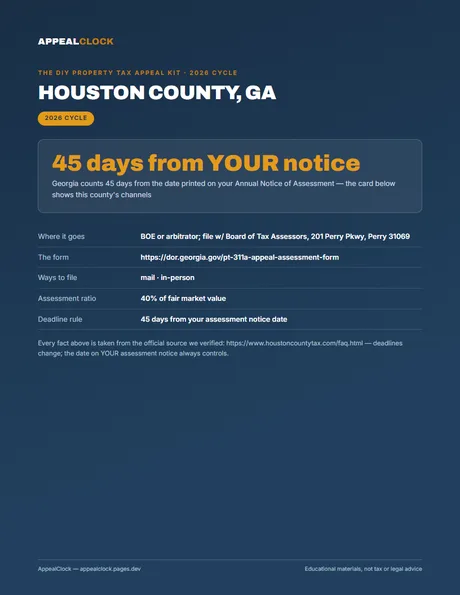
How the 45-day window works in Houston County
Houston County mails assessment notices once a year, and the appeal clock starts on the date printed on your notice — not the day it arrives in your mailbox. The countywide deadline shown above applies to most parcels, but the legally controlling date is the one on your notice. Check the top of the notice before you calendar anything; if your date differs from the countywide date, yours is what matters.
Miss the window and Georgia law gives you no path forward until next year's notice. There is no extension, no hardship exception, and no informal workaround. Your appeal right simply resets with the next annual mailing — which is exactly why this page keeps a countdown running. A vacation week or a slow-arriving notice can cost you an entire cycle.
The 40% math that determines whether filing is worth it
Georgia law (O.C.G.A. § 48-5-7) requires every county to assess property at 40% of fair market value. Your tax bill is that 40% figure multiplied by the local millage rate — not the full appraised value. Concrete example: if the Board of Tax Assessors values your home at $280,000 and comparable sales support $250,000, you've removed $30,000 from the appraisal — which is $12,000 off the assessed base. At a combined millage around 30 mills, that's roughly $360 off the annual bill. And a successful appeal typically locks your value for the following two years under Georgia's 299(c) freeze, so one afternoon of paperwork can protect you across multiple billing cycles.
Houston County is one of Middle Georgia's faster-growing markets, which means the assessors' mass-appraisal model can drift from street-level reality. The Georgia property tax appeal system exists precisely to correct those gaps at the individual parcel level.
What actually wins at the Board of Equalization
Houston County appeals that aren't resolved at the assessor level move to the Board of Equalization — a panel of trained local residents, not assessor staff — and they respond to evidence, not frustration. Three things carry the room:
- Comparable sales. Three to five homes near yours, similar in size, age, and condition, that sold before the assessment date for less than your appraised value. This is the backbone of nearly every winning residential appeal.
- Record-card errors. Pull your property record from the Board of Tax Assessors and verify square footage, bedroom and bathroom count, basement finish status, and lot size. A 200-square-foot data-entry error is not rare, and it's often the fastest win available.
- Condition documentation. Photographs and written repair estimates for anything a mass-appraisal model can't detect — foundation issues, drainage problems, storm damage, or a deteriorated outbuilding still on the books at assessed value.
Organize your evidence on a single page. Boards reward homeowners who make the decision easy; a folder of unsorted screenshots doesn't accomplish that. The same evidence framework applies across Georgia's county systems — see how neighboring jurisdictions handle it on the Bartow County and Barrow County pages.
Filing in Houston County: mail and in-person only
Houston County does not offer an online appeal portal. Your two options are mailing form PT-311A or delivering it in person to the Board of Tax Assessors at 201 Perry Pkwy, Perry, GA 31069. The filing table below lists office hours. Both methods are equally valid — the difference is your paper trail.
If you mail your appeal, send it certified mail with return receipt requested. The USPS postmark is your proof of timely filing, and you want that documentation in hand before the window closes. If you deliver in person, ask the counter staff to date-stamp your copy before you leave — don't walk out without it.
After you file, the Board of Tax Assessors reviews your appeal first and may offer a revised value. Accept it and the matter is closed. If the revised value still doesn't reflect market reality, your case advances to the Board of Equalization for a hearing — typically a 15-to-20-minute conversation where you walk through your comparable sales and any record errors. You may also elect arbitration at filing time, but for most residential appeals the BOE path is free and effective. If the BOE outcome still feels inaccurate, Superior Court is available, though for most homeowners the 299(c) freeze from a partial win outweighs the cost and time of litigation.
Houston County traps worth knowing before you file
Three wrinkles catch property owners every cycle. First, the assessment notice is not your tax bill — it shows the value you have 45 days to challenge. The actual bill arrives later, after your appeal window has closed. Treat the notice like a deadline, not a formality.
Second, Georgia requires you to pay a temporary bill — typically calculated at 85% of the new assessed value — while your appeal is pending. Budget for a possible reconciliation payment or refund depending on the outcome; the net savings are usually still significant, but the timing can surprise people.
Third, homestead exemptions are a completely separate filing with their own spring deadline. Winning an appeal doesn't apply them retroactively, and they don't apply automatically. While you're already reviewing your assessment, check your eligibility through the Houston County Tax Commissioner's office — the two levers stack, and you may be leaving money on the table by only pulling one. The Georgia property tax appeal overview covers statewide exemptions that can reduce your taxable base further.
Finally, if your neighborhood was part of a mass reassessment, don't assume the county's figure is accurate simply because everyone on the block received a similar notice. Mass-appraisal models are built for speed, not parcel-level precision. Street-level problems — drainage, condition, micro-market softness — are exactly what the Board of Equalization exists to hear.