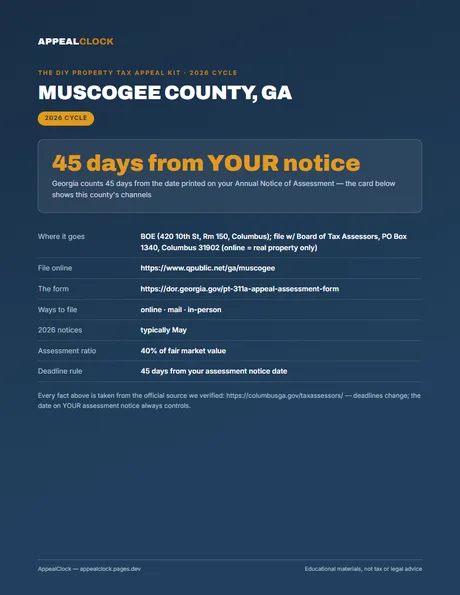
How the 45-day clock works in Muscogee County
Muscogee County — the consolidated city-county government centered in Columbus — mails assessment notices once a year, and the appeal window opens the day your notice is dated, not the day it arrives in your mailbox. Columbus issues notices in batches, so your personal date may differ slightly from a neighbor's. The date printed in the top corner of your notice is the one that legally controls — verify it before relying on any countywide estimate.
Miss the window and the right to appeal is gone for this cycle. Georgia's appeal clock resets only when next year's notice arrives. That is the entire reason this page carries a countdown above.
The 40% math: when an appeal is worth your afternoon
Georgia law requires all property to be assessed at 40% of fair market value (O.C.G.A. § 48-5-7). Your tax bill is that assessed figure multiplied by Muscogee County's combined millage rate. Concrete example: if the Board of Tax Assessors values your Columbus home at $220,000 and comparable sales support $195,000, you have reduced the appraised value by $25,000 — removing $10,000 from your taxable base and producing real annual savings that hold across the life of the lower value.
A successful appeal typically triggers Georgia's 299(c) freeze, locking the resolved value for the two years following — so one organized filing can cover three tax cycles. You can verify your current assessed value and property record at the county assessor's portal before deciding whether the gap between the county's number and recent sales justifies filing. If you want the statewide framework first, the Georgia property tax appeal guide lays out the full system.
What wins at the Muscogee County Board of Equalization
Appeals that survive the Board of Assessors' initial review proceed to the Board of Equalization — a citizen panel sitting at 420 10th St, Rm 150 in Columbus, not assessors' staff. They respond to evidence, and NTUF data consistently shows 40–60% of homeowners who file see some reduction. Three categories of evidence carry the most weight:
- Comparable sales. Three to five homes near yours, similar in size and age, that sold for less than your appraised value in the year before the assessment date. This is the foundation of nearly every winning residential appeal.
- Record-card errors. Pull your property card from the qPublic portal and check square footage, bedroom and bath counts, lot size, and noted improvements. Measurement errors are common in mass-appraisal systems and represent the fastest win available.
- Condition documentation. Photos and contractor estimates for anything the county's model cannot observe — foundation issues, storm damage, or deferred maintenance. The BOE can only weigh what you put in front of them.
An organized one-page summary beats a folder of loose screenshots. The letter template in the Georgia appeal guide shows exactly how to structure your presentation.
Three ways to file — online, mail, and in person
Muscogee County supports all three filing routes, and the right choice depends on your property type and how much runway you have before the deadline:
- Online. The qPublic portal handles real property appeals electronically and timestamps your submission instantly. Save the confirmation email — it is your proof of filing.
- Mail. Send PT-311A to the Board of Tax Assessors, PO Box 1340, Columbus, GA 31902. Mail several days before the window closes and request a USPS postmark — the postmark date controls legally, not the date the office receives it.
- In person. Walk the completed form to 420 10th St, Rm 150 and ask for a date-stamped copy. This is the most reliable method if you are filing in the final days of the window.
Form PT-311A is a one-page state form available from the Georgia DOR. After filing, the Board of Assessors reviews first and may offer a revised value. Accept it and the case closes; decline and it advances to a BOE hearing — typically a 15-minute conversation where you walk through your comps. Arbitration and hearing-officer paths are also available at the time of filing, but for a standard residential appeal the BOE route is free and effective for most Columbus homeowners.
Muscogee-specific traps worth knowing
A few local wrinkles catch Columbus homeowners off guard every cycle. First, the assessment notice is not a tax bill — it shows the value you can contest, not money due. The actual bill arrives later, well after the appeal window has closed. Second, a pending appeal triggers an interim bill calculated at 85% of the county's proposed value; budget for a reconciliation payment when the case resolves, whichever direction it goes. Third, homestead exemptions are a separate filing with their own spring deadline — an appeal does not apply them retroactively, so confirm your exemption status while you already have the assessor's portal open.
If your street saw a mass reassessment, do not assume the new value is untouchable. Mass-appraisal models apply broad neighborhood adjustments that routinely miss block-level or lot-specific problems, which is exactly what the BOE exists to correct. Homeowners in neighboring Barrow County and Bartow County face identical mechanics — the 40% ratio and BOE structure are statewide — so comp research and hearing strategy transfer cleanly across county lines.