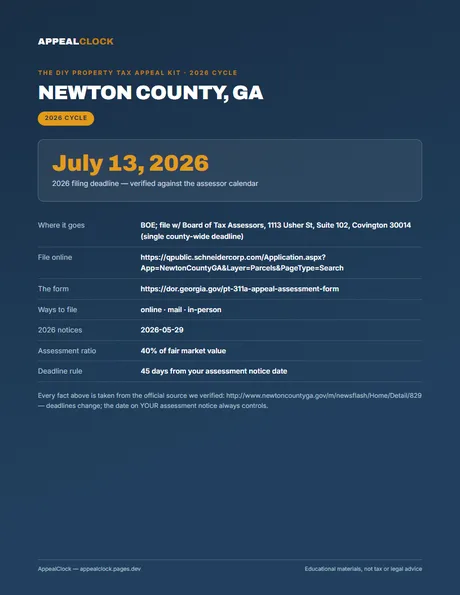
How Newton County's 45-day window actually works
Newton County mails assessment notices once a year, and Georgia law starts your 45-day clock on the date printed on the notice — not the day it arrives in your mailbox, and not the day you open it. That single date in the upper corner of the notice is the one that legally controls.
The deadline shown above reflects the countywide reported date, but notices can go out in batches, so your personal date may fall slightly earlier or later. Because the deadline here carries reported confidence rather than direct verification, the safest move is to check the date on your specific notice and count 45 days from there. If your date differs from the countywide figure on this page, yours wins.
Miss the window and Georgia law provides no second chance this cycle — your appeal right resets with next year's notice. That's the only reason this page carries a countdown.
The 40% math that decides whether appealing is worth it
Georgia assesses property at 40% of fair market value under O.C.G.A. § 48-5-7. Your tax bill is that 40% figure — the assessed value — multiplied by the local millage rate. That structure is what makes a successful appeal compound in your favor year over year. Concrete example: if the county places your Newton home at $280,000 and comparable sales support $250,000, you've removed $30,000 of appraised value — which is $12,000 of assessed value. At a combined millage in the 30-mill range, that's roughly $360 off your annual bill, and in Georgia a resolved appeal typically freezes your value for two additional years under the 299(c) rule. One afternoon of organized paperwork can realistically be worth over $1,000 across the cycle.
The math holds even on a modest claim: a $10,000 appraised-value reduction becomes $4,000 of assessed value and still saves real money each year. The question isn't whether the effort is worth it — it's whether your evidence is strong enough. The Georgia property tax appeal guide lays out the statewide framework before you start building your case.
What actually wins at Newton County's Board of Equalization
Newton County appeals that aren't resolved at the Board of Tax Assessors level move to the Board of Equalization — a panel of trained citizens, not assessor staff — and they rule on evidence, not frustration. Three types carry the room:
- Comparable sales. Three to five homes near yours, similar in size, age, and condition, that sold for less than your appraised value in the period before the assessment date. This is the foundation of nearly every successful residential appeal.
- Property record errors. Pull your record card through the county's qPublic parcel search and verify square footage, bedroom and bathroom counts, garage classification, and lot acreage. A 200-square-foot entry error in the county's database is not unusual and is among the fastest wins available.
- Condition evidence. Photographs and contractor estimates for anything a mass-appraisal model can't see — drainage problems, deferred maintenance, structural issues, or storm damage. Newton County has absorbed significant residential growth, and mass models calibrated on new construction can overvalue older or distressed stock.
Bring your evidence condensed to one organized page. Boards respond to homeowners who make the decision easy; a folder of loose screenshots works against you.
Filing: portal, mail, and in-person walk-in
Newton County offers three routes to file, and all three are free.
Online portal — The fastest path is the qPublic parcel portal, which lets you locate your property and initiate a review. An electronic submission timestamps your appeal instantly and produces a confirmation to save.
Mail — Download and complete form PT-311A from the Georgia Department of Revenue and mail it to the Board of Tax Assessors at 1113 Usher St, Suite 102, Covington, GA 30014. If you mail it, the USPS postmark is your legal proof of timely filing — use certified mail and keep the receipt.
In person — You can also deliver the completed PT-311A directly to the Usher Street office. Walking it in lets you confirm receipt on the spot and ask basic procedural questions.
After filing, the Board of Tax Assessors reviews first and may offer a revised value. Accept it and the case closes. Decline — or receive no change — and your appeal moves to a Board of Equalization hearing, typically a 15-minute session where you walk through your comparables. You may also elect arbitration or a hearing officer at filing time, but for standard residential appeals the BOE path is free and resolves the vast majority of cases cleanly. Superior Court remains an option if the BOE result is still wrong, though the Georgia 299(c) freeze from even a partial win often makes escalation unnecessary.
Newton County traps worth knowing
Four patterns catch property owners every cycle in Newton County.
The notice is not a bill. The assessment notice shows the value you can challenge; your tax bill arrives separately, by which point the appeal window has closed. If you're waiting for the bill before acting, you've already lost the chance.
Interim billing at 85%. Filing an appeal means your temporary bill during the appeal period is calculated at 85% of the disputed value. Budget for a reconciliation — either a refund or a balance due — when your case resolves.
Homestead exemption is a separate filing. An appeal adjusts assessed value; it does not create or apply a homestead exemption. Exemptions have their own spring deadline with the county. Review the Georgia appeal guide for exemption timing while you're already in the paperwork — missing that deadline is a separate, costly mistake.
Mass reassessments in a fast-growing county. Newton County's rapid residential expansion means countywide reassessments can sweep in streets where individual home conditions diverge sharply from the model's assumptions. A mass increase can feel like a done deal — but mass models miss street-level problems, which is exactly what the BOE exists to hear. Neighboring counties face the same dynamic: see the Barrow County appeal guide and the Bartow County appeal guide for the same evidence strategy applied nearby.