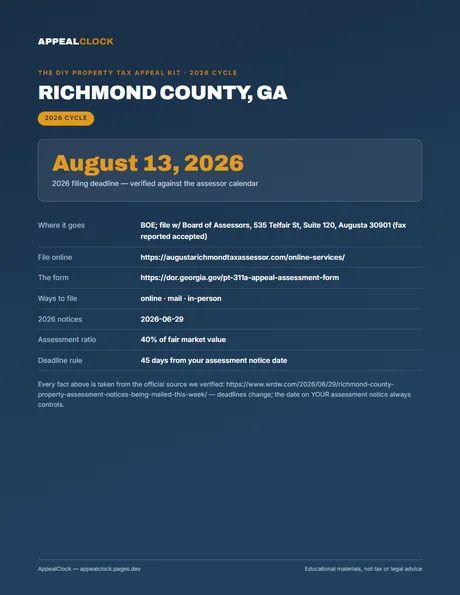
How Richmond County's 45-day window actually works
Augusta-Richmond County mails assessment notices once per cycle, and the clock starts from the date printed on the notice — not the day you find it in the mailbox. The countywide deadline shown above is based on reported mailing timing; because batches can go out across several days, the date on your notice is the one that legally controls. Verify it before relying on the countywide figure.
Georgia gives you one shot per cycle. Miss the 45-day window and there is no path to appeal until next year's notice arrives — which is the only reason a countdown belongs on a page like this one.
The 40% assessment math — why the appraised value is the real fight
Under O.C.G.A. § 48-5-7, Georgia assesses property at 40% of fair market value. Your tax bill is that 40% figure multiplied by the local millage rate — in Augusta-Richmond County that combined rate spans the mid-20s to low-30s per $1,000 of assessed value depending on district and school zone. Concrete example: if the county appraises your home at $210,000 and you can document comparable sales that support $180,000, you've removed $30,000 of appraised value — which is $12,000 of assessed value. At 28 mills, that's roughly $336 off the annual bill, and the saving repeats every year the lower value holds.
Georgia also has a 299(c) freeze: a value resolved through appeal is typically held for the following two years, meaning one successful appeal protects your assessment for an entire property tax cycle. That return on a few hours of paperwork is why the Georgia property tax appeal guide emphasizes acting every cycle the number looks wrong.
Evidence that moves Richmond County's Board of Equalization
Richmond County appeals route to the Board of Equalization — trained community members, not the assessors who set the value — and they respond to organized evidence, not arguments about fairness. Three categories carry the room:
- Comparable sales. Three to five homes near yours — similar square footage, age, and condition — that sold for less than your appraised value in the twelve months before the assessment date. This is the backbone of nearly every successful residential appeal.
- Property record errors. Pull your record card from the assessor and cross-check square footage, bedroom and bathroom count, basement finish status, and lot size. A 200- or 300-square-foot overcount is not uncommon and is the fastest correction available — you don't need comps to win a factual mistake.
- Condition documentation. Photos and contractor estimates for anything the county's mass-appraisal model can't see: foundation issues, a deteriorating outbuilding, water intrusion, deferred maintenance. Estimates carry more weight than photos alone.
Present everything on one organized page. Boards across Georgia — Barrow, Bartow, Richmond — reward homeowners who make the decision easy, not homeowners who make the hearing feel adversarial.
Three ways to file — and what happens after you submit
Richmond County offers more filing paths than most Georgia counties. The fastest is the online portal at the Augusta-Richmond Tax Assessor's website (linked in the filing table below) — it timestamps your submission and generates a confirmation to keep. If you prefer paper, file form PT-311A by mail or drop it off in person at the Board of Assessors, 535 Telfair St, Suite 120, Augusta 30901. Fax is reported to be accepted as well; confirm the current fax number with the office before sending. For mailed submissions, the USPS postmark is your proof of timely filing — send it certified.
After you file, the Board of Assessors reviews first and may offer a revised value. Accept it and the case closes; decline and your appeal advances to a Board of Equalization hearing — typically a 15-minute presentation where you walk through your comps and any record-card corrections. The BOE path is free. Arbitration and a hearing officer are available alternatives at filing time, but for a standard residential appeal the BOE is the practical choice. If the BOE result still feels wrong, Superior Court is the next step, though the 299(c) freeze from a partial win often makes that escalation unnecessary.
Richmond County traps that catch homeowners every cycle
Four patterns repeat every year in Augusta. First, the assessment notice is not a tax bill — it shows the value you can contest; the actual bill arrives later, after the appeal window has closed. Don't wait for the bill before acting. Second, filing an appeal means your interim tax payment is calculated at 85% of the proposed value until the case resolves — budget for a reconciliation payment or refund when the final value is set. Third, homestead exemptions are a completely separate filing with their own spring deadline; a successful appeal does not apply them retroactively, and many homeowners leave exemption savings untouched by confusing the two processes. Review your eligibility at the Georgia appeal and exemption overview while you have the assessor's site open. Fourth, if your neighborhood was reassessed en masse, don't assume the increase is airtight — mass-appraisal models apply broad averages and miss street-level condition differences, which is exactly what the Board of Equalization is built to hear.