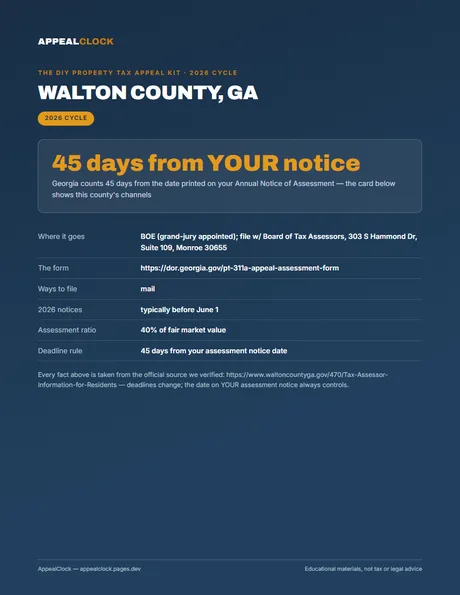
How the 45-day window works in Walton County
The clock starts from the date printed on your assessment notice — not the day it arrives in your mailbox or the day you open it. Walton County issues notices annually, and while a general countywide deadline appears in the band above, the date that legally controls your window is the one on your specific notice. Check the top corner of the notice; if it differs from the countywide figure, yours governs.
Missing the window forfeits your right to appeal for the entire cycle. Georgia resets the clock only with the following year's notice, which is why the countdown on this page exists and why acting early is worth doing.
The 40% math that decides whether filing is worth it
Georgia law (O.C.G.A. § 48-5-7) assesses all real property at 40% of fair market value. Your bill is that assessed figure multiplied by the local millage rate. If the county values your home at $320,000 and comparable sales support $285,000, you've removed $35,000 of appraised value — $14,000 off the assessed base. At a combined millage rate around 30 mills (Walton's composite rate varies by city and school district; verify yours on the bill), that reduction runs roughly $420 per year.
The compounding effect matters. A successful appeal typically triggers Georgia's 299(c) value freeze for the two following years, meaning one afternoon of paperwork can pay off across three tax cycles. That's the calculation worth running before deciding whether to file.
What the Walton County BOE actually weighs
Walton County's Board of Equalization is appointed by the grand jury — trained community members, not assessor staff — and their standard is evidence, not frustration. Three categories carry the most weight in residential cases:
- Comparable sales. Three to five homes near yours, similar in size and age, that sold for less than your appraised value in the period before the assessment date. This is the spine of nearly every winning appeal.
- Record-card errors. Pull your property card from the assessor's office and check square footage, bedroom and bathroom count, basement finish, and lot size. Input errors are common in mass-appraisal models and among the fastest wins available.
- Condition evidence. Photos, contractor estimates, or inspection reports for problems the county's model can't see — structural issues, drainage problems, storm damage, a deteriorated outbuilding.
Bring your evidence organized on a single page. BOE hearings move quickly, and boards reward homeowners who make the decision straightforward.
Filing by mail: PT-311A and what happens after
Walton County does not offer an online appeal portal — all appeals must be filed on form PT-311A, mailed to the Board of Tax Assessors at 303 S Hammond Dr, Suite 109, Monroe, GA 30655. The form is available from the Georgia Department of Revenue. If you're filing near the deadline, take the envelope to a USPS counter and request a dated postmark; it's your proof of timely filing if any question arises later.
Once your appeal is on file, the Board of Assessors reviews it first and may offer a revised value. Accept and the case closes. If you don't accept, the appeal moves to the Board of Equalization for a short hearing — typically 15 minutes where you walk through your comparable sales and any record errors. The BOE path is free and appropriate for most residential appeals. If the BOE result still feels inaccurate, Georgia allows further escalation to binding arbitration or Superior Court, though for most homeowners the value freeze from a resolved BOE appeal is the practical stopping point.
Walton County traps that catch filers every cycle
A few local patterns trip up homeowners each year. First, the assessment notice is not your tax bill — it shows the value you can contest. The actual bill arrives later, when the appeal window is already closed. Second, while your appeal is pending, Walton collects a temporary bill at 85% of the new assessed value; budget for a reconciliation payment or credit once the appeal resolves either way. Third, homestead exemptions are a separate application with their own spring deadline — filing an appeal does not apply them retroactively. The Georgia property tax appeal guide covers exemption deadlines and statewide procedures worth checking while you have the paperwork out.
Finally, if your neighborhood was reassessed broadly, don't assume the increase is beyond challenge. Mass-appraisal models miss street-level conditions — foundation problems, drainage issues, inferior finishes — and the BOE exists specifically to hear those cases. Homeowners in neighboring Barrow County and Bartow County operate under the same 45-day Georgia framework, though each county's assessor office and BOE procedures differ in the details.