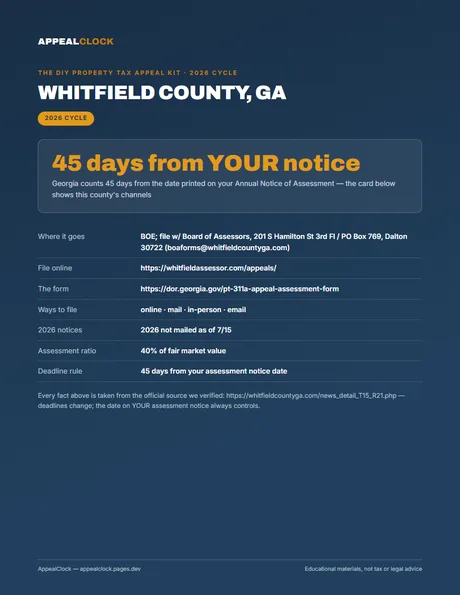
How the 45-day clock works in Whitfield County
The appeal window opens the day your assessment notice is dated — not the day it arrives, and not the postmark. Whitfield County's Board of Assessors mails notices annually, and because batches can go out over several days, the date printed on your notice is the one that legally controls. The countywide deadline shown at the top of this page reflects the standard cycle, but check the date at the top of your actual notice first — if yours differs, yours wins.
Missing the window by even one day forfeits your appeal right for the entire cycle. Georgia resets the clock only when next year's notice arrives, with no administrative remedy in between. That's the whole reason this page carries a live countdown rather than a static date.
The 40% assessment math and why Whitfield appeals pay off
Georgia law sets every county's assessment ratio at 40% of fair market value (O.C.G.A. § 48-5-7), and Whitfield follows that rule. Your tax bill is that 40% figure — the assessed value — multiplied by the combined millage rate for your city, county, and school district. Every dollar you remove from appraised value is worth forty cents of assessed-value reduction, and mills apply on top of that.
Practical example: if the county appraises your home at $280,000 and recent comparable sales support $250,000, you've identified a $30,000 gap — which is $12,000 of assessed value. At Whitfield's combined millage, that difference typically produces several hundred dollars in annual savings. A successful appeal also triggers a two-year value freeze under Georgia's 299(c) provision in most cases, meaning the same reduction carries forward for two additional cycles without re-filing. One afternoon of documentation routinely produces three years of protection.
What wins at the Board of Equalization
Whitfield County appeals are heard by the Board of Equalization — an independent panel of trained local residents, not the assessor's staff — and they respond to organized evidence, not general frustration about rising values. Three categories consistently move hearings:
- Comparable sales. Three to five recent sales of nearby homes with similar size, age, and condition that closed below your appraised value. Sales from the twelve months before the assessment date carry the most weight and form the spine of nearly every winning residential case.
- Record-card errors. Pull your property record from the county and verify square footage, bedroom and bathroom counts, garage type, basement finish, and lot size. Data-entry errors are common enough that this check alone occasionally produces a corrected value without a full hearing.
- Condition documentation. Photos and written repair estimates for anything the county's mass-appraisal model can't observe from the street — foundation issues, storm damage, deferred maintenance, or drainage problems. Physical-condition arguments the model missed are legitimate and frequently underused.
Consolidate your evidence onto one or two pages. Boards reward submissions that make the decision easy; a well-structured appeal letter signals preparation before you say a word.
Four ways to file in Whitfield County
Whitfield gives you more filing paths than most Georgia counties. The online portal at whitfieldassessor.com/appeals/ is the fastest option — it timestamps your appeal instantly and generates a confirmation record. If you prefer paper, mail the completed PT-311A to PO Box 769, Dalton, GA 30722; the USPS postmark serves as your proof, so get one at the counter rather than dropping it in a blue box. In-person delivery is accepted at the Board of Assessors office at 201 S Hamilton Street, Third Floor, Dalton — ask for a dated receipt. If you're filing close to the deadline, email your form and supporting documents to boaforms@whitfieldcountyga.com and retain the sent-message timestamp as evidence of timely filing.
After submission, the Board of Assessors reviews first and may offer a revised value. Accept it and the case closes. Decline and your appeal advances to a Board of Equalization hearing — typically a 15-to-20-minute session where you walk the panel through your comparables and any condition evidence. Arbitration and a hearing-officer option are available at filing time, but for a standard residential appeal the BOE path is free and effective. Superior Court remains available if the BOE result still feels wrong, though for most homeowners a partial win combined with the 299(c) freeze is the practical stopping point.
Whitfield County traps that catch homeowners every cycle
A few local patterns trip up otherwise prepared filers. First, the annual assessment notice is not a tax bill — it shows the value you can challenge. The actual bill arrives later, after the appeal window has already closed. Treat them as separate documents with separate deadlines.
Second, filing an appeal means your interim tax bill is calculated at 85% of the new assessed value while the case is pending. When the appeal resolves, a reconciliation payment or credit applies depending on the outcome — budget for it in either direction.
Third, homestead exemptions and appeals are entirely separate filings with separate deadlines. A successful appeal does not automatically apply your homestead exemption, and the exemption's spring filing deadline is well before the appeal window opens. Check your exemption status while you're reviewing the notice — the Georgia property tax appeal guide covers statewide exemption rules in full.
Finally, if your neighborhood was mass-reassessed, don't assume the increase is uncontestable. Mass-appraisal models are built on broad averages and routinely miss property-specific problems — which is precisely what the BOE exists to hear. Homeowners in neighboring Barrow County and Bartow County face the same dynamic, and in both cases individual evidence consistently outweighs the neighborhood trend at the board level.