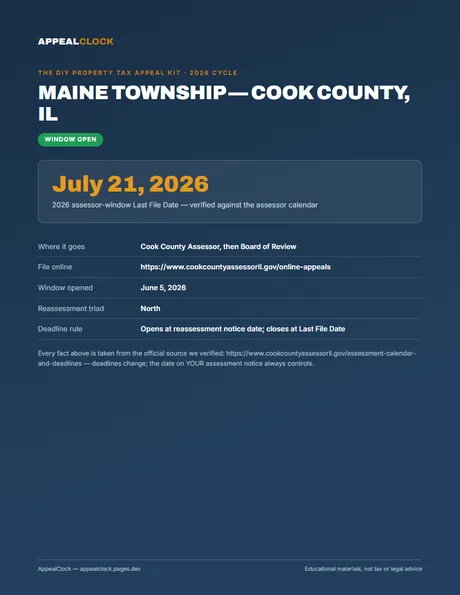
How Maine Township's appeal window works — and why it closes fast
Cook County reassesses property on a triennial cycle, rotating through three geographic triads. Maine Township lands in the North Triad, and when the Assessor mails your reassessment notice, a countdown begins. The window closes on the Last File Date shown in the band above — not when your neighbor files, not when the tax bill arrives, but on that specific cutoff for Maine Township parcels.
The notice is not a bill. It is a proposed value, and it is the only thing you can legally contest at the Assessor level this cycle. Miss the Last File Date and the Assessor's door closes — though the Board of Review provides a second window, described below. That two-stage structure is what makes Cook County different from most Illinois counties and worth understanding before you file.
The Cook County assessment math that decides whether appealing is worth it
Illinois law sets the assessment level for Class 2 residential property at 10% of market value. The Illinois Department of Revenue then applies an annual state equalization factor — the so-called multiplier — to bring the county's overall assessment level to the statutory 33.33% of market value. Your tax bill is computed against that equalized assessed value (EAV), not against market value directly.
In practice, a reduction in your appraised value travels through two multiplications before it reaches your bill. A downward revision to your assessed value first lowers your base by 10% of that revision; the state multiplier — which has historically run in the high-2x to low-3x range for Cook County — then amplifies the reduction in your EAV. Multiply the resulting EAV drop by your combined local tax rate and you have your annual savings, recurring for each year the lower value holds. The math rewards filing even when the underlying disagreement feels modest.
What actually wins at the Cook County Assessor and Board of Review
Both the Assessor's review and the Board of Review respond to organized evidence, not to frustration about rising values. Three categories carry nearly every successful residential appeal:
- Comparable sales. Three to five closed sales of similar homes in your Maine Township neighborhood — similar size, age, and condition — that sold below your proposed assessed value. Sales from the year prior to the assessment date carry the most weight. Pull these from public records or the county's sales search before you file.
- Record card errors. The Assessor's property record card drives the mass model. Errors in square footage, bedroom and bathroom count, basement finish, and lot size are common — and each can be corrected on appeal with documentation you already own: a closing disclosure, building permit, or dated photos. A verified square-footage discrepancy is the fastest win available.
- Uniformity and equity. Illinois law allows you to argue that your assessment is out of line with comparable properties even if the absolute value seems defensible. If neighboring homes of similar size and age are assessed lower, that inequity is grounds for relief under Cook County's system — and it is the Board of Review's core mandate to correct it.
Bring your evidence organized on a single page. Boards respond to clarity, and the Assessor's portal lets you attach supporting documents at the time of submission.
Filing with the Assessor — portal, paper, and what happens next
The fastest path is the Cook County Assessor's online portal at cookcountyassessoril.gov/online-appeals — it timestamps your submission and returns a confirmation immediately. You can attach comparable sales, a corrected record card, and condition photos in the same session. Paper filings are accepted at Assessor district offices, but the portal removes any question about whether your appeal arrived before the Last File Date shown above.
After submission, Assessor staff reviews your evidence and may issue a revised value. If you accept, the matter is closed for this cycle. If the revision is insufficient or none comes, your case becomes eligible for the Board of Review — a separate three-member panel that holds its own evidentiary hearings. The BOR North Triad session dates are shown in the filing panel above. You do not refile from scratch; the Board of Review is a continuation of the same appeal cycle. For most Maine Township homeowners, working both stages is the optimal path — the Assessor's review costs nothing extra and sometimes resolves the case cleanly before the BOR is needed.
Maine Township traps that catch filers every cycle
Four issues recur in North Triad appeals. First, the reassessment notice is not a tax bill — do not wait for the bill to arrive before acting, because by then the appeal window has already closed. Second, Cook County's homeowner exemption, senior freeze, and other available exemptions are separate filings with their own deadlines; a successful appeal does not apply missed exemptions retroactively, so confirm yours are in place while you're engaged with the process — the Cook County overview covers which exemptions to check. Third, Maine Township spans several municipal boundaries — Park Ridge, Des Plaines, Niles, Morton Grove, and others — so draw your comparable sales from your actual neighborhood rather than the full township; courthouse distances matter in mass models. Fourth, when the North Triad is reassessed, increases tend to land across many parcels at once; a mass upward revision is not automatically accurate. The same pattern plays out in Cicero Township and Palos Township each cycle, and the Board of Review's uniformity standard exists precisely to correct it.