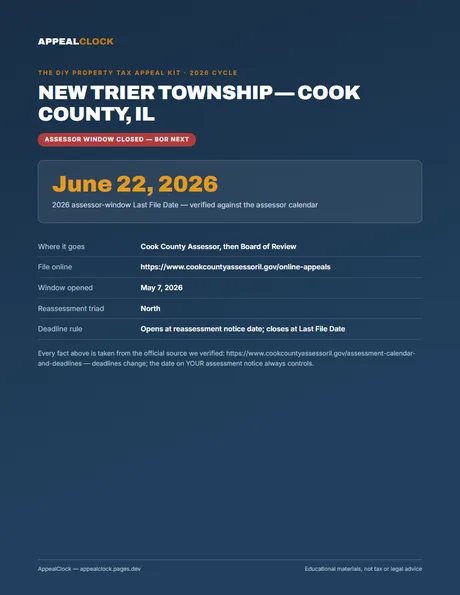
The Assessor window is closed — the Board of Review is your real second chance
Cook County's appeal system has two independent tiers that run on separate calendars. The first tier — the Cook County Assessor's appeal — has closed for New Trier Township's current cycle. The second tier is the Cook County Board of Review, a separately elected three-member body that is not bound by anything the Assessor concluded and operates on its own filing window (shown in the panel above). Critically, you can file with the Board of Review even if you never appealed at the Assessor level — the two processes are legally distinct.
The BOR's mandate is specifically to correct overassessments, which gives it a structurally different posture than the office that originally set your value. A successful BOR appeal reduces your assessed value for the tax year at issue, cutting your bill and establishing a lower baseline. For a full picture of how both tiers interlock across all townships, the Cook County property tax appeal overview walks through the mechanics and what to expect at each level.
The 10% assessment math — and why the equalization factor multiplies your savings
Illinois law sets the assessment level for residential property at 10% of fair market value (35 ILCS 200/9-145). The Cook County Assessor estimates your property's market value and takes 10% of that as your assessed value. From there, the Illinois Department of Revenue applies an annual equalization factor — adjusted to push Cook County's aggregate assessments toward the statutory 33.33% standard — to produce your equalized assessed value (EAV). Your local millage rates are applied to the EAV, not the assessed value, when calculating your bill.
In recent Cook County cycles the equalization factor has generally run in a range that means each dollar of assessed-value reduction produces roughly three dollars of EAV reduction. In a North Shore township like New Trier, where combined rates across school districts, municipality, and county regularly exceed 10%, those dollars accumulate quickly. If the BOR reduces your assessed value by $20,000, your EAV drops by roughly $60,000 — and at a 10% combined rate, that's approximately $6,000 off your annual bill, repeating until the next triennial reassessment. Your exact millage rate appears on your most recent tax bill.
What the Board of Review actually responds to
The BOR is a formal quasi-judicial body — it takes evidence, holds hearings on request, and issues written decisions. Three categories carry the most weight in residential appeals:
- Comparable sales. Three to five arm's-length sales of homes similar to yours — matching square footage tier, age, and condition — that closed before the assessment date at prices below your implied market value. This is the spine of most winning cases. The Cook County Assessor's public portal and local MLS data are the two primary sources.
- Record-card errors. Your property record card (available on the Assessor's website) lists square footage, bedroom and bathroom counts, garage, basement finish status, and lot size. A 200-square-foot overstatement or a basement listed as finished when it isn't can justify a meaningful reduction, and these errors appear more often than owners expect.
- Condition and functional issues. Foundation problems, deferred maintenance, an outbuilding in disrepair, or any defect the Assessor's mass-appraisal model cannot see from the street. Photos and contractor estimates are the currency here — they document what the model assumed away.
Organize everything into a single coherent document. The BOR processes hundreds of New Trier appeals each cycle and responds well to homeowners who make the logic easy to follow. One page with your comp table and the relevant record-card field highlighted beats an unorganized folder of screenshots every time.
Filing with the Board of Review: from submission to decision
The Board of Review accepts filings online and by mail. Online filing is the faster path — it generates a timestamped confirmation that removes any ambiguity about whether you met the deadline. The BOR's township-by-township schedule is published on the Cook County Assessor's assessment calendar, and the deadline for New Trier is shown in the panel above.
After submission, the BOR's analyst staff reviews your evidence. Most residential appeals are resolved as a record review rather than a live hearing, though you can request an in-person appearance if you want to present your case directly. Decisions typically arrive weeks to months after the close of the window. If the BOR reduces your value, the corrected figure flows to the Cook County Treasurer and appears as a lower bill or a refund depending on timing. If the result still feels wrong, you can escalate to the Illinois Property Tax Appeal Board (PTAB) or circuit court — though for most homeowners a partial BOR win is the practical stopping point. For comparison, Cicero Township and Palos Township follow the same two-tier structure on their own triennial schedules — the evidence standards at the BOR are consistent countywide regardless of township.
New Trier's triennial cycle and what the next opportunity looks like
Cook County reassesses each of its three geographic triads — North, South, and City — on a rotating three-year schedule. New Trier sits in the North triad, meaning the current cycle brought a full reappraisal; the next full reassessment won't happen for roughly three years. In the interim years between reassessments, assessed values generally hold unless the Assessor makes a specific change, which is why the reassessment year — and the Board of Review window that follows it — is the most important filing opportunity in the cycle.
If the BOR window shown above closes before you act, your appeal right for this cycle ends. The following North triad reassessment year reopens both the Assessor appeal and BOR windows from scratch. That's a long enough gap to miss entirely if you're not watching for it. Use the reminder tool on this page to get an email when the next New Trier window opens — the window moves faster than most homeowners anticipate, and the stakes in a township with New Trier's property values make missing it genuinely costly.