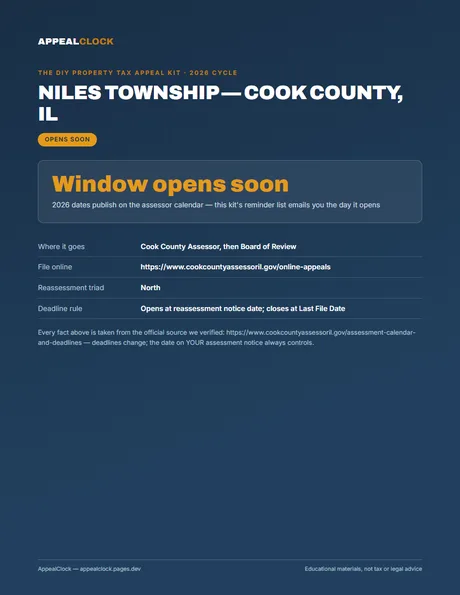
The upcoming window — and how Cook County's two-level system works
Niles Township sits in Cook County's North Triad, which rotates through full reassessment on a three-year cycle. When the Assessor's office sends out notices, the appeal window opens immediately and runs until the Last File Date shown in the filing panel above. That cutoff is hard — the county does not grant extensions, and missing it closes the Assessor's path for the cycle.
What Cook County offers that most Illinois counties don't is a second independent opportunity: the Board of Review. That's a separately elected three-member panel that hears your case on its own calendar after the Assessor's window closes. Filing at the Assessor level doesn't register you for the Board of Review — both require separate submissions with separate deadlines. Together they represent two legitimate shots at the same value, which is why preparing your evidence package before notices even arrive is worth the time. The full county-level framework is at Cook County property tax appeal.
Why the North Triad reassessment year matters
Cook County divides its townships into three triads — City, North, and South — that rotate through a full mass reappraisal on a three-year schedule. Niles Township's reassessment year is the event that triggers this page's window. During the reassessment, the Assessor's office appraises every parcel simultaneously using a modeling approach that applies market trends across large areas — which is efficient but blind to street-level conditions on any individual property.
That gap between mass-appraisal output and individual reality is where appeals succeed. If your neighborhood's values have risen sharply since the last North Triad cycle, expect notices to reflect that increase. The more the appraised value departs from what nearby homes have actually sold for, the stronger your comparable-sales argument. Between reassessment years the Assessor can still make mid-cycle adjustments, but the large swings happen at the triennial review — which is why this year's window deserves attention.
The math: 10% assessment, the state multiplier, and what's actually at stake
Illinois sets a statutory assessment level of 33⅓% of fair market value for equalization purposes, but Cook County's Assessor values Class 2 residential property at 10% of market value first. The Illinois Department of Revenue then applies an annual equalization factor — the "multiplier" — to bring Cook County's aggregate assessments closer to the statutory standard. That multiplier amplifies every reduction you win at the Assessor level: a $30,000 cut in appraised value produces more than $3,000 of relief in equalized assessed value before the multiplier is applied.
Concrete illustration: if the Assessor places your Niles home at $375,000 and comparable sales support $340,000, you're arguing a $35,000 reduction. At 10%, that's $3,500 of assessed value; after the state multiplier, the equalized assessed value drop is proportionally larger, and that reduction repeats across every tax bill until the next reassessment cycle. One afternoon of preparation, compounded over three years, can represent thousands of dollars.
What wins at the Assessor and the Board of Review
Both appeal bodies respond to documentation, not frustration. Three evidence categories carry the most weight in Cook County residential cases:
- Comparable sales. Three to five arms-length sales of similar homes nearby — comparable square footage, age, lot size, and condition — that closed before the assessment date and support a lower value. This is the spine of most winning residential appeals at both the Assessor and Board of Review levels.
- Property record card errors. Your record card is available through the Assessor's portal and lists every characteristic used in the mass appraisal: square footage, room counts, basement finish, garage, and lot dimensions. Errors occur frequently and can produce a straightforward reduction without requiring comparables at all.
- Condition evidence. Photos and contractor estimates for issues the mass model cannot see — foundation problems, water intrusion, deferred maintenance, an unusable outbuilding. This evidence carries particular weight at the Board of Review, which hears the case fresh and isn't defending the original number.
Board of Review hearings are brief — a short conversation where you walk the panel through your package. One organized page beats a folder of unstructured printouts. Neighboring townships like Cicero and Palos follow the same evidence standards under Cook County's process, so the same preparation approach works across the county.
Exemptions — the parallel filing that stacks with your appeal
An appeal reduces your assessed value before exemptions apply; exemptions then reduce your equalized assessed value further. Both matter, and they run on separate deadlines that don't align with the appeal window — winning an appeal doesn't retroactively apply exemptions you haven't claimed, and missing an exemption deadline doesn't extend your appeal right.
Cook County's Homeowner Exemption is the baseline: it reduces EAV by a flat amount each year for your primary residence. It requires a one-time filing if you haven't already claimed it, and it can lapse if the deed changes through a sale or refinance without a new application. The Senior Exemption and Senior Freeze offer additional relief for qualifying homeowners aged 65 and over, each with its own annual renewal requirements. Verify your current exemption status at the Assessor's portal — the same portal where you file your appeal — while the window is open. The combination of a successful appeal and a corrected exemption stack is what produces the largest bill reductions.