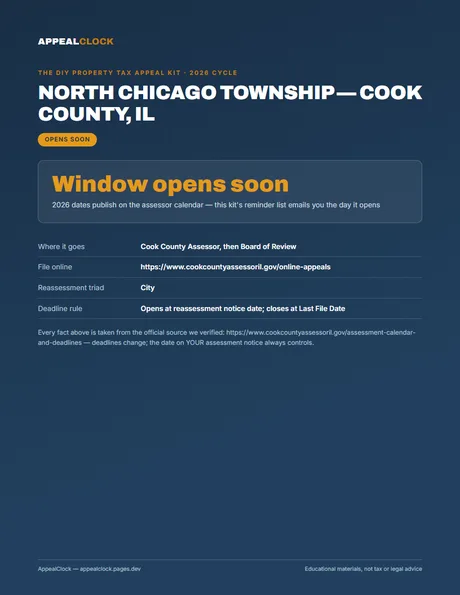
How North Chicago Township's City triad cycle shapes your window
Cook County divides its townships into three triads — North, South, and City — each reassessed on a rotating three-year schedule. North Chicago Township sits in the City triad, meaning full reassessment happens on a triennial clock alongside the other Chicago townships. When the Assessor mails notices to North Chicago parcels, the appeal window opens; it closes at the Last File Date on the Assessor's calendar, shown in the panel above. If the status marker reads "upcoming," your window is approaching — the time to gather comparable sales and pull your property record card is before the deadline, not after.
Cook County's two-stage structure gives you more than most Illinois counties offer. File first with the Cook County Assessor, who may revise your value based on your evidence. If the result doesn't move far enough, the Board of Review — an independent three-member elected panel — conducts its own hearing during a separate North Chicago Township window. Both windows are tracked above. Miss the Assessor stage and you've lost that opportunity; miss both and the right resets with the next triennial cycle, which can be up to three years away.
The 10% assessment math in a high-value north lakefront market
Illinois sets Cook County's Class 2 residential assessment rate at 10% of estimated fair market value. The Illinois Department of Revenue then applies an annual equalization factor — the "multiplier" — to produce your equalized assessed value (EAV), which is the base your combined city, county, and school district rates actually hit. Your appeal targets the Assessor's estimated market value, before that factor is applied.
North Chicago Township covers some of Cook County's most active real estate submarkets — Lincoln Park, Lakeview, Lincoln Square, and surrounding north lakefront neighborhoods — where the Assessor's appraised values tend to run higher than in suburban townships. That means even a modest percentage overestimate represents real money. If the Assessor places your home at $480,000 and comparable sales support $440,000, the $40,000 gap produces $4,000 less in assessed value before the multiplier, taxed at Cook County's combined rates across city, county, and school district levies. That reduction compounds over the life of the assessed value. The Cook County property tax appeal overview explains the triennial calendar and how the equalization factor works across all three triads.
What wins at the Board of Review in a dense urban township
The Board of Review is a quasi-judicial panel — it weighs evidence, not arguments about the level of Cook County taxes. Three categories carry the most weight in North Chicago Township residential cases:
- Comparable sales. Three to five arm's-length sales of properties near yours, closed before the assessment date, at prices below your appraised value. In a market that mixes condominiums, vintage graystones, two-flats, and coach houses, property type matching is critical — a high-rise condo sale doesn't speak to a vintage walkup's value, and a recently gut-rehabbed unit isn't a fair comp for one with original systems. The strongest comp sets control for property type, unit size, parking, and condition precisely.
- Property record card errors. Pull your record from the Assessor's site and check square footage (interior condo measurements are frequently misstated), parking space classification, bedroom and bathroom count, and any improvement characteristics on file. Cook County's mass-appraisal model carries data-entry errors forward across reassessment cycles, and a clean, documented factual mistake is among the fastest wins available.
- Condition evidence. Photos and contractor estimates for anything the model can't detect — a deteriorated roof, unremediated water damage, aging mechanicals that suppress market value. These shift the burden back to the county to justify its estimate.
Homeowners in other Cook County townships face the same evidence standard at the Board of Review — see the Cicero Township appeal page and the Palos Township appeal page for how the process plays out in different Cook County submarkets.
Filing with the Assessor and what comes after
The Cook County Assessor's online portal is the fastest first-stage path — it timestamps your submission immediately and returns a confirmation number to save. Filing is free. The portal covers the Assessor stage only; when the Board of Review window opens for North Chicago Township, that body uses its own separate filing process, linked in the panel above.
After you file with the Assessor, one of three outcomes follows: the Assessor reduces your value to match your evidence, issues a partial adjustment, or holds the original. You can accept any revised figure or carry the case to the Board of Review. A BOR hearing is typically brief — ten to twenty minutes where you present your comparable sales and record-card corrections to the panel. If the BOR result still falls short, further escalation to the Illinois Property Tax Appeal Board (PTAB) or Circuit Court is available; those paths carry more complexity and a longer timeline, and make sense when the dollars at stake justify the additional effort. For most North Chicago Township homeowners, a Board of Review resolution — even a partial reduction — is the practical stopping point.
Cook County traps that catch North Chicago Township homeowners
Four patterns repeat every City triad cycle. First, the reassessment notice is not a tax bill — it shows the estimated value you have the right to challenge, and it arrives well before the tax bill that reflects it. By the time the bill lands, the appeal window is closed. Act on the notice.
Second, in North Chicago Township's condo-heavy and vintage-building market, the Board of Review scrutinizes property type matching closely. Using a sale from a doorman high-rise as a comp for a three-flat, or ignoring parking when your unit includes a deeded space, undermines your case. Build your comp set with the same precision the Assessor's model should have used — and then exceed it for street-level detail.
Third, Cook County homestead exemptions — the standard Homeowner Exemption, the Senior Freeze, and the Longtime Occupant Exemption — carry their own spring filing deadlines and are not applied automatically through a successful assessment appeal. Verify that yours are active while you're already in the Assessor's portal reviewing your record card.
Fourth, if North Chicago Township was reassessed in a mass cycle and values jumped across the neighborhood, don't assume the increase is defensible just because it was uniform. Mass-appraisal models average out block-level distinctions — the unit above a commercial tenant, the coach house on a deteriorating alley, the building with chronic rear-unit flooding — and those are precisely the arguments the Board of Review exists to hear.