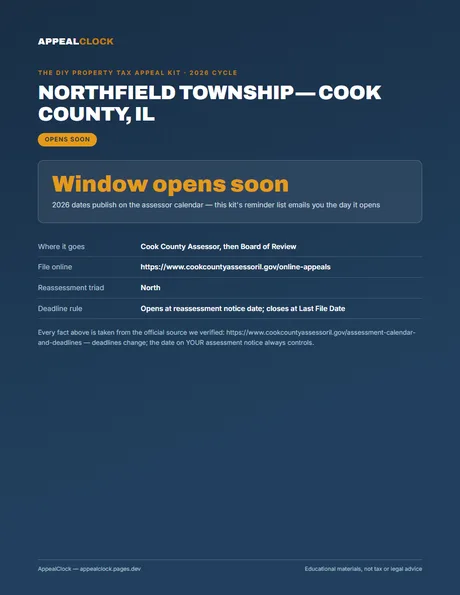
How Northfield Township's reassessment cycle creates your appeal window
Cook County reassesses property on a three-year rotation split across North, South, and City triads. Northfield Township sits in the North Triad, which means your assessed value is formally re-examined on the North Triad's cycle year — and that's when the primary Assessor appeal window opens. The clock starts on the Last File Date shown above, tied to your reassessment notice, not the postmark date or the day you open the envelope.
One practical advantage of Cook County's structure: you get two sequential opportunities rather than one. The Cook County Assessor accepts appeals first; after that round closes, the Board of Review holds its own independent hearing session. For the 2025 cycle, the G3 Board of Review session dates are displayed above. Missing the Assessor window does not end your options for the cycle — missing the Board of Review deadline does.
The Cook County math that decides whether an appeal is worth your afternoon
Illinois law sets Cook County residential assessments at 10% of fair market value (35 ILCS 200/9-145). That figure is then multiplied by the state equalization factor — a ratio the Illinois Department of Revenue recalculates annually to bring Cook County's aggregate assessment level to one-third of market value as required by statute. In recent cycles that multiplier has been close to 3.0, meaning the equalized assessed value (EAV) your tax rate actually applies to is roughly three times the 10% figure.
Concrete math: a home the Assessor values at $500,000 carries an assessed value of $50,000. After the equalization multiplier, EAV runs near $145,000–$150,000. At a combined levy rate around 8% — typical when you stack the school district, village, park district, and county levies for northern Cook County parcels — that produces an annual bill in the range of $11,600. Knock $20,000 off the appraised value and you've removed roughly $450–$500 from the annual bill, every year the lower value holds through the triennial cycle. That's the calculation worth running before deciding a few hours of prep isn't worth it.
What the Board of Review actually responds to
The Cook County Board of Review is an independent elected body — separate from the Assessor's staff — and it weighs evidence, not frustration. Three types consistently move the outcome:
- Comparable sales. Arm's-length sales of properties with similar age, square footage, construction type, and condition in Northfield Township or immediately adjacent streets, closing within the 12 months before the assessment date. Three to five well-matched comps form the backbone of most successful residential appeals.
- Property record errors. Retrieve your Cook County property record card through the Assessor's PIN search and verify the square footage, bedroom and bathroom count, garage configuration, and lot dimensions against your deed. Mass-appraisal models generate clerical errors no one corrects unless an owner raises them — a 200-square-foot overstatement is among the fastest wins available.
- Condition and obsolescence. Structural problems, deferred maintenance, and functional issues — drainage defects, a dated mechanical system, an unusable outbuilding — that the Assessor's drive-by valuation cannot capture. Photos with dates and contractor estimates tied to specific dollar figures carry more weight than general descriptions alone.
Present this evidence on a single organized page. The Cook County appeal overview covers the Board of Review filing process in full and includes the document checklist worth reviewing before your hearing date.
Filing at the Assessor level and what happens in each round
The Cook County Assessor's online portal (linked in the filing panel above) is the fastest path: it timestamps your appeal immediately, accepts document attachments for comps and photos, and returns a confirmation number you can save. Paper filing is accepted at the Assessor's office if you prefer a physical record — if you mail it, the postmark date governs, so use a method that produces proof of when it was sent.
After you file with the Assessor, the outcome is a revised value you can accept or reject. Declining — or receiving a denial — makes you eligible for the Board of Review round, where you file again and present evidence at a brief hearing. You can also file directly with the Board of Review during its session even if you skipped the Assessor round; neither filing requires the other as a prerequisite, and both are free.
Beyond the Board of Review, Illinois property owners can escalate to the state Property Tax Appeal Board (PTAB) or Circuit Court. For most residential appeals in Northfield Township, the BOR result — especially combined with any applicable homeowner or senior exemptions — is the practical endpoint before further costs outweigh additional savings.
Cook County and Northfield Township traps worth knowing before you file
Several patterns catch owners every reassessment cycle. First, the reassessment notice is not a tax bill — it establishes the value you can challenge; actual bills arrive later on a separate schedule, after the appeal window has already closed. Second, homeowner, senior, and other Cook County exemptions are separate filings with their own deadlines and are not applied retroactively by an appeal result; check your exemption status while the reassessment is front of mind. Third, if any portion of your parcel has commercial use, that portion is assessed at 25% rather than 10%, which changes both the baseline and the leverage math considerably.
For comparison context: Northfield Township's North Triad reassessment timeline runs on a different cycle year than South Triad townships. Owners with property in Cicero Township or southwest townships like Palos Township should check each parcel's triad year separately — the windows do not align, and assuming they do is a common reason owners miss a deadline entirely.