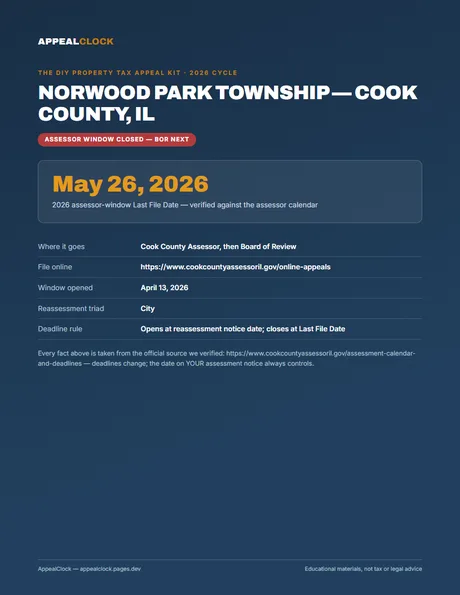
The Assessor window closed — the Board of Review is your second chance
Cook County runs a two-stage appeal process that most Illinois counties don't offer. When the Assessor's window closes for a township, the Board of Review — a separate, independent body — opens its own filing period. You don't need to have filed with the Assessor first to use it. The BOR window for Norwood Park Township's Group 1 cycle is shown in the deadline band above; if it is still open, this is your last opportunity to reduce the current year's bill.
The Board of Review operates with its own staff, its own hearing officers, and its own evidentiary standards. A reduction granted here carries identical legal weight to one from the Assessor's office — your tax bill drops the same way either route wins. The full county-level process, including how the Assessor stage and BOR stage interact, is detailed in the Cook County property tax appeal guide.
Cook County's 10% assessment math and why a reduction compounds
Illinois law (35 ILCS 200/9-145) sets the assessment level for Class 2 residential property — single-family homes, two-flats, and most condos — at 10% of estimated fair market value. Your assessed value is that 10% figure, then multiplied by the state equalization factor (the "multiplier," set annually by the Illinois Department of Revenue to bring Cook County's aggregate level toward the statewide statutory standard) and then by the combined local tax rate.
Concrete example: if the Assessor values your Norwood Park home at $380,000, the initial assessed value is $38,000. Successfully reducing the estimated market value to $340,000 removes $4,000 from that base before the multiplier even applies. Because the equalization factor amplifies whatever base it starts from, trimming assessed value early in the chain produces a larger bill reduction than the raw dollar figure suggests — and if the lower value holds into subsequent years, the savings repeat.
The two arguments that win at the Board of Review
The BOR hears two core challenges, and you can raise either or both at once.
- Overvaluation. The county's estimated fair market value is too high. Support this with three to five comparable sales — similar homes in Norwood Park or immediately adjacent neighborhoods that sold for less than your estimated value in the year preceding the assessment date. Arm's-length sales carry the most weight; bring them organized by address, sale date, square footage, and price per square foot.
- Uniformity. Your property is assessed at a higher percentage of fair market value than comparable nearby properties, even if the absolute number looks defensible. Pull assessed values for similar homes on your block or in your subdivision from the Assessor's property search and compare effective assessment rates. A consistent pattern of higher treatment is independently sufficient grounds for relief.
Before either argument, check your property record card. Square footage, bedroom and bathroom counts, basement finish status, and lot size all feed the county's mass-appraisal model. A 200-square-foot error — not uncommon in a township with as many vintage bungalows and two-flats as Norwood Park — produces the fastest correction available because it's purely factual, not a valuation judgment.
How to file with the Board of Review before the window closes
The BOR accepts filings online and by mail; the online route generates a confirmation number that proves your filing date, which matters because the deadline shown above is a hard cutoff with no grace period. You'll need your Property Index Number (PIN), your current assessment notice, and your supporting evidence organized before you start. The filing form asks for the specific value you believe is correct — come in with a dollar figure backed by your comparables rather than a percentage reduction. Hearing officers respond to "comparable sales support $340,000" more readily than "I think it's too high."
After filing, most residential cases resolve in one of two ways: the Board issues a written decision on the papers without scheduling a hearing, or you're called in for a brief informal presentation — typically around 15 minutes. Either path, the result applies to the current tax year's bill. Note that the Assessor's online portal (linked in the filing table) handles Assessor-stage filings; Board of Review filings go through the BOR's own portal, also linked in the table above.
If the BOR window closes: off-cycle prep and next-year positioning
If the Board of Review window expires before you file, your next formal opportunity is the following reassessment cycle. Norwood Park Township sits in Cook County's City triad, which reassesses on a triennial schedule — a full market-value review every three years. In intervening years values can still change, but the triennial cycle is the primary window for broad challenges. Set a free AppealClock reminder above and you'll be notified when the next Norwood Park window opens before the deadline arrives.
Two steps are worth taking in any off-year. First, verify your property record card at the Assessor's site for errors in square footage, room count, or lot size — those persist and compound until corrected, and fixing them now means the next reassessment starts from a cleaner base. Second, confirm that all eligible exemptions (homeowner, senior, veteran, disability) appear on your current bill; missing exemptions are corrected on a separate administrative track and don't require waiting for the next appeal cycle. For context on how neighboring townships navigate the same BOR process, see the guides for Cicero Township and Palos Township.