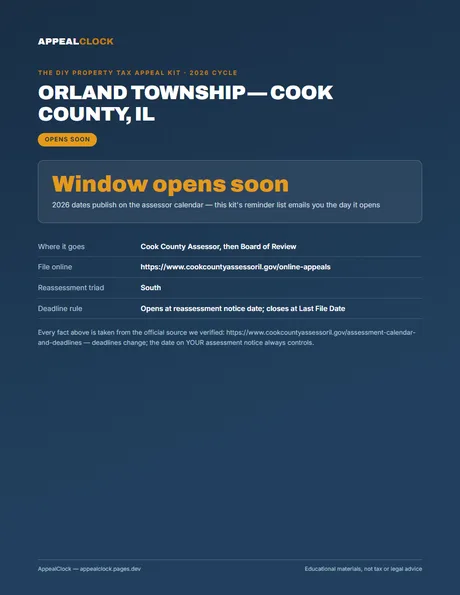
How the Orland Township reassessment window actually works
Cook County divides its townships into three triads — North, City, and South — and reassesses each triad on a rotating three-year cycle. Orland falls in the South Triad, which means your property's full reassessment happens every three years, and the appeal window that follows is the only formal opportunity to challenge the new value before it sets. Miss both the Assessor and Board of Review windows in a reassessment year, and the next chance to contest the base value is three years out.
The window opens when the Cook County Assessor mails reassessment notices and closes on the Last File Date listed for your township. The date that legally controls is the one printed on your notice, so check it against the calendar shown above before assuming you're safe. Notices can go out in batches, and a few days' difference matters when the window is short.
Because the South Triad reassessment is a triennial event, the stakes are higher than a routine annual adjustment. The value the Assessor sets today becomes the baseline Cook County uses — and stacks exemptions off of — for the next several years. Getting it right now is worth the paperwork.
Cook County's 10% assessment math and why it compounds
Cook County assesses residential property (Class 2) at 10% of estimated market value — then the state applies an equalization factor (the "multiplier") to bring the county's aggregate to 33.33% of market value, the Illinois statutory target. The result is your Equalized Assessed Value (EAV), which is the number the Assessor can correct in an appeal and what the Board of Review can revise further.
Here's why the math matters: if the Assessor's market estimate is $40,000 too high, your EAV is overstated at the 10% level before the multiplier is even applied — and your tax bill is that inflated EAV times the local tax rate, every year until the next reassessment or a successful appeal. A one-time correction doesn't just fix this year's bill; it resets the baseline the county builds from for the remainder of the triennial cycle. For Orland homeowners, even a modest reduction in the Assessor's market estimate translates to a meaningful EAV correction and real savings on what the township extension bills each installment.
For a full breakdown of how Cook County's rates, exemptions, and multiplier interact across all townships, the Cook County property tax appeal guide covers the statewide framework in detail.
Two bites at the apple: Assessor first, then Board of Review
Cook County is unusual in giving property owners two formal chances to reduce a value in a single cycle. The first is the Assessor's appeal, filed during the township's open window (the deadline is shown above). The Assessor's office reviews your evidence and may issue a corrected value. If you accept, the process ends there. If the result still feels too high — or the Assessor window has already passed — the Board of Review opens its own session and accepts appeals from Cook County taxpayers whose Assessor appeal was denied or who couldn't file in time.
The Board of Review is an independent three-member panel that operates separately from the Assessor's office. BOR sessions are assigned by group number and township; Orland's 2025 BOR window is shown in the filing panel on this page. Evidence that didn't move the Assessor often lands differently at the BOR, because the panels are trained to weigh comparables and record-card errors rather than defend prior decisions. Think of the two stages as sequential, not redundant — each is a fresh review with its own leverage.
Neighboring townships in the South Triad follow the same two-stage structure; you can cross-reference how those windows align at Palos Township and Cicero Township if you own property across township lines.
What actually wins at the Cook County Board of Review
Both the Assessor and the Board of Review respond to evidence, not frustration. Three categories carry the most weight in residential appeals:
- Comparable sales. Three to five arms-length sales of similar homes — comparable size, age, and style — that closed before the assessment date at prices below the Assessor's market estimate. This is the backbone of the majority of successful residential appeals. Pull them from the county recorder's data or a real-estate search tool and present them on a single organized page.
- Property record card errors. The Assessor's mass-appraisal model builds your value from a data card — square footage, bedroom and bathroom count, lot size, basement finish, and construction quality. Errors are common and correctable. Request your card, compare it against what you know about the property, and flag every discrepancy with documentation.
- Condition and functional issues. Deferred maintenance, structural problems, or obsolescence that a drive-by inspection misses. Repair estimates and photographs give the board a concrete reason to depart from the market model.
One organized submission beats a disorganized stack. The appeal letter template in the kit structures all three categories in the format both Assessor staff and BOR reviewers are used to seeing.
Orland Township traps that catch homeowners every triennial cycle
Four wrinkles come up repeatedly for Orland filers. First, the reassessment notice is not a tax bill — it shows the proposed market value you can contest; the actual bill arrives later, well after the appeal window has closed for most homeowners. Don't wait for the bill to act on the notice.
Second, the three-year cycle means this is not a routine annual adjustment. Missing the Assessor and BOR windows in a reassessment year leaves the base value locked in for an extended run of tax bills. The countdown at the top of this page exists because that gap is long enough to cost a significant amount of money across multiple installments.
Third, homeowner exemptions — the General Homestead, Senior Homestead, and others — are filed separately from an appeal. Winning a reduction in assessed value does not retroactively apply an exemption you haven't claimed. While you're reviewing your assessment, confirm that every exemption you qualify for is already active on your parcel; the Assessor's office maintains a record of which exemptions are on file.
Fourth, if the Assessor issues a voluntary reduction after reviewing your appeal, that revised value becomes the Board of Review's starting point — not the original assessment. In some situations, accepting a partial Assessor reduction and pushing the remaining gap to the BOR is the stronger play. Whether that's true depends on how far the reduced figure is from what your comparables actually support.