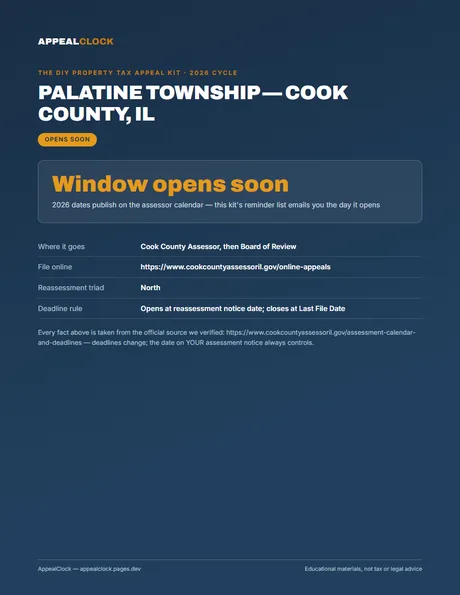
How Cook County's two-stage appeal system works for Palatine Township
Cook County gives every property owner two formal opportunities to challenge an assessment in a single cycle. The first is the Cook County Assessor's appeal: file before the Last File Date shown above, and the Assessor's staff reviews your submission and mails a decision. If you accept the revised value, the cycle ends there. If not — or if you skip the Assessor stage entirely — the Board of Review is your second body. The BOR is an elected, three-commissioner panel that operates independently of the Assessor and routinely revises values the Assessor left unchanged.
Palatine Township belongs to the North Triad, meaning it undergoes triennial reassessment — a full parcel-by-parcel revaluation every three years. Reassessment years produce the largest swings in assessed value and historically the highest volume of successful appeals, because the Assessor's mass-appraisal model works from aggregate market data and cannot inspect your specific home. That's the condition this window was built for. See the Cook County property tax appeal overview for the full jurisdictional map and how Palatine fits into the countywide calendar.
The Illinois tax math — what reducing your assessment actually saves
Illinois law (35 ILCS 200/9-145) assesses residential property — Cook County Class 2 — at 10% of estimated market value. The Illinois Department of Revenue then applies a state equalization factor, commonly called the multiplier, to bring aggregate assessed values to the statutory one-third of market value. The result is your equalized assessed value (EAV), and your combined levy rate applies to that number.
The multiplier amplifies every dollar you remove from the estimated market value. Reduce the Assessor's estimate by $30,000 and your assessed value drops by $3,000 — then the multiplier magnifies that reduction in EAV, and the full combined rate applies to the smaller base every year the lower value holds. Cook County stacks city, township, school district, and special district levies into some of the highest combined rates in Illinois, which means a successful appeal here is worth more per EAV dollar than in most of the state. That's the math that makes the filing deadline worth your afternoon.
What wins at the Assessor and at the Board of Review
Both stages respond to the same categories of evidence, so building your file once covers you at either level:
- Comparable sales. Three to five closed sales of similar homes in Palatine — comparable size, age, and condition — dated before the assessment date and priced below your appraised value. This is the spine of nearly every successful residential appeal and carries the most weight at both stages.
- Record-card errors. The Assessor's property record card captures square footage, bedroom and bathroom counts, basement finish, garage size, and lot dimensions. Errors here are more common than most homeowners expect, and a documented discrepancy corrects the basis of the entire assessment directly — often the fastest win available.
- Condition evidence. Photos and contractor estimates for anything the mass-appraisal model can't see: structural issues, water intrusion, deferred maintenance, an outbuilding that no longer functions. The Board of Review is particularly receptive to condition arguments that explain why the open market wouldn't pay the assessed value.
Bring your evidence organized to a single page or a clean upload. The Assessor stage often resolves straightforward cases; if yours doesn't, carry the same file into the BOR hearing.
Filing: the Assessor portal and the two-stage path
The fastest route is the Cook County Assessor's online portal — it generates a confirmation number immediately and lets you upload your evidence in one session. The portal link and mailing address are in the filing table below. If you submit by mail, preserve the postmark as your proof of timely filing.
After the Assessor reviews your appeal, you'll receive a notice showing the resulting value. If you accept, you're done. If not, file a separate appeal with the Board of Review — a distinct body with its own intake process and hearing schedule. Palatine Township was assigned to Group 6 for the 2025 BOR session; for the current cycle, verify your BOR window at the assessment calendar linked in the filing table, because the BOR deadline is often meaningfully later than the Assessor's. If both bodies decline a meaningful reduction, the Illinois Property Tax Appeal Board (PTAB) accepts written submissions at the state level, followed by Circuit Court as a final escalation — but most residential appeals reach a workable result at the Assessor or BOR stage.
Cook County and Palatine-specific traps
Four patterns catch North Triad homeowners off guard every cycle. First, the Assessor's notice is not a tax bill — it shows the value you can contest; the actual bill arrives later, when appealing is no longer an option. Act on the notice, not the bill. Second, homeowner exemptions are a separate filing with their own spring deadline; a successful appeal does not apply them retroactively. Check the Cook County appeal and exemptions guide while you're already engaged, because missing the exemption deadline compounds the loss.
Third, Cook County's mass-appraisal model is especially fallible on streets with high sale-price variance — if your neighborhood has a wide spread of sale prices, the model's aggregate estimate may land well above where your specific home sits in that range. The BOR exists precisely to hear that argument. Fourth, if you miss the Assessor's window, the Board of Review is a genuine second chance in the same cycle, not a consolation prize — and its deadline is separate. South Triad townships like Palos operate on a different triennial schedule, but the same evidence categories carry weight across all of Cook County. Closer in, Cicero Township homeowners face similar mass-appraisal pressure and the same two-stage path.