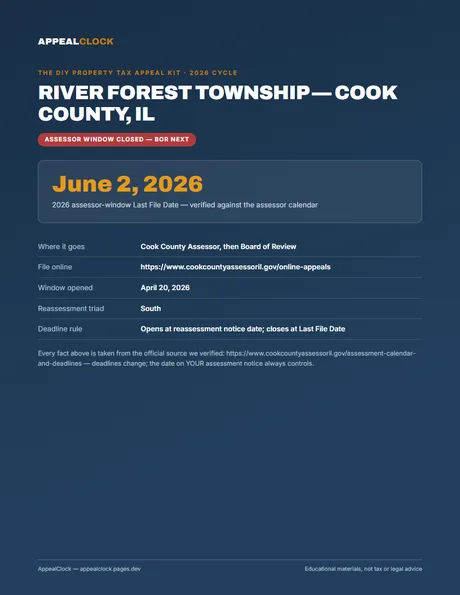
Cook County's two-step appeal path — and why the second step matters
Most homeowners assume the appeal process ends when the Assessor's window closes. It doesn't. Cook County gives every property owner two separate bites: first the Assessor's office, then the Board of Review — a county-appointed body that operates independently of the Assessor and is not the same staff reviewing your case a second time. The BOR carries the same legal authority to revise your assessed value, and its decision feeds directly into your bill.
For River Forest Township, the Assessor window is closed for this cycle. That makes the Board of Review window shown above your primary route now. If you filed with the Assessor and received a revised value you didn't accept, the BOR is where you escalate. If you missed the Assessor window entirely, the BOR is a fresh start — you don't need an Assessor decision to file there. For a full overview of how both steps fit together, see the Cook County property tax appeal guide.
The Board of Review Group 1 window: your open door for River Forest
River Forest falls in Cook County's South Triad, which runs its reassessment and appeal calendar on its own three-year cycle. The BOR's Group 1 session — covering South Triad townships — has the dates shown in the panel above. Check them now: if the window is still open, you can file online through the county's portal or by paper submission. Online filing is faster and gives you a confirmation number that proves your submission was timely.
The BOR doesn't require you to rehash what happened with the Assessor. You file fresh evidence, the board schedules a brief hearing (typically 15 minutes), and you walk through your comparables. The process is designed for homeowners, not attorneys. If the window above shows it has already closed, skip to the next-cycle prep section below.
What actually wins at the Cook County Board of Review
The BOR panel responds to evidence, not frustration with a tax bill. Three categories move the room:
- Comparable sales. Three to five homes in River Forest or the immediately surrounding area — similar size, age, and condition — that sold for less than your assessed value implies. Sales from the year before the assessment date carry the most weight. This is the backbone of nearly every winning residential appeal.
- Record-card errors. Pull your property's PIN record on the Assessor's website and verify square footage, bedroom and bathroom count, lot size, and garage type. Mass-appraisal models miss details, and a 200-square-foot overcount is not unusual. Errors are the fastest wins available because the math is undeniable.
- Condition evidence. Photos and contractor estimates for deferred maintenance, foundation issues, or structural problems the model can't see. Anything that makes your property worth less than the number on the card is fair to document.
Organize your evidence on one or two pages. The BOR hears many cases; a homeowner who makes the decision easy tends to do better than one who arrives with a folder of unsorted screenshots.
The math behind Cook County assessments — and why it's worth fighting
Cook County assesses Class 2 residential property at 10% of estimated fair market value. The state then applies an annual equalization factor — the Cook County multiplier — to push values toward the Illinois standard of one-third of fair market value. The result is your equalized assessed value (EAV), which is what your composite tax rate multiplies against to produce your bill.
The compounding effect matters: a reduction in the Assessor's fair market value estimate cuts your assessed value first, then that lower figure runs through the multiplier, shrinking your EAV. For a River Forest homeowner whose market value is disputed by even $30,000–$50,000, the downstream effect on EAV — and therefore the bill — is real and repeats every year the lower value holds. That's what makes one afternoon of paperwork worth the effort.
If both windows close before you act: next-cycle prep
If the BOR window shown above has also passed, your appeal right resets with River Forest Township's next reassessment notice in the South Triad cycle. That gap isn't wasted time — it's the best window you'll have to build a stronger case.
- Set the reminder above. AppealClock will email you when the next River Forest assessor window opens, so the deadline doesn't slip past again.
- Photograph your property now. Condition issues are easier to document when they're fresh, and photos taken years before an appeal carry more credibility than last-minute ones.
- Track comparable sales. Bookmark a few recent sales of similar River Forest homes. The comps that matter most are the ones closest to the assessment date — collecting them now means you won't be scrambling later.
- Check your exemptions separately. The Illinois homestead exemption, senior freeze, and disability exemption are separate filings with their own spring deadlines. An appeal doesn't apply them retroactively, and they can cut your bill independent of assessed value.
Neighboring South Triad townships run on the same reassessment cycle — if you know homeowners in Cicero Township or Palos Township, the timing advice here applies to them as well.