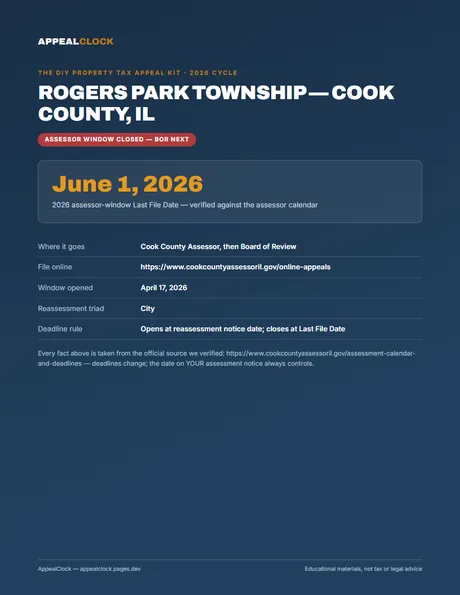
The closed Assessor window is not the end — here is why
Cook County's appeal process has two independent steps. The first is with the Assessor's office. The second — its own distinct window, with its own deadline — is with the Board of Review, a three-member elected body that has full authority to modify any value the Assessor set. For Rogers Park Township (City triad), the Board of Review's Group 1 window is shown in the filing panel above.
If you missed the Assessor's window entirely, the Board of Review is your path this cycle — you don't need to have filed at step one. If you did file with the Assessor and received only a partial reduction, the BOR is your chance to push further. The legislature created this two-step structure because the Assessor's mass-appraisal model is built for scale, not for individual properties — the Board of Review exists to hear what it gets wrong.
For how Rogers Park fits into the county-wide system, the Cook County property tax appeal overview covers the full framework.
Illinois assessment math: 10%, the equalization factor, and why reductions compound
Illinois law sets the assessment level for Class 2 residential property — single-family homes and small multi-units — in Cook County at 10% of fair market value. But that 10% figure is not your taxable base. The state applies an equalization factor, known as the Cook County "multiplier," to bring local assessed values into line with the statewide median. That produces your Equalized Assessed Value (EAV), and your tax bill is EAV multiplied by your composite tax rate.
The chain matters. A reduction in appraised fair market value trims your assessed value, then that trimmed figure gets multiplied by the equalization factor before the tax rate applies. That compounding is why even a modest successful appeal produces a meaningful dollar result — and why the savings recur every year your lower value holds. An appeal that cuts $40,000 off the assessed fair market value does not save you 10% of $40,000; it saves you 10% of $40,000 times the equalizer times the rate. The numbers add up faster than they appear to.
What the Board of Review actually responds to
The BOR reviews most residential appeals on the record — decisions are made on the documents you submit, without a live hearing unless you request one. That means what you file is what decides the case. Three types of evidence carry the most weight:
- Comparable sales. Three to five arm's-length sales of similar properties near yours, from around the assessment date, that support a lower fair market value than the Assessor assigned. This is the foundation of most winning residential appeals.
- Property record errors. Pull your parcel data from the Assessor's portal and check square footage, class designation, unit count, and lot size. Cook County's mass-appraisal model uses these inputs directly — an input error is the fastest available fix, and it requires nothing beyond documentation of the correct figure.
- Condition evidence. Photos and repair estimates for anything that depresses your property's value below the neighborhood model — structural problems, deferred maintenance, functional issues the Assessor's field staff didn't note.
The BOR has authority to reduce, sustain, or — rarely — increase an assessment. Organized, specific evidence is far more effective than a general dispute over the bill amount. The appeal letter template and comparable-sales worksheet exist because boards respond to clarity, not grievance.
Filing with the Board of Review: what the process looks like
BOR appeals are filed at the Board of Review's portal — linked in the filing panel above — not through the Assessor's online-appeals portal, which handles only first-step filings. You will need your Property Index Number (PIN) from your tax bill or assessment notice, your current assessed value, and your evidence package. The portal timestamps your submission and generates a confirmation; save it.
After filing, the BOR reviews your submitted record. If you want to present in person, you can request a hearing at filing time. The Board issues its decision by mail. If the result is still unsatisfactory, the next escalation options are the Illinois Property Tax Appeal Board (PTAB) or Circuit Court — but for most Rogers Park homeowners, the BOR is the practical finish line. The process is free at every step.
Homeowners in neighboring Cook County townships follow the same two-step path — see Cicero Township and Palos Township for their specific windows.
Rogers Park in the City triad — next-cycle prep that pays
Rogers Park is part of Cook County's City triad, which the Assessor reassesses on a three-year rotation. The reassessment year is the highest-leverage moment: the Assessor recalculates every value from scratch, which concentrates both the most errors and the widest spreads between assessed and true market values. In the intervening years you can still appeal if your value is wrong, but reassessment years drive the bulk of successful appeals countywide.
Preparation done now carries forward directly. Gather recent comparable sales while transaction records are fresh. Verify your property record card for input errors — square footage discrepancies and wrong class designations are common and correctable without a hearing. Document any condition issues with dated photos. The work done before the window opens is the work that wins after it does.
One often-missed item: homeowner and senior exemptions are separate applications with their own annual deadlines. An appeal does not apply them retroactively, and a missed exemption frequently costs more in a single year than a successful assessment reduction saves. Check your exemption status on the Assessor's portal now, while you have the parcel open. Set a reminder above and AppealClock will notify you when Rogers Park's next Assessor window opens — the clock starts the day your notice is dated, not the day you find it.