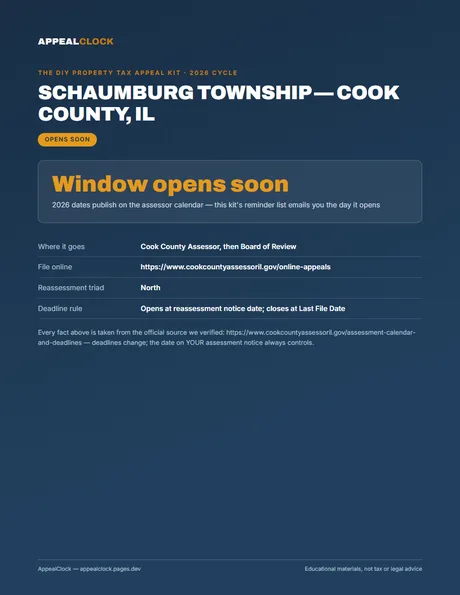
How Cook County's triennial cycle puts Schaumburg on the clock
Cook County divides its townships into three geographic triads — North, South, and City — and reassesses each on a rotating three-year schedule. Schaumburg Township is in the North Triad, meaning every parcel in the township receives a fresh mass appraisal in the same year. When the Cook County Assessor mails your reassessment notice, that mailing opens the appeal window. The close date is the Last File Date shown in the filing panel above, and it is a hard stop with no extensions. Miss it and the Assessor's window closes for this entire three-year cycle.
That cadence is what makes acting this cycle unusually worthwhile: a value you successfully reduce now typically holds until the next North Triad reassessment year, so one organized filing can produce three years of lower bills. Confirm the current open and close dates at the Assessor's calendar page — and check the top of this page, where the live deadline panel shows the dates for your group.
The 10% assessment math and why Schaumburg's composite levy amplifies every reduction
Illinois law sets the residential assessment level at 10% of estimated fair market value. Cook County's assessed value is then multiplied by a state equalization factor — the annual "multiplier" set by the Illinois Department of Revenue — before the composite levy rate is applied. The number you can change through an appeal is that starting estimated fair market value, and every dollar you remove flows through the rest of the formula.
Concrete example: if the Assessor pegs your home at $380,000 and comparable sales support $340,000, you've argued away $40,000 of fair market value — removing $4,000 from the assessed value before the multiplier. Schaumburg Township's composite levy bundles Cook County, township road district, fire protection, park districts, and multiple school district levies. Those layered rates mean even a moderate fair-market-value reduction translates to a meaningful annual bill difference, compounded across three cycles. For a full breakdown of how Cook County calculates tax bills township by township, the Cook County overview covers the formula in detail.
What actually wins at the Cook County Assessor level
The Assessor's mass-appraisal model works from large-scale neighborhood sales data — it cannot see the drainage problem in your backyard, a structural repair the previous owner never disclosed, or the fact that your attic conversion was unpermitted and adds no marketable value. Evidence that corrects those blind spots is what wins. According to the National Taxpayers Union Foundation, homeowners who file with organized evidence win at the Assessor or Board of Review level 40–60% of the time.
- Comparable sales. Three to five arms-length sales of similar homes near yours that closed before the assessment date and sold for less than your appraised value. This is the backbone of most winning residential appeals in Cook County.
- Property record errors. Pull your record card from the Assessor's portal and verify square footage, room count, lot size, and any special features attributed to your property. Errors of several hundred square feet are not rare in a large, built-out township like Schaumburg.
- Condition evidence. Dated photos and contractor estimates for foundation issues, water intrusion, or deferred-maintenance items the mass model cannot price — anything that would suppress what a buyer would actually pay.
Bring your evidence organized on one or two pages. The appeal letter template in the kit is structured around this sequence because reviewers reward clarity over volume.
Filing through the Assessor's portal and what happens next
The Cook County Assessor's online appeals portal is the fastest path — it timestamps your submission and generates a confirmation number you should save. Paper filing at the Assessor's office is also accepted; if you mail, use a method that produces a postmark as proof of timely filing.
After you file, the Assessor reviews the submission and may issue a revised value. Accept it and the appeal is complete. Decline it — or receive no revision — and your case becomes eligible for the Board of Review, which is a separate three-member body that operates on its own schedule and can set value independently of what the Assessor offered. You don't need to restart the process: a filed Assessor appeal preserves your path to the Board of Review without a separate intake filing.
The Board of Review: Cook County's second-chance window
Even homeowners who miss the Assessor's window get one more opportunity: the Board of Review opens its own appeal period for each township group later in the annual cycle. The Board is not a rubber stamp — it hears cases independently and can reduce values the Assessor declined to adjust. The evidence standards are identical: comparable sales, record-card errors, and condition documentation carry the room.
If you're coming to the Board of Review after the Assessor's window has closed, the critical thing is to file before the Board's Last File Date for your group — the deadline shown in the panel above. Homeowners across Cook County face the same two-level structure; the process for Cicero Township and Palos Township follows the same Assessor-then-Board sequence, though each township group runs on its own schedule.
Schaumburg-specific traps worth knowing before you file
Three local patterns catch homeowners every cycle. First, your reassessment notice is not a tax bill — it shows the value the Assessor intends to use for the next three years; the actual bill arrives later, when the appeal window has already closed. Act on the notice, not the bill. Second, Cook County's mass model is calibrated to large neighborhood patterns: a street-level condition that genuinely suppresses your home's sale price — proximity to a busy commercial corridor, a drainage easement on your lot, a flight-path overlay — will not automatically appear in the modeled value unless you document and present it. Third, homestead exemptions (the General Homestead Exemption, the Senior Freeze, the Disabled Veterans Exemption) are separate filings with their own deadlines and do not carry forward automatically if ownership or qualifying status changes. An appeal reduces your assessed value; exemptions reduce it further — verify your exemption status on the Assessor's portal while you have the record card open.